











































After Helen and her lover Paris fled to Troy, her husband King Menelaus called his allies to war. Under the leadership of King Agamemnon, the allies met in the harbor at Aulis. They prepared to sail for Troy, but they could not depart, for there was no wind.
Kings Agamemnon, Menelaus, and Odysseus consulted with Calchas, a priest of Artemis, who revealed that the angered goddess was balking their departure. The kings asked Calchas how they might convince Artemis to grant them a wind. He answered that she would only relent after King Agamemnon brought his eldest daughter, Iphigenia, to Aulis and sacrificed her to the goddess.
* * *
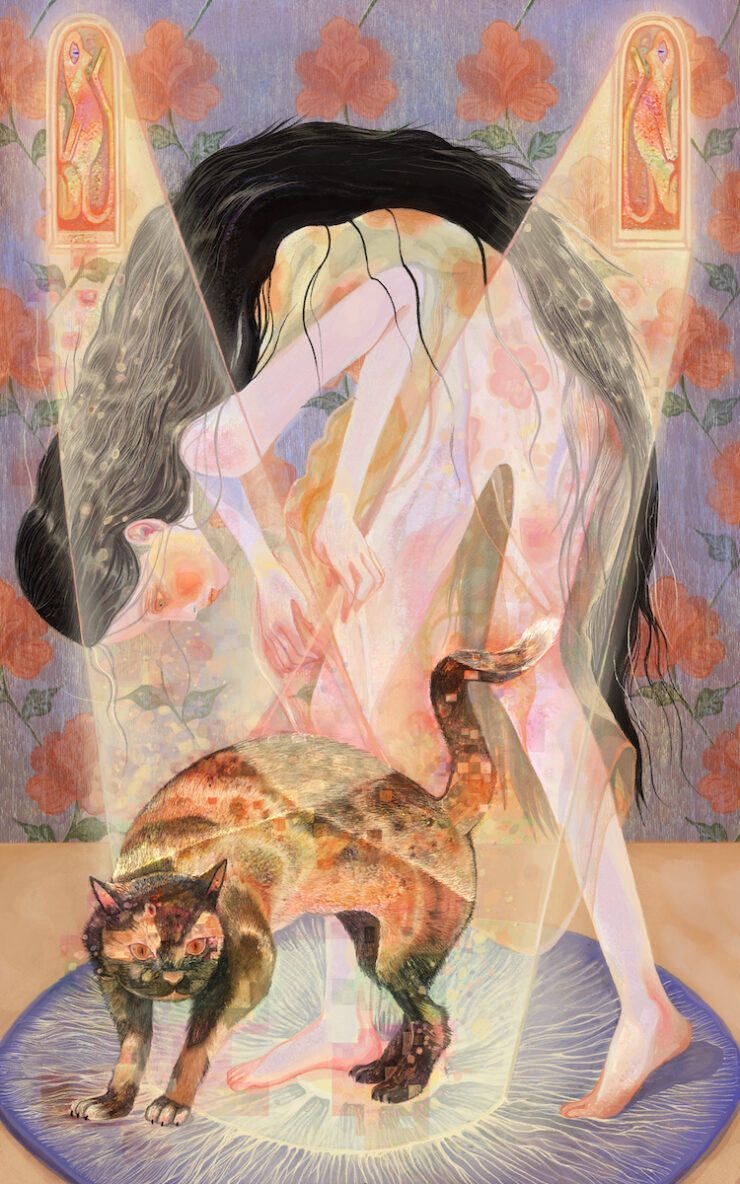
I began turning into wind the moment that you promised me to Artemis.
Before I woke, I lost the flavor of rancid oil and the shade of green that flushes new leaves. They slipped from me, and became gentle breezes that would later weave themselves into the strength of my gale. Between the first and second beats of my lashes, I also lost the grunt of goats being led to slaughter, and the roughness of wool against calloused fingertips, and the scent of figs simmering in honey wine.
Around me, the other palace girls slept fitfully, tossing and grumbling through the dry summer heat. I stumbled to my feet and fled down the corridor, my footsteps falling smooth against the cool, painted clay. As I walked, the sensation of the floor blew away from me, too. It was as if I stood on nothing.
I forgot the way to my mother’s rooms. I decided to visit Orestes instead. I also forgot how to find him. I paced bright corridors, searching. A male servant saw me, and woke a male slave, who woke a female slave, who roused herself and approached me, bleary-eyed, mumbling. “What’s wrong, Lady Iphigenia? What do you require?”
I had no answers.
VIEW ALL BY · Tuesday November 03, 2009 08:35am EST
VIEW ALL BY · Tuesday November 03, 2009 10:01am EST
VIEW ALL BY · Tuesday November 03, 2009 12:56pm EST
VIEW ALL BY · Tuesday November 03, 2009 10:30pm EST
VIEW ALL BY · Wednesday November 04, 2009 12:56am EST
VIEW ALL BY · Wednesday November 04, 2009 07:55am EST
VIEW ALL BY · Thursday November 05, 2009 07:20pm EST
On a similar note, it would be interesting to see your takes on Andromache, Penelope, or Lavinia for example. What always strikes me when reading mythology is the brevity when characters like Iphigenia are mentioned - if they are mentioned at all.
And I'm definitely going to agree with the description of haunting: "I need you to remember me for me." Enough said.
Thursday November 05, 2009 07:22pm EST
Friday November 06, 2009 03:55am EST
VIEW ALL BY · Friday November 06, 2009 05:09am EST
VIEW ALL BY · Friday November 06, 2009 08:05am EST
All the characters--Clytemnestra, Agamemnon, Helen--wonderfully rich.
Friday November 06, 2009 11:56am EST
Friday November 06, 2009 01:20pm EST
Friday November 06, 2009 07:11pm EST
Friday November 06, 2009 10:00pm EST
The story is beautiful, haunting and rich. It's a real gift. Thank you so much for sharing it with us.
VIEW ALL BY · Saturday November 07, 2009 03:12am EST
Tuesday November 10, 2009 06:21pm EST
Wednesday November 11, 2009 07:49pm EST
Thank you for a wonderful read!
Thursday November 12, 2009 02:01am EST
Thursday November 12, 2009 09:03pm EST
Beautifully written.
VIEW ALL BY · Sunday November 15, 2009 07:16am EST
Monday November 16, 2009 05:56pm EST
Frodoo, you seemed to be asking me specifically, so I thought I'd respond. I apologize if it's out of place:
"but I really wonder how could you kill a character as beautiful as Iphigenia. or is it that some stories and characters are meant to be so. does sadness and death only can make few stories complete?"
Just answering for myself -- this story is based, of course, on the old stories about the Trojan war. All we really know about Iphigenia is her death. The old stories imagine her as incidental. Who she was, what she thought and said and did and felt, didn't really matter to those writers. They were interested in how her father felt about killing her.
So, to answer your question, yes I think it's true that some stories are meant to be so. In this case, Iphigenia's death is the beginning (of my impulse to write) and the end (of almost everything we know about her from traditional sources). But I wanted to imagine her as more than just her death, to create a middle for her story.
VIEW ALL BY · Tuesday November 17, 2009 12:13pm EST
VIEW ALL BY · Tuesday November 17, 2009 08:36pm EST
VIEW ALL BY · Wednesday November 18, 2009 11:18pm EST