











































Quotes from âRosencrantz and Guildenstern Are Deadâ by Tom Stoppard Copyright © 1967 by Tom Stoppard
Used by permission of Grove/Atlantic, Inc.
Rushes on the floor, rustling underfoot. Fire roaring in the hearth. Something savory roastingâsometimes, something once savory but now forgotten and scorchingâover the fire. On a bright morning, the shadow of St. Paulâs slowly sliding back and away as the sun climbs higher. Small, sweet curls of smoke rising now and then from a pipe of tobacco in the hand of a man of newfangled habit. Always, always, ale in the air. Sometimes, too, the acrid aftermath from a man whoâs had all he can hold and one more tankard besides, and cannot dash to the street quick enough to give it back to the gutter.
Bread Street. The Mermaid Tavern. 1606. A new century taking hold, and a new king.
Sunset comingâno, sunset here. One of the serving maids goes from table to table, lighting candles from a twig sheâs thrust into the fire. She is a pretty little thing, just about ripeâfifteen, maybe even sixteen. The theatre folk whoâve crowded several tables together near the hearth slow their banter for a moment to ogle her.
When the banter picks up again, someone mentions Hamlet. A player from another company looks over at William Shakespeare. âAh, the Prince of Denmark,â he says, drinking up. âI had forgot that was yours.â
âWell, it is.â If Shakespeare sounds touchy, who can blame him? Sure as the devil, who remembers the poet? âWhat of it?â
âSome play to be given on the morrow called it to my mind. What names gave you that pair of Danes, the old friends to Hamlet?â
âWhy, Guildenstern and Rosencrantz,â Shakespeare answersânames common as Baker and Johnson amongst the lesser Danish nobility.
âSo I thought.â The player nods to himself. âThe pair of âem figure in tomorrowâs performance at the Rose.â
Rage rips through Shakespeare. âMay Satan scour all whoreson cullionly barbermongers! Milk-livered, scurvy villains! They will steal, sir, an egg out of a cloister. But their filching is like an unskillful singer, for they keep not time. And meseems they pillage from Hamlet in especial.â
He hates the horrible botch a printer made of the play. The man must have got what passes for the text from an actor in the productionâone who does not know it very well. And all Shakespeare can do is complain. Go to law over a pirated quarto? There is no law to go to in such cases. Even if there were, it would cost more than he can ever hope to squeeze from a rascally printer!
He turns to his friends and his fellow topers in the Mermaid. âShall we by our silence give them leave to do what they will with mine own words? Or shall we take arms against this sea of troubles, and by opposing end them?â
He cribs from himself, from the very play the wretches at the Rose purloin. Does anyone cheer his cleverness? Does anyone so much as notice? The ale has been going around for some little while, and nobody seems inclined to care about such thingsânot even Richard Burbage, who first gave the lines life on stage. But some muzzy shouts and raised tankards more or less promise he wonât beard the bandits alone tomorrow afternoon.
* * *
More or less. Sometimes more. Sometimes less. Less today. Shakespeare waits outside the Rose. He waits, and waits, and waits some more. His friends? His fellow topers? They must have something else to do. Wherever they may be, here they are not.
âMost friendship is feigning, most loving mere folly,â Shakespeare mutters. Which is true. And which does him no good whatever.
The signboard mocks him. It is not put there deliberately for that purpose . . . he supposes. Or maybe it is. Without his friendsâand fellow topersâat his side, at his back, he feels less sure of . . . well, of everything. Deliberately placed or not, there it is. ROSENCRANTZ & GUILDENSTERN ARE DEADâa play by Tom Stoppard.
Shakespeare grinds his teeth, which pains himâone has started to ache. He keeps putting off a trip to the dentist. Who in his right mind does not? As well visit the torturers in the Tower, and pay for the privilege besides. But part of the hurt lies in his spirit. Not content with stealing his characters, this very superficial, ignorant, infected Stoppard has taken his line as well, and taken it for a title.
And Shakespeare has to spend a penny to get into the Rose to see precisely what Stoppard has done to him. He would like to spend a penny on the back of the bacon-fed, malmsy-nose knave, or on the blackguardâs face. Now, though, he can only hand the prentice villain at the door his coin and go in with everyone else out for an afternoonâs amusement.
He takes some somber satisfaction in noting what a tumbledown wreck the theatre is. If only it could have tumbled down altogether before offering this abortion! The Globe, no more than a furlong distant, puts it to shame. Yes, the Rose deserves a fire.
It is also small next to the Globe. To try to make up for that, they stuff it as full with folk as a tennis ball is with feathers. Shakespeare has to elbow his way through the groundlings to approach the stage.
âHave a care, thou rude unpolished hind,â warns a young man in a sailorâs spiral-striped trousers and golden ear-hoop.
Shakespeare sometimes wears an ear-hoop himself, but never one so large and gaudy. He looks down his nose at the sailor, who is several inches shorter. âSir Patrick Spensâ fortune to thee, whipworthy rogue,â he says, and feels better for warming his wit before turning it on the dayâs proper target.
A trumpet soundsâa long, blaring note. The crowd quiets, as much as a crowd ever quiets. A stout woman next to Shakespeare crunches nutmeats, one after another, as if she means to go on doing it all through the play. From the intent look on her face, she does. His cheek tooth twinges.
Two men stroll out on stage. By their clothes, they may be prosperous merchants or not so prosperous aristocrats. Are they counting the house, making sure the moment is ripe to begin? Their manner is so unaffected and natural, Shakespeare needs a moment to understand they are players.
He has never set eyes on either of them before. That also makes him slower than he might be to realize they purpose performing. He has thought he knows every player in and around London, at least by sight. Has some company from the provinces come in to strut its stuffâhis stuffâon a stage in the capital, even if only on this mean one? He thinks he should have heard of it. Evidently not, though.
Both players carry leather sacks that clink, one nearly empty, the other correspondingly full. Shakespeare stands on tiptoe and leans forward, intrigued in spite of himself. It is a pretty bit of business. Nor is he the only one it draws in. Nothing like money to make a crowd pay heed.
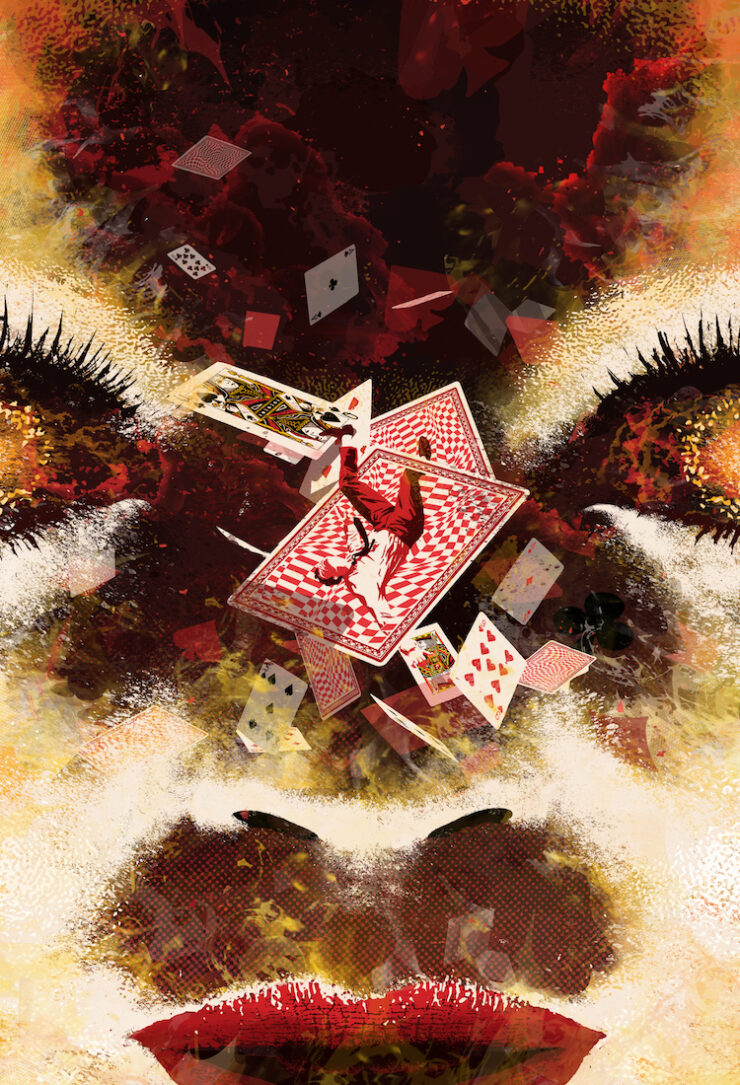
The player with the almost-empty sack takes a coin from it. The coin flashes gold as it spins in the air. It is surely brass or gilded lead, but flashes gold regardless. The other player catches it. He gives it a brief look.
âHeads,â he announces, and drops it into his bag.
Without changing expression, the player with the starving sack takes out another coin. He tosses it. Hungry eyes follow it as it too flashes gold. Groundlings and gallery folk must know it is not real. Shakespeare knows. His eyes follow it regardless. Ah, if only it were!
Smooth as silk, the player with the stuffed sack snatches it out of the air. He looks at it, as he had with the first coin.
âHeads,â he says, and into his sack it goes. The clink is less melodious than real gold would give.
They run through the same rigmarole six or eight more times. âWhatâs toward here?â calls a man in a butcherâs stained leather apron. Several other groundlings, including the plump woman still crunching away, scratch their . . . heads.
Shakespeare scratches his head, too, perhaps for different reasons. What an odd way to open a play! No prologue to set the scene, no announcement of who the characters are and what they are about. He sweats blood every time he starts setting goose quill to paper. How to get across what the audience needs to know without setting it yawning?
This thieving Stoppard, whoever he may be, answers the question by not answering it. He cares not a fig for what the audience needs to know. And, somehow, he makes the audience care not a fig with him.
When one of these players declares heâs won this game seventy-six times in a row, damned if titters donât go up from the crowd. The claim is obviously impossible. Any fool knows a coin will not turn up heads seventy-six straight times. And any fool knows no one will be fool enough to let himself lose a game seventy-six straight times. Which makes Shakespeare and anyone else at the Rose with a groatâs worth of wit wonder why these players play this game this way.
And Shakespeare suddenly wonders whether this Stoppard will tell his auditors what they need to know. Whoever the rascal is, he plainly has a cozening heart. Shakespeare almost admires him. With reluctance, he does admire himâbut for the title, the unknown poet hasnât stolen anything from him.
Yet.
No. Not poet. Playwright. The two playersâthe one still steadily losing coins, the other as steadily winning themâspeak prose, not blank verse. Shakespeare curls his lip at that. By their dress, by their manner, these men seem too highly placed in life to speak prose. Prose, to his way of thinking, is for gravediggers and other such base mechanicals. He has a long-practiced knack for putting ideas into verse. Heâs always thought any other playwright would have it, too.
Little by little, he also notices they speak a peculiar kind of prose. He has no great trouble following what they say, but more often than not wouldnât say it that way himself. No one sentence in their disjointed maunderings about why the coins keep coming up heads seems any too odd by itself. Taken all together, they leave him frowning even more than he is already.
The players have an odd accent, too. Shakespeare has heard a good many in his time, but he canât place this one.
After the count reaches eighty-eight, the nameless fellow who is winning says, âIâm afraidââ
âSo am I,â the other, also still nameless, breaks in.
âIâm afraid this isnât your day.â
âIâm afraid it is.â
What does that mean? Does it mean anything? Why would the player who is losing a fortune fear this is his day? What can be worse than that? If he is afraid to find out, maybe Shakespeare also should be.
When the count reaches ninety-one, the one who is losing snaps, âYou donât get my meaning. What is the first thing after all the things youâve forgotten?â
âOh, I see,â the one who is winning answers brightly. The beat he waits is well timed. âIâve forgotten the question.â
Shakespeare snorts laughter. The woman murdering nutmeats beside him doesnât stop chewing, but her eyes slide his way. Even as her jaw works, the corners of her mouth turn down. He sees something funny that sheâs missed, and she dislikes him for it.
A bit later, the one who is losing says, âThere was a messenger . . . thatâs right. We were sent for.â
Shakespeare leans forward again. If they are sent for, someone has a reason to send for them. He wants to know who. He wants to know why. The playwright has intrigued him that much, anyhow. But then, maddeningly, the players go off at another tangent.
That also irks a groundling standing near Shakespeare. He throws a small cabbage at the men up on the stage. The one who keeps winning gold pieces ducks and comes out with his next line as if nothing has happened. Shakespeare smiles in spite of himself. He cannot imagine a player who lets heckling faze him.
âWe were sent for,â says the player who is winning.
âYes,â the other man agrees.
âThatâs why weâre here.â A beat. âTravelling.â
âYes.â
The player who is winning all at once takes fire. âIt was urgentâa matter of extreme urgency, a royal summons, his very words: official business and no questions askedâlights in the stable-yard, saddle up and off headlong and hotfoot across the land, our guides outstripped in breakneck pursuit of our duty. Fearful lest we come too late!â
This is exciting stuffâor it would be, except that the losing playerâs pause makes the excitement leak away like air from a pricked pigâs bladder. âToo late for what?â he asks.
âHow do I know? We havenât got there yet,â the winning player comes back in calm, reasonable tones.
âWell, hurry along then, and go somewhere, you dunghill grooms!â someone bawls at them from the packed mass around the outthrust stage.
Whatever else the players may do, they donât hurryâor go anywhere. The one who is winning thinks he hears a band. Shakespeare and the rest of the audience hear nothing. The one who is losing offers up something that sounds like a logical proposition at a university debate . . . but it is utter madness. He invites the other player to demolish it. The other player ignores him.
Just when Shakespeare decides the band is another bit of madness, real instruments begin to play backstage. Out comes as sorry a troupe of tragedians as Shakespeare has ever seen. They tootle and bang away, just far enough from staying right on tune to be annoying.
Next to Shakespeare, the woman with the nutmeats chews to the beat of the drum. He is sure she has no idea she is doing it. Her fat-padded face shows fresh interest: the two strange simpletons wonât be all this play has to give, anyhow. And Shakespeare too stares more intently, remembering the title of this piece. Heâd brought just such a tatterdemalion set of actors to Elsinore. Could these be . . . ?
Their boy, who will play the female roles, is a monstrous, tarted-up libel on womanhood. By contrast, the fellow who is obviously their leader swaggers enough to make Burbage jealous. But Burbage has earned his swagger; he heads a real company, not this scurvy convocation.
The leader wants the troupe to perform for the two simpletons. He wants them to perform for anybody, and the simpletons happen to be there.
âWe can do you a selection of gory romances, full of fine cadences and corpses, pirated from the Italian; and it doesnât take much to make a jingleâeven a single coin has music in it,â he declares grandly, with a sweeping wave Burbage would admire. The members of the troupe flourish and bow, raggedly. âTragedians, at your command,â the spokesman says.
âMy name is Guildenstern, and this is Rosencrantz,â says the man with the bulging leather sack. Nowâat last!âthey own names. Shakespeare is about to explode. These prose-prattling mountebanks, his characters? The fellow with the empty sack whispers in his friendâs ear. Friend nods and speaks again: âIâm sorryâhis nameâs Guildenstern, and Iâm Rosencrantz.â
Ragged laughter rises in the Rose. Shakespeare joins in. He is too startled to stop himself. How can a man not know his own name? The befuddled soul on stage seems to have no trouble at all, and to be too troubled to have the faintest idea how troubled he is.
If hisâRosencrantzâsâtrouble troubles the tragediansâ spokesman, that worthy likewise gives no sign. He merely replies, âA pleasure.â He goes back and forth with Rosencrantz, still trying to talk him out of cash in exchange for a performance. At last, after a weary bow, he says, âDonât clap too loudlyâitâs a very old world.â
That only bewilders the woman beside Shakespeare. He wishes it struck no chord in him. How many times has he played in shows that won nothing but catcalls and cabbages? How many times has he wished he could play in any show at all? Even a hurled cabbage may still have good bits. Along with a stale roll, it can make a supper of sorts. And, to a man out of sorts, even a supper of sorts looks good.
Back and forth they go, Rosencrantz and Guildenstern against the spokesman. Much of it is clever. A few lines lodge in Shakespeareâs memory. The playwright is also more open about the things some boys who play women do than any Shakespeare has heard before him. How he got his lines past the Master of the Revels . . . is a question for another day. Too many other, more urgent, questions, flood Shakespeareâs mind now.
Up on the stage, they do more with coins. Everything keeps coming up headsâagainst the spokesman, even Guildenstern uses this to his advantage. Then one last coin, which the spokesman tries to keep under his boot. Rosencrantz elbows him away from the golden disk and puts his own foot down on it. Disgruntledâno performance, no possible profitâthe spokesman mooches away.
Rosencrantz stoops to retrieve the coin. âI sayâthat was lucky.â
âWhat?â Guildenstern asks.
âIt was tails,â Rosencrantz answers.
And everything changes.
* * *
A richly dressed young woman rushes onstage. If the two strange simpletons are Guildenstern and Rosencrantz, if this play has anything to do with Hamlet, she must be Ophelia. Where the boy burlesquing a woman in the tragediansâ troupeâAlfred, he goes byâis a jape against femininity, and a sour jape at that, this player is astoundingly convincing. Shape, skin, and mannerisms are perfect, though the player does not speak. Shakespeare has seen some fine personations, but none to match this one.
Likewise, the man who hurries after her has to be Hamlet. His fancy doublet is half unlaced, his stockings dirty and ungartered. He grabs her wrist, stares into her face, and sighs like a man coming to pieces inside himself. Then he sighs cavernously, lets her go, and exits with long strides. She lightfoots off in the opposite direction.
Neither Ophelia nor Hamlet notices Rosencrantz and Guildenstern, who stand transfixed, gaping at the piteous spectacle they form. After both the other players exit, Guildenstern unfreezes first. He grabs Rosencrantzâs arm. âCome on!â
Too late. Ruffles and flourishes announce another entrance, an important one. In sweep a gray-bearded king and his equally middle-aged queen: Claudius and Gertrude. Attendants trail them. Shakespeare has eyes only for the player acting Gertrudeâs part. Beardless boys, with training, can imitate young women well. Women not so young, women with jowls and wrinkles, are far harder to play. Ophelia is marvelously good. For the life of him, he cannot see where Gertrude falls short of perfection.
Claudius greets Rosencrantz and Guildenstern by name (though he waves to the one while calling him by the otherâs name). And Shakespeare grinds his teeth louder than the woman beside him chomps her nutmeats. Claudius doesnât just speakâhe speaks the words Shakespeare wrote for him in Hamlet. The player in the role has a fine feel for the blank verse, though his accent is as odd as those of the men portraying Guildenstern and Rosencrantz.
Gertrude also speaks well, and with that same accent. And if the playerâs voice is not that of a woman nearing fifty, Shakespeare has never heard one that is.
âAbandoned robbers!â he shouts furiously, shaking his fist at the stage. Stoppard hasnât just robbed him of his characters. Heâs lifted a whole great chunk of Hamlet and transplanted it into his play.
When Rosencrantz and Guildenstern respond, they too use blank verseâShakespeareâs blank verse. Their air of befuddlement, bewilderment, drops away like an abandoned cloak. They are everything their creator could wish them to be . . . except for bestriding the stage in this pilfered piece of play.
The poet is not the only one to realize something is rotten in the state of Denmark. In front of him, a short, squat, pockmarked man turns to the woman beside him and says, âHave we not seen this before, Lucy?â
âIs it so?â Lucy replies. âNever can I keep all of them straight in my head, but they do help the days spin by.â
âThat they do,â the pockmarked man agrees. âA fine furry robe the kingâs got, eh? One like it and even youâd not complain of cold on a winterâs night.â Lucyâs sniff says she wonât admit she complains about anything.
A skinny, white-bearded man in somber black enters: Polonius. He too comes out with Shakespeareâs lines:
And I do think, or else this brain of mine
Hunts not the trail of policy so sure
As it hath used to do, that I have found
The very cause of Hamletâs lunacy. . . .
He, Claudius, Gertrude, and the attendants exit together.
Guildenstern and Rosencrantz stand alone on the stage once more. They look wildly in all directions, as if wondering what has just happened to them. When a cheapjack, gimcrack building falls down and men scramble and stagger from the ruins, their faces bear such expressions of horrified amazement. London is full of buildings like that. Shakespeare has seen such expressions before. Rarely has he seen them done so well in the theatre.
âI want to go home,â Rosencrantz says, and the plaintiveness in his voice pierces Shakespeare to the root.
The two players talk on. They are not, or they seem not to be, in Hamlet any more. They have returned to the other play, the bizarre play, the one they inhabited until Claudius and Gertrude and Polonius swept them up and carried them away and . . . left them high and dry. They might be nothing more than a couple of twigs abandoned, for the moment, by the tide. What can they do, where can they go, by themselves? Nowhere, not till that impetus, or some impetus, seizes them again.
Watching them abandoned there, Shakespeare feels his rage against this Tom Stoppard all at once fall away. âSweet Jesu!â he whispers. Almost, almost, he crosses himself. His father followed the Romish faith in secret. Some leanings that way linger in him still. But to show them . . . to show them is to ask for a nasty end to his days.
He knows that. How can he not? Even so, he nearly betrays himself, so vast is his astonishment. No wonder his rage falls by the wayside. He has no room for it within himself, not any more. He suddenly sees why Stoppard has appropriated Hamlet for his own purposes. The stranger has found questions in drama Shakespeare knows he never would have dreamt of for himself, not if he were to live another 300 years and more.
Up on the stage, Guildenstern is saying, âA man standing in his saddle in the half-lit half-alive dawn banged on the shutters and called two names. He was just a hat and a cloak levitating in the grey plume of his own breath, but when he called we came. That much is certainâwe came.â
How many messengers and knights and nobles and constables and other such folk has Shakespeare written into his plays? More than he can remember. More than he can count if he could remember. What do they do? Whatever the action requires of them. They come on stage. They say their lines and make their motions. Sometimes they exit.
Sometimes they die.
In a way, that is as it should be. The play could not advance without them. But never has Shakespeare thought to wonder what the worldâthe world of the play, the world within the play, the world as a wholeâmight look like through the eyes of such a personage. A playwright is but a lesser God. How do his smaller, less favored creatures liveâdo they live?âwhen his eye is not fully on them?
Like this Guildenstern and Rosencrantz, perhaps?
They are damned. And the worst of their damnation is, they know not that they are damned. They cannot cry, with poor dead Kitâs Faustus, Why this is hell, nor am I out of it. They have to try to kick against the pricks, until . . . the play is ended.
* * *
Shakespeare waits to see how Stoppard chooses to end what he has begun. As he waits, as he watches, he sees things that escaped him earlier. Rosencrantz and Guildenstern are not quite the pair of identical zedsâunnecessary lettersâhe first took them to be. Rosencrantz has no real notion anything is wrong. Guildenstern sometimes does, but he cannot see what his troubles are or do anything about them. Which is the worse, the baser, futility? One more thing to ponder.
And, whenever the action calls for them, both Danes fall back into Hamletâs story, in which they are trapped like flies in sticky pine sap. Their diction and manner change. They have sudden purposeâShakespeareâs purpose. But, although they are Hamletâs schoolmates and thus longtime acquaintances, he is no more sure which is which than was his uncle before him.
The tragedians and their spokesman also flutter on the fringes of the plot. They have more self-knowledge than Guildenstern or Rosencrantz: they know what they do. They know it from the inside out, too. Some of the words the playwright puts in the spokesmanâs mouth . . .
âYou donât understand the humiliation of itâto be tricked out of the single assumption which makes our existence viableâthat somebody is watching. . . .â he howls. After a confused response (what else?) from Rosencrantz, he adds, âDonât you see?! Weâre actorsâweâre the opposite of people!â
Shakespeare starts laughing and finds he canât stop. The woman crunching nutmeats edges away from him. So do the pockmarked man and his ladylove Lucy. They donât think itâs funny. They think heâs funny, and in no good fashion. He feels sorry for them. They must never have performed.
As Rosencrantz and Guildenstern likewise recoil, the spokesman dons calm like a mantle. And, as with a mantle, who knows what that calm conceals? âThink, in your head, now, think of the most . . . private . . . secret . . . intimate thing you have ever done secure in the knowledge of its privacy. . . .â
He waits. Rosencrantz looks guilty. Shakespeare no doubt looks guilty, too. So do most of the groundlings around him. Who wouldnât, thinking of something like that? A born innocent, maybe. Or a born liar.
âAre you thinking of it?â the spokesman asks softly. He springs at Rosencrantz like a lion. âWell, I saw you do it!â
âYou never! Itâs a lie!â Rosencrantz says, but his voice is hopeless, doom-filled. He staggers away. Only when the spokesman pursues no farther does he realize the other man couldnât have. He giggles in relief.
So does half the crowd. Shakespeare would, but his mouth has gaped into a new O of admiration. How many players has he sent up on stage to love, to rage, to sin? Perhaps worst of all, to plot sins yet uncommitted? How many tens of thousands of eyes watched them feign both passions and solitude?
Once or twice, he has played with this. As You Like It, with boys pretending to be maidens pretending to be youths . . . But, most of the time, while he writes he acts as if what is happening inside the audience isnât layered so closely with what happens up on the stage.
Meanwhile, this play goes on. âWe only know what weâre told, and thatâs little enough,â Guildenstern protests. âAnd for all we know it isnât even true.â
The spokesman only shrugs. âFor all anyone knows, nothing is.â One more line to set the Master of the Revelsâ teeth on edge!
As the tragedians begin to rehearse the play with which Hamlet hopes to catch the conscience of the king, Guildenstern asks, âWhat is this dumbshow for?â
âIt makes the action that follows more or less comprehensible,â the spokesman explains. âYou understand, we are tied down to a language which makes up in obscurity what it lacks in style.â
Beside Shakespeare, the woman with the bottomless sack of nutmeats screws up her face. âWhatâs that?â she says, as if the air will tell her. He quite likes the double mockery with the more than doubled deprecation. It is not his language, even if it is Englishâthe intrusion of his language into this different one makes that plain. But, as the players can manage with his speech, so he can with theirs. And Tom Stoppard knows all its tricks.
The tragediansâ pantomime includes two spies sailing off to England. Because of a letter, they meet their deaths at the hands of the English king. This fails to register fully on Guildenstern or Rosencrantz, though Rosencrantz wonders. What did he say early on? How do I know? We havenât got there yet.
But they will.
And they do. They begin the third act (which will plainly be the lastâstrange structure, thinks Shakespeare, who is used to plays with five) on a ship. Hamlet is with them, too, as he must beâasleep, at the moment.
Guildenstern comes as close to understanding as he ever does: âFree to move, speak, extemporise, and yet. We have not been cut loose. Our truancy is defined by one fixed star, and our drift represents merely a slight change of angle to it: we may seize the moment, toss it around while the moments pass, a short dash here, an exploration there, but we are brought round full circle to face again the single immutable factâthat we, Rosencrantz and Guildenstern, bearing a letter from one king to another, are taking Hamlet to England.â
Everything he says is true. None of it does him any good. He is trapped in the drama. Does he remember the tragediansâ pantomime, now when remembering might save him? He does not, nor will he and his comrade be saved.
Sure as sure, he and Rosencrantz sleep. Sure as sure, Hamlet lifts their letter and substitutes his own. Sure as sure, the tragedians and their spokesman emerge from barrels by the rail. They are playing the tune they used when Rosencrantz and Guildenstern first met them. Shakespeare nodsâa pretty touch, that.
âIncidents! All we get is incidents!â Rosencrantz cries. âDear God, is it too much to expect a little sustained action?!â
At which, of course, the pirates attack. There is a mad scramble, people screeching and running and fighting and jumping in and out of barrels. Some of it sets the groundlings howling with laughter. Will Kempe would play well in such buffoonery, Shakespeare thinks. Kempe has left the craft, though, and fallen on hard times. He was a great name in London theatre. He is . . . nobody. It can happen to anyone.
The pirates are beaten back. Hamlet goes missingâas he must, for his place in the remaining action lies in Elsinore. Is he any freer than Guildenstern and Rosencrantz, or only better written?
Without Hamlet, but still with that letter, his hapless schoolmates struggle on. Guildenstern opens the letter. He discovers, to no oneâs surprise but Rosencrantzâs and his own, that it means their deaths, not Hamletâs.
âBut why? Was it all for this?â He turns to, and on, the tragediansâ spokesman. âWho are we?â
âYou are Rosencrantz and Guildenstern. Thatâs enough.â
Guildenstern stabs the spokesman, who dies, horribly. Even Shakespeare is impressed. Then, to the tragediansâ applause, the fellow revives. The prop knifeâany company will have oneâis revealed for what it is.
âWeâve done nothing wrong. We didnât harm anyone,â Rosencrantz says desperately. âDid we?â
âI canât remember,â Guildenstern says.
Rosencrantz gathers himself. âAll right, then. I donât care. Iâve had enough. To tell you the truth, Iâm relieved.â He falls through a trap door and is gone.
âThere must have been a moment, at the beginning, when we could have saidâno. But somehow we missed it.â Guildenstern looks around. He stands all alone on the front of the stage. âRosenâ? Guilâ?â Like Rosencrantz before him, he prepares for the inevitable. âWell, weâll know better next time. Now you see me, now youââ A different trap opens beneath him. He too disappears.
A curtain opens, showing the tableau from the end of Hamlet. Claudius, Gertrude, Laertes, and Hamlet all lie dead, the Prince of Denmark in Horatioâs arms. Fortinbras stands off to the side. In come two English ambassadors. One of them delivers Shakespeareâs lines:
The ears are senseless that should give us hearing
to tell him his commandment is fulfilled,
that Rosencrantz and Guildenstern are dead.
âHe never gave commandment for their death,â Horatio answers, and goes on with his speech. Musicians play through his words, louder and louderâyet again, the tragediansâ tune. One phrase, though, Shakespeare makes out very plainly: âPurposes mistook fallen on the inventorsâ heads.â
The curtain closes again. The players step out through it for their bows and applause. They winâsome. Shakespeare claps till his palms burn. The stout woman whoâs eaten through the performance edges away from him again. She makes for the exit. So do almost all the groundlings, and their betters in the galleries. The Rose empties like a basin.
Shakespeare goes the other way. He has to get backstage.
* * *
He is acquainted with the bruiser at the tiring-room door. âNow, Master Will . . .â The fellow shuffles his feet in faint embarrassment. ââLet no one in,â they told me. And a fine, fat threepenny bit they gave me, too, to see that I hearkened.â
âSurely, Ned, they meant but the general,â Shakespeare says. âI share the craft, and Iâm fain to gratulate âem on work well done.â
ââLet no one in,â they said.â The bruiser is not inclined to bend. He has his reasons: âWith a threepenny bit behind it, that carries weight.â
âThe scales should balance, then,â Shakespeare says with a sigh, and hands him another silver threepence. He pays three times as much to reach the tiring room as he did to get into the Rose. But he doesnât begrudge the coin . . . too much.
Ned weighs it in his hand. Has he the gall to insist the scales should better than balance? Have I the gall to name him Judas-rogue if he should? Shakespeare wonders. He is glad it does not come to that: Ned shrugs broad shoulders and opens the door he guards. âCome on, come on. Balance they do. If the players grumble, Iâll tell âem you sneaked past me.â
Inside, the after-the-play chaos seems hearteningly familiar. Half-dressed players scrub makeup from their faces and talk in loud voices of what has just gone well and what not so wellâand of anything else that pops into their heads.
But, after a heartbeat or two, it is not so familiar as all that. The players keep the sharp, unfamiliar accent they used on stage. They also keep the sharp, unfamiliar syntax that suffuses the parts of their play Shakespeare did not write. There sits the one who acted Ophelia, bantering easily with the rest. No boy ever born owns such firm, full, rosy-teated breasts.
Shakespeare blushes to the roots of his hair. It is not as if he has never seen a womanâoh, no. But a woman player? He has never dreamt of such a strange, abnormous beast. She covers herself and scratches and curses as casually as any of the men.
One of those menâthe one who played poor, damned Guildensternânotices Shakespeare. âWho the fuckâre you, Charlie?â he snaps.
Hesitantly, Shakespeare gives his name. Then, when the player cups a hand behind his ear to show he has not heard, Shakespeare gives it again, this time loud enough to pierce the din.
Silence slams down. All eyes swing his way. He has played before plenty of larger houses, but never one so attentive. âWow! Oh, wow!â breathes the player who acted Ophelia. That is a womanâs voice. Once you see past the enormity of the notion (and once you see those ripe breasts), it becomes obvious.
âDoes look a little like himâdamned if it doesnât,â says the fellow who played the tragediansâ spokesman. Several others from the company nod. Shakespeare wonders how they know, or think they know, what he looks like.
Before he can ask, the one who played Rosencrantz says, âMan, I never expected . . . this. But hey, I never expected any of this.â Again, several in the company nod. To Shakespeare, the man still sounds as bewildered as he did delivering his lines on the stage.
The player who was Guildenstern sets hands on hips. âOkay, William Shakespeare, what the hell dâyou want with us? Whyâd you barge in here, anyway, and how much did you pay the hired muscle outside?â
âI matched your threepence,â Shakespeare answers automatically, noting hired muscle for future use. Only then does he come back to the main question: âWhy came I? To offer my praises to your clever Master Stoppard. See I him here before me?â
âWell . . . no,â says the woman who was Ophelia. Her laugh sounds distinctly nervous, those of the other players even more so. âThey brought us over to London for the Rosencrantz and Guildenstern centennial, and then. . . .â Her voice trails away. She looks around the Roseâs cramped, mildewed tiring room.
âThen all this weird shit comes down on us,â one of the tragedians says. The rest of the players nod again, this time in almost perfect unison.
A couple of sentences, and they give Shakespeare more questions than he knows what to do with. He tries one: âThe Rosencrantz and Guildenstern . . . centennial?â
âIsnât that a word yet?â the woman asks, which sparks more questions. She goes on, âMeans the hundred-year anniversary.â
âYes,â Shakespeare saysâacknowledgment, not agreement. His mind races faster than a horse galloping downhill. Try as he will, he canât mistake her meaning. If Rosencrantz & Guildenstern Are Dead is dead itselfâa century dead!âthen Hamlet must be older yet. But his head had only a little more hair, and that only a little less gray, when he wrote it. An impossibilityâan impossibility he has just seen staged. âHow came you hither?â he inquires.
âGood question. If there are no more questions, class dismissed,â says the man who played Rosencrantz.
âProof is left to the student. Thatâs what the old geometry books said, right?â adds the fellow who played Guildenstern. Maybe the responses mean something to them. Or maybe they truly are as witstruck by the strange fate that has entrapped them as were the characters they portrayed.
âWe were in London,â the young woman says. âAnd then we were in . . . London.â She says the same name twice. By the way she says it, the second Londonâthis Londonâmay lie beyond the sphere of the fixed stars, or whatever is farther away than that, from the one she knows.
âWhen will you return thither?â Shakespeare asks.
The players eye one another. Now they all shrug together. âWe donât know,â says the graybeard who played Claudius. On the stage, he effortlessly ordered Guildenstern and Rosencrantz about. Now he is as much out of his depth as they feigned being.
Which leads Shakespeare to his next question, as inexorably as Hamletâs disappearance led Guildenstern to open the fatal letter: âWill you return thither?â
They look at one another again. They also look at Shakespeareâas if they hate him. And if they do, who can blame them? Are some questions not better left unfaced? âWe donât know,â the graybeard says once more, in a voice like ashes.
âIf we donât know what happened to us, how are we supposed to know whatâs going to happen to us?â The player who performed as Rosencrantz might have lifted his line from the play. He might have, but he hasnât.
âHow will you live whilst here?â Shakespeare comes out with another natural question.
âWeâre actors.â Yes, that is the man who played the spokesman. And yes, that is a line from the play. But, Shakespeare realizes, it is also an answer. The man continues, âWeâve got stuff we can do. We wonât starveâany more than actors always starve, I mean.â
âAh, sadness! woe! that it should be so in your strange London, even as it is here,â Shakespeare says.
âListen, man, if there are actors in heavenâfat chance, yeah, but like I say, ifâtheyâre starving there, too. Bet your sweet ass they are.â The player who was Guildenstern speaks with complete assurance.
Still so many things to wonder at! Shakespeare scarce knowsâknows notâwhere to begin. The best he can do is, âWhat is it like in, in your London?â
Yet again, the players look at one another. This time, Shakespeare understands their glances at a glance. Let them tell him, and tell him true, and he will grasp even less than they do of his city.
But then the woman who was Gertrude speaks for the first time. And she too beyond doubt is a woman, not so young and fresh as the companyâs Ophelia, but no crone, either. She has teeth marvelously clean and white. Everyone in the company seems to.
âIt is full of noises,â she says softly.
Sounds and sweet airs, that give delight, and hurt not.
Sometimes a thousand twangling instruments
Will hum about mine ears; and sometimes voices,
That, if I then had wakâd after long sleep,
Will make me sleep again.
âHoly crap, Jessica! What a showoff!â the spokesman says.
âTeacherâs pet!â the player who was Guildenstern puts in.
Shakespeare takes no notice of them, but bows to her. He has more of an answer than he thought he would get. And . . . âThose are not the worst of verses. Whose, if I may make bold to ask?â
Coming up to him, she takes his hands in hers. âWhy, they are yours, Master Shakespeare.â
With regret, he shakes his head. âNever sprang they from my pen.â
She leans forward to kiss him gently on the cheek. They are very much of a height. Her breath is sweetâhow not, with those perfect teeth? âNever yet,â she whispers, and slips away.
And that, at last, is altogether too much for Shakespeareâs ravished senses. He flees the tiring room, stumbling in his haste to get away. âCast you forth, did they?â Ned says, rough sympathy in his voice. Shakespeare gives back not a word. Will he write those lines because Gertrudeâno, Jessicaâgave him them? Would he have written them had he never set eyes on her? Will he not write them now because she gave them, and in the giving somehow spoiled them?
Questions. Always questions. Answers? How do I know? We havenât got there yet. Christ, how he pities Rosencrantz and Guildenstern!
* * *
Can he stay away from the Rose? That question he answers on the morrow: he cannot, and scarcely tries. The lure of the lost company from that other London is too great. Can nails resist a lodestone? Not even if their ship falls to pieces because they fly from it.
When he comes up, the signboard says they are giving something new. He nods to himself. Any company will offer a variety of its wares.
He sets a penny in the moneytakerâs palm and goes in with the groundlings. A fresh curiosity kindles. Who is this Godot, and why is someone waiting for him?
Copyright © 2009 Harry Turtledove
VIEW ALL BY · Thursday March 19, 2009 09:30am EDT
VIEW ALL BY · Thursday March 19, 2009 10:03am EDT
A quick note regarding formats:
Due to rights issues involving the usage of parts of Mr. Stoppard's play within this story, we've not been able to provide an audio version of this story. Apologies in advance to those who prefer the audio versions.
For what it's worth, Mr. Shakespeare, despite initial protestations, took no issue with it once he read the story.
VIEW ALL BY · Thursday March 19, 2009 10:58am EDT
VIEW ALL BY · Thursday March 19, 2009 12:13pm EDT
Bloody brilliant. You got the language perfectly.
Thursday March 19, 2009 05:39pm EDT
Especially as a theatre person, catching everything was great fun (and I'll have to share it around to various Shakespeare nuts I know). Love Stoppard, too, especially this play.
The bit about Waiting for Godot at the end was great, too.
Thursday March 19, 2009 05:46pm EDT
How ironic is that?
Shakespeare can be be copy-pasted and recited all day, everywhere, but Stoppard's work needs to be sequestered away and protected like a fine, timeless jewel. What a strange world we live in.
Excellent story BTW.
Thursday March 19, 2009 05:57pm EDT
VIEW ALL BY · Thursday March 19, 2009 06:10pm EDT
Thursday March 19, 2009 06:25pm EDT
VIEW ALL BY · Thursday March 19, 2009 06:27pm EDT
VIEW ALL BY · Thursday March 19, 2009 06:42pm EDT
Thursday March 19, 2009 07:08pm EDT
Thursday March 19, 2009 07:59pm EDT
I'm not sure what to call it -- meta-metatheatre? But really lovely, call it what we will.
VIEW ALL BY · Thursday March 19, 2009 08:54pm EDT
VIEW ALL BY · Thursday March 19, 2009 10:19pm EDT
VIEW ALL BY · Thursday March 19, 2009 10:21pm EDT
Thursday March 19, 2009 10:25pm EDT
Friday March 20, 2009 02:00am EDT
I approve!
VIEW ALL BY · Friday March 20, 2009 02:25am EDT
This story deserves awards.
Friday March 20, 2009 04:34am EDT
Friday March 20, 2009 07:10am EDT
There is *no* justice if this doesn't make next year's Hugo nomination list...
VIEW ALL BY · Friday March 20, 2009 08:16am EDT
Please see comment 2 by pablodefendini.
Friday March 20, 2009 08:58am EDT
VIEW ALL BY · Friday March 20, 2009 10:01am EDT
I'm sure being able to quote _in extenso_ from Shakespeare and Stoppard makes me sound better than I am. And I want to thank Dara Hyde, the permissions maven at Grove/Atlantic, for making it possible for me to quote from R&G.
Friday March 20, 2009 12:27pm EDT
VIEW ALL BY · Friday March 20, 2009 02:25pm EDT
Friday March 20, 2009 04:03pm EDT
Bravo!
Friday March 20, 2009 06:01pm EDT
This is brilliant. Thank you.
Saturday March 21, 2009 12:02pm EDT
I do think Shakespere would have a more negative response though, as would most people during that time not for the theft but for the questions it raised. Waiting for Godot with its much more blatant atheism would have been even worse. Otherwise the touches of what life would have been like during that time felt right. Overall very good work.
Sunday March 22, 2009 06:05pm EDT
And then watch your daughter perform the modified version :D
VIEW ALL BY · Monday March 23, 2009 01:04pm EDT
VIEW ALL BY · Monday March 23, 2009 09:47pm EDT
Loved it!
VIEW ALL BY · Tuesday March 24, 2009 04:09pm EDT
When I first read R&G, I became a Stoppard fan (I assume all literate English speakers are fans of The Bard), and I've always enjoyed Mr. Turtledove's alternate histories. This offering has now increased my gratitude to Chance that introduced me to all three!
I agree that a stage version of the above is a great concept - but I tremble lest it be staged by the accountants who control our media, and who'd cast Paris Hilton as Ophelia and Ryan Seacrest as Hamlet to guarantee an audience. John Rhys-Davies might be excellent as Shakespeare, but it would probably be DiCaprio or Affleck (even Sean Connery might be chosen, signaling the End Of Days). Even PBS can not be counted upon to deliver quality in these sad, degenerate days.
Tuesday March 24, 2009 05:13pm EDT
How ironic is that?
Shakespeare can be be copy-pasted and recited all day, everywhere, but Stoppard's work needs to be sequestered away and protected like a fine, timeless jewel. What a strange world we live in.
It's called "copyright law." William Shakespeare has been dead for nearly 400 years; his was composed prior to the current legal regime regarding intellectual property. His work is in the public domain. No one is deprived of their livelihood by an unpaid performance of the Bard's work. That said, one can copyright a particular adaptation of Shakespeare's work, footnotes, scholarly apparati, et cetera.
Sir Tom is still alive and he is legally entitled to royalty payments for performances of his work. Either Tor cannot acquire the rights for an online audio performance, or the rights are cost-prohibitive given the budget of their online offerings. Let's not begrudge the authors' rights nor the publisher's right to balance their books.
Wednesday March 25, 2009 10:51am EDT
VIEW ALL BY · Thursday March 26, 2009 10:06am EDT
Thursday March 26, 2009 09:07pm EDT
VIEW ALL BY · Sunday March 29, 2009 09:05pm EDT
Tuesday April 07, 2009 07:06pm EDT
Thank you for a very well crafted story! For a second I almost thought I was reading Howard "cultural mashup" Waldrop...
Tuesday April 07, 2009 07:07pm EDT
VIEW ALL BY · Friday April 17, 2009 07:56pm EDT
Sunday April 19, 2009 08:00am EDT
Thank you very much indeed - I'm passing the link on to my partner, who is a huge fan of the alternative histories!
VIEW ALL BY · Friday August 21, 2009 10:45am EDT
Monday October 26, 2009 11:15pm EDT
origineel HP inktpatroon voor printer