






























No matter what else Baum wrote, his readers constantly demanded more Oz books. So, just three years after swearing off the series forever, when he found himself short of money again, he broke down and wrote a new Oz book. (Conan Doyle would have sympathized.) However brief, the break invigorated him: The Patchwork Girl of Oz is one of Baum’s best Oz books, an assured and fast-moving fairy tale raising questions of fairness and comparative morality.
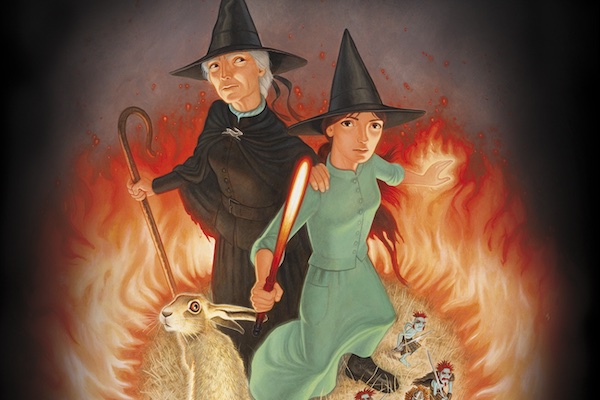
Despite the title, the story centers around the quest of young Ojo the Munchkin to find six strange ingredients needed for a potion that can restore his uncle and a neighbor to life. (A magician accidentally turned them into stone.) In the first half of the book, Ojo and his companions, new characters the Glass Cat and the Patchwork Girl, travel to the Emerald City, meeting the Shaggy Man, the Scarecrow and the Woozy (whose tail is one of the needed ingredients) along the way.
At the Emerald City, Ojo is imprisoned for the crime of stealing another necessary ingredient, a six leaf clover. Ojo does not deny the crime; he finds the law foolish. Ozma explains that since six leaf clovers form a major component of evil spells, and since evil magicians and witches continue to practice magic despite her laws forbidding magic, she has outlawed the picking of six leaf clovers. Why Ozma thinks that people who are already flouting the first law will care too much about anti-clover picking laws is unclear.
(Believe it or not, I really don’t want to be all about the Ozma hate. But honestly, Ozma, would it have killed you to, you know, explain the idea behind your law to the Shaggy Man, at least, so that it would not have seemed so arbitrary and unfair? Especially given that just two books ago you merrily welcomed a self confessed thief of magical items to Oz, so arresting a kid that only wanted to save his uncle by picking a six leaf clover comes off as particularly unfair. No wonder the Wizard has to provide the required happy ending of the book—but I anticipate.)
After this, Ojo, the Patchwork Girl, Dorothy and the Scarecrow head off on a quest to find the other remaining ingredients. They find two seemingly impossible ones. Triumphantly, they are about to take the last item—the left wing of a yellow butterfly—only to be stopped by an indignant Tin Woodman, who states that pulling off a butterfly’s wing is torture. He will not permit it, even to bring Unc Nunkie back to life.
When I first read this book as a child, I was horrified that my kind hearted Tin Woodman was willing to let two people—one a beloved uncle of the main character—remain stone statues, essentially dead, all to keep a butterfly from feeling any pain. And although as an adult I can see the Tin Woodman’s point, I still find the elevation of a butterfly over the urgent needs of two humans morally dubious. This isn’t just about making them happy; this is letting the humans live—and not incidentally, bringing the only relative Ojo has ever known back to life.
(My distressed feeling is not helped by Ozma’s squeaking, “oooh, if you'd just told me that you'd needed the left wing of a yellow butterfly, I would have told you not to bother to take that trip.” Gee, THANKS OZMA! Oh. Right. Just said I didn't want to be all about the Ozma hate. Onwards!)
Ojo makes the same argument. But the Tin Woodman, a moral absolutist, declares that torture is never justified. Even on insects.
(I’ll just tiptoe by the obvious contemporary parallel, shall I?)
Incidentally, it’s the second time in the book that characters have placed the needs of insects over the needs of others, continuing the minor theme of Insects They Are Awesome Don’t Kill Them running through all of the Oz books.
Baum is not just against torture, but against harsh punishments as well:
We consider a prisoner unfortunate. He is unfortunate in two ways — because he has done something wrong and because he is deprived of his liberty. Therefore, we should treat him kindly, because of his misfortune, for otherwise he would become hard and bitter and would not be sorry he had done wrong...
And so the guilty Ojo is treated kindly, feels terrible shame indeed, and readily confesses and feels sorry for his crime. But before we get too comfortable with the overwhelming kindness of Oz, the Shaggy Man gives us this little bit:
“In this country,” remarked the Shaggy Man, “people live wherever our Ruler tells them to. It wouldn’t do to have everyone live in the Emerald City, you know, for some must plow the land and raise grains and fruits and vegetables, while others chop wood in the forests, or fish in the rivers, or herd the sheep and the cattle.”
This, coming from the one character who never seems to do any work at all, and enjoys a luxurious suite of rooms at the palace, seems a little much. Previous books had already shown that certain characters, thanks to their friendship with Ozma or by virtue of their uniqueness, were able to ditch the idea of work entirely, living in luxury surrounded by servants, but this is the first indication that Ozma is actually ordering the workforce around to ensure that the system works. (It’s only fair to add that some of the queer and magical characters do work—Jack Pumpkinhead, for instance, is a hard working and skilled pumpkin farmer and baker of pumpkin pies.) This is also the first book emphasizing that only certain people are allowed to practice magic to make their lives a little easier. Hmm.
Two things mar Patchwork Girl: an incident with the Tottenhots, meant to refer to stereotypical descriptions of the Hottenhots of South Africa, and the horrible song played by the living phonograph, with the godawful lyrics, “Ah wants mah Lulu, my coal-black Lulu.” The Oz characters, to their credit, also object to this song, even if they seem to be reacting more to the sound than to the lyrics. Both bits are jarring in a book where a literally colorful woman, created to be a household slave, earns her independence and merrily defends her unusual, “crazy” appearance, refusing to be pitied or condemned. It’s also a depressing reminder that here, at least, Baum was all too much a man of his age, despite his pointed examples of tolerance and acceptance of differing sorts of people in this and other Oz books.
(The racial references have been removed in the Books of Wonder editions, but can be found in other printings and in the Gutenberg etexts. The rest of Baum’s Oz books, with the exception of another unfortunate reference in Rinkitink in Oz, are generally free of racial stereotyping, although Baum did pen bigoted statements against Native Americans in non-Oz related contexts.)
Mari Ness would happily pick a six leaf clover to perform a little magic, if she could find one. She lives in central Florida.
Thursday November 26, 2009 02:48pm EST
VIEW ALL BY · Friday November 27, 2009 05:24pm EST
To be honest, I never really noticed the myriad failures until I read the books at one fell swoop for this project, when it became obvious that something was going on here. I'm not sure what, but your theory of sneaking one under the radar definitely works for me.
Friday November 27, 2009 10:20pm EST
With the living phonograph, it seems as though Baum is parodying ragtime and proto-jazz; he also has sardonic things to say about classical music or the cult thereof, which you don't mention:
This used to be one of my favorite of the Oz books, but on further re-readings the flawed endings of this one, and of Rinkitink in Oz (also one of my favorites from when I first read them) bother me more than they used to, while I find that Tik-Tok of Oz and The Tin Woodman of Oz get better with re-reading; at this point, having re-read twelve of Baum's fourteen (plus The Sea Fairies and Sky Island) in the last couple of months, I'd rank The Tin Woodman of Oz just below The Marvelous Land of Oz and The Wizard of Oz as one of the two or three best. Still, The Patchwork Girl of Oz has a lot of great characters and incidents even if the plot unravels at the end.
Saturday November 28, 2009 11:43am EST
My own favorite Oz books are Rinkitink, one of his transparent get-me-the-hell-out-of-Oz books, and Glinda, his last. As a kid I liked Rinkitink despite the plot holes, which amount to brining all of Oz in at the end as one big deus ex machina. As an adult I kind of like it because of that. It's all you could really do with Oz at that point.
I liked Glinda because the adventure felt more scale-appropriate--the dei ex machina are actually in the midst of things for once--and for the weird mix, in both the story and the illustrations, of magic and "technology." I especially remember a great Neill illustration of Glinda, in her fairy queen robes, peering earnestly through a sextant-like thingy at the underwater town.
I had a theory at one time that the magic in Baum's stories worked better than the point-and-shoot Magic Energy in modern fantasies, because it was somewhat technical. Much more fun, anyway.
Saturday November 28, 2009 11:51am EST
VIEW ALL BY · Friday December 04, 2009 09:38am EST
But the two books are rather related - two boys attempt to save their parents/guardians, do everything right in their quest, but in the end, are unable to save their parents/guardians without outside assistance. I find this less frustrating in Patchwork Girl, where it's clear from at least the middle of the book that the laws of Oz are going to give Ojo problems, than in Rinkitink where the only reason Inga can't save his parents is that Baum needed to change the book into an Oz book and bring in Oz characters.
@Seth e - I love Rinkitink right up to the point where Dorothy appears to save the day, which annoys me so much that I have to put the book down. I agree that Glinda is one of the best of the Oz books.
And yes, I always loved the fact that Glinda, Ozma and the Wizard all have little workshops, just like magical laboratories and stuff, to conduct magical research and create magical tools. And quite a few of their magical tools eventually became part of our technology (I'm thinking mostly of the Magic Picture here, but the Wizard has a few anticipatory tricks as well.)