




















School is starting up soon. My son used to attend a preschool/kindergarten for special-needs kids and their siblings, and now he’s going on to a public school, though still in the special education program. He’s cool with it, but I am a little freaked. It has brought up a whole childhood can of worms regarding my less-than-lovely educational experience, and makes me reflect on issues of social acceptance for neurologically atypical people overall. That leads me to fandom. I can’t help but think neurodiveristy is an area in which science fiction and fantasy fans are a long, long ways ahead of society in general.
A few years ago I attended a panel at Norwescon that was supposed to be about the future of psychology but quickly became a discussion of the neurological make-up of fandom. The lively and engaged discussion covered dyslexia, Asperger’s, ADHD, autism, sensory integration dysfunction, and related topics. The general consensus was that among convention-goers, the percentage of people with such atypical neurology ranged around 60 to 70 percent. Almost all the audience members who spoke identified with one or more of the above, or mentioned a close relative that did.
What I found most remarkable about the discussion was not that we acknowledged the high percentage—which is pretty obvious to anyone who knows what to look for—but rather that at no point did the panel become gloomy. No one said, “Oh, no! We’re all screwed up!” but rather the feeling was one of pride in the open-heartedness of science fiction and fantasy fans. It wasn’t about “normal people tolerating the strange ones” but rather a warm and broad acceptance and appreciation on all sides. I left the panel feeling downright cheerful. Throughout the convention I reflected on how marvelous it was to see a group of such unusual minds. I hardly think fandom is Utopia, but in terms of acceptance, it’s a fantastic thing.
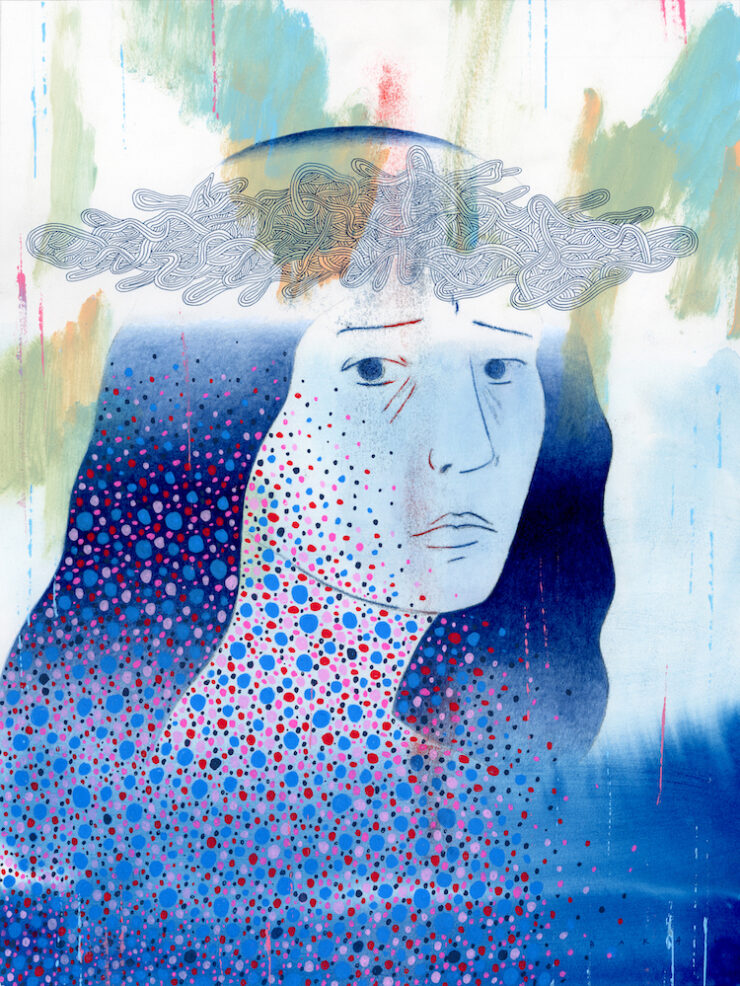
Allow me to give you my view of neurodiversity. We all have strengths. We all have problems. I believe that no one deserves to be defined by his or her problems. Atypical neurology brings with it both challenges and advantages, and when looking at the life of an neurologically atypical person, the view should not be blocked by preconceived notions of what is and what is not normal, or worse still, believing that normal is best. (Also, though I require them as an expedient, I don’t quite like the words neurotypical and atypical because they force an unfair notion of duality when the reality is more often a matter of degrees of difference.)
A Google search for neurodiversity and fandom brings up a ton of stuff. It makes perfect sense to me that folks like me are drawn to genres that frequently investigate what it means to be an unusual human (on a quest, lost in a distant galaxy, prophesized, cursed, vital, altered, hunted, etc.), or what it means to be an alien, or a sentient machine…in short, what it means to be “other.” For those of us who have lived in the shadows of people’s assumptions of how we are “supposed” to be, it’s refreshing and empowering to see the so-called other win in the struggle for self-definition.
There was once a time when a great many atypical people ended up institutionalized or otherwise isolated and subjected to torturous therapies. What I’ve faced has been nowhere near as harsh, but far from enjoyable. There was no real attempt from my teachers to understand what was going on in my head, let alone to think perhaps there were advantages to it, along with the difficulties. That said, when I reflect on the ignorance and prejudice I faced as a young student, I can only marvel at how much progress has been made since then. I know that my son, who faces substantially greater challenges than my own, has been treated far better in school than I was. The desire to understand differences and work with strengths has improved tremendously. But it’s early days yet, and schools have a very long way to go (and society in general even further) before they can even begin to approach the appreciation of neurological diversity that happens in fandom.
When I think of my son and the world he’ll inherit, I know he’ll be strong enough to face whatever comes his way, but I hope that the general social trend toward tolerance and understanding continues and strengthens. I believe science fiction and fantasy fandom can continue to play a vital role in this. The more social environments such as conventions and other communities embrace and empower the otherwise marginalized, the more these empowered people will bring that confidence outside those safe environments, to everyone’s benefit.
When Jason Henninger isn’t reading, writing, juggling, cooking or raising evil genii, he works for Living Buddhism magazine in Santa Monica, CA
VIEW ALL BY · Thursday August 27, 2009 01:55pm EDT
My wife Teresa Nielsen Hayden and I have noticed it for years, because Teresa suffers from a gaudy neurological disorder, narcolepsy. This means that she will frequently experience periods of extreme (and highly visible) tiredness during the day, and it also means that, when surprised by something funny (for instance, an unexpectedly hilarious remark), she will sometimes collapse helplessly onto the floor for a minute or two, like a marionette whose strings have been abruptly cut.
It's not really a big deal--as she always says, it would be ghastly if people tiptoed round trying not to set her off. She'd rather hear the jokes. But while people in the non-fannish world are often obviously alarmed by (and uncomfortable about) Teresa's symptoms, SF fans, with almost no exceptions, have always been supremely easy-going and practical about the matter, matter-of-factly adapting around the disability without making her feel bad about it. It's a set of virtues that can be found outside of SF fandom, but it's striking how widespread it is inside.
VIEW ALL BY · Thursday August 27, 2009 02:21pm EDT
Thursday August 27, 2009 02:49pm EDT
VIEW ALL BY · Thursday August 27, 2009 03:22pm EDT
VIEW ALL BY · Thursday August 27, 2009 04:28pm EDT
Thursday August 27, 2009 06:13pm EDT
I guess I can see why that treatment appeals more to the majority of the mainstream market, but... there's an interaction between the fandom and the work produced for them, I guess is my point.
VIEW ALL BY · Thursday August 27, 2009 08:43pm EDT
Alot of these kids are afraid of each other on the first day of school, but once they realize the guy also loves Star Wars and collects Yugi-Oh! cards, they start talking and improving their social skills.
As one of the girls in last year's homeroom said, "I love going to a school where the geeks have taken over."
VIEW ALL BY · Friday August 28, 2009 08:06am EDT
VIEW ALL BY · Friday August 28, 2009 10:11am EDT
My son, who has moderate cerebral palsy, started early on to benefit from the genre we all love. Though I've tried to guide him gently into the world of space ships, dragons and, really the full spectrum of SF themes, he's really latched onto the monster side of things. "Frankenstein Makes a Sandwich" is one of his favorite books, and many a Saturday night we've spent taking in classic monster movies.
He sees people - adults and other kids - staring at him as he goes by in his walker. I believe he identifies with the monsters because he knows he is different than most kids. I think he can see himself as Frankenstein, who has food thrown at him just because he doesn't look like the rest of the neighbors.
And I'm glad that I can share with him the wealth of ideas and, as you say, broad acceptance, that is available in the SF genre.
I also shared something akin to your experience growing up: I was diagnosed with a "learning disability" in grade school because I preferred reading to playing sports or doing my math homework. One of their conclusions was that I would have a hard time writing.
Luckily, I disregarded their diagnosis as soon as I was able and now make my living as a writer.
In any case, thanks again Jason for sharing in this thoughtful and thought provoking post.
VIEW ALL BY · Friday August 28, 2009 03:18pm EDT
VIEW ALL BY · Friday August 28, 2009 09:36pm EDT
VIEW ALL BY · Saturday August 29, 2009 11:32am EDT
I've been away from the internet for a few days. I just wanted to say thank you for all the kind and thoughtful responses.
Sunday August 30, 2009 05:42pm EDT
VIEW ALL BY · Monday August 31, 2009 03:17pm EDT
VIEW ALL BY · Tuesday September 01, 2009 06:56am EDT
Saturday October 24, 2009 09:33pm EDT
Can I use this post for a new neurodiversity blog, shiftjournal.com?
Thank you,
Andrew Lehman