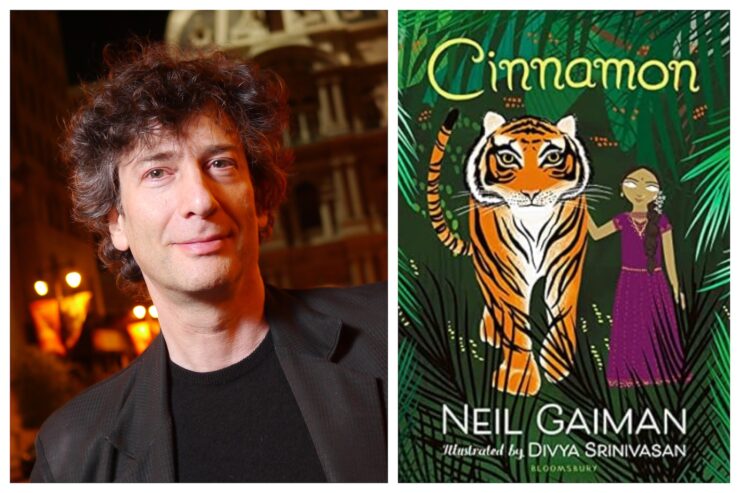









The Sandman was a monthly comic book written by Neil Gaiman, published in 75 issues of 32 pages apiece, from 1989 to 1996. It’s now in print as a series of graphic albums. Wikipedia and other easily found sources can tell you about all the awards and notice and praise it’s gotten, the collected editions in which it’s been republished, the artists who’ve given it visual form, et cetera and so forth; so I’m going to skip those bits.
Sandman is one of those landmark works of imagination that reshape our genre. It’s a story about stories and how they work, but it never feels tiresomely metafictional, or like reading it might be good for you. Its complex structure owes a good bit to works like The One Thousand and One Nights and Jan Potocki’s The Manuscript Found in Saragossa, where one story is a frame for another story, which itself is a frame for a third, which may or may not loop around and reconnect with the main storyline anytime soon. It is nevertheless fitted neatly and painlessly into the very complicated DC Comics continuity, where it does no harm and ties up a lot of loose ends. And you don’t need to know one bit of that in order to enjoy reading it.
The book follows the adventures of Dream of the Endless, also called Morpheus or the Sandman. The other Endless, his siblings, are Destiny, Death, Desire, Despair, Destruction, and Delirium, the offspring of Erebus and Nyx.* Morpheus is the ruler of the Dreaming, and all who are passing through it. If your pantheon has a god of sleep or dreams, he’s that guy. He’s also called the Prince of Stories, and “he to whom Allah has given dominion over that which is not and was not and shall never be.” This fits. Like dreams, stories are mutable but not arbitrary, and though unreal may nevertheless be true.
Dream defines reality in the same way that his sister Death defines life. He’s the ruler of the realm of unreal things. Stories belong to him. Like dreams, they’re mutable but not arbitrary, and though unreal may be equally true or false. They shift, they morph and mutate; and yet when they change, something remains. It’s that thing we’re talking about when we ask whether there’s any difference between a story and the words in which it’s told.
I have a theory about what else is going on in Sandman. I believe it’s meant to be an epic.
That word gets kicked around a lot—epic movie, epic fantasy, epic whatever—but real epics are a literary form. There’s even a set of specs for them. They’re long, and are written in a high style. They have to start in medias res, in the middle of the action, and fill in the backstory using flashbacks. The chronology can be elastic, but the setting in which all this takes place must be enormous. It may include heaven, but it pretty much has to include hell.
The hero, who may have divine or supernatural ancestry, must be almost but not quite invulnerable, have failings as well as virtues, and undertake a task no one else can manage. His weapons must be distinctive, and may, like him, be of supernatural origin. He’s optionally allowed a band of followers—a comitatus, or what we’d now call a personal staff.
A muse must be invoked. Gods and superheroes must interfere in human affairs. There must be journeys, quests, adventures, religious observances, and one-on-one combats with worthy opponents; and these various events must form an organic whole where each part is related to the central theme, and the whole shows us the hero’s world in microcosm.
There must be formal speeches, boasts and flyting, epithets, titles, patronymics (or these days, matronymics), epic similes, prophecies, omens, and a journey to the underworld. The narrative must digress to talk about genealogies, the lives of the gods, and the histories of significant objects; likewise to recapitulate other stories you might not normally think would come into it.
Finally, you get extra points if when your epic starts, your main character is seriously pissed off.
Next installment: Issue #1, “The Sleep of the Just.”
* To quote my husband, “Sandman is a work that manages to bestow coolness on both Hesiod’s Theogony and Prez, and it’s hard to say which of those was less likely.”
Teresa Nielsen Hayden is an American editor of science fiction and fantasy, as well as a fan writer, essayist, blogger, teacher, and moderator.
VIEW ALL BY · Tuesday August 04, 2009 09:46am EDT
Tuesday August 04, 2009 10:22am EDT
VIEW ALL BY · Tuesday August 04, 2009 11:25am EDT
Tuesday August 04, 2009 11:31am EDT
Tuesday August 04, 2009 11:45am EDT
I am looking forward to your insights.
VIEW ALL BY · Tuesday August 04, 2009 12:02pm EDT
VIEW ALL BY · Tuesday August 04, 2009 12:57pm EDT
VIEW ALL BY · Tuesday August 04, 2009 01:09pm EDT
VIEW ALL BY · Tuesday August 04, 2009 01:19pm EDT
VIEW ALL BY · Tuesday August 04, 2009 02:37pm EDT
I have been waiting for a Sandman reread to come along ever since they started doing rereads on this site.
Thank you, Tor, for fueling my addictions.
VIEW ALL BY · Tuesday August 04, 2009 04:02pm EDT · amended on Thursday August 06, 2009 03:09am EDT
One key to it is set out in "Worlds' End", where travelers are telling stories under a circumstance that turns out to be directly linked to Morpheus. "There aren't any women in these stories," says Charlene Mooney. "...We're just pretty figures in the backround to be loved or lost or avoided or obeyed or...whatever."
The larger narrative of Sandman, by contrast, overflows with women. Look at who the protagonists of the story arcs are, other than Dream himself: Rose Walker, Barbie, Delirium, Lyta Hall. (And then there are Thessaly, Nuala, and Death.)
(Remainder enciphered in ROT13 for spoiler protection. To decipher, use rot13.com or other online tools.)
Zbecurhf unf n ahzore bs eryngvbafuvcf orsber uvf pncgvivgl, naq gurl nyy raq onqyl, cerpvfryl orpnhfr ur vf hanoyr gb gerng jbzra nf crbcyr. Ybbx ng ubj ur qrnyg jvgu Anqn: vg jnf nyy nobhg uvz, fur jnf whfg na bowrpg.
Nsgre uvf pncgvivgl ur punatrq (gubhtu sbe n ybat gvzr ur jnf va qravny nobhg gung), creuncf ersyrpgvat gur punatr va gur fgnghf bs jbzra va Jrfgrea fbpvrgl naq yvgrengher. Cebzcgrq ol Qrngu, ur fbhtug gb eryrnfr Anqn; ur gevrq n eryngvbafuvc jvgu n jbzna zber rzcbjrerq naq vaqrcraqrag; ur yvfgrarq gb Qryvevhz naq urycrq ure. ("Lbh'ir arire ncbybtvmrq gb zr. Lbh whfg npg yvxr lbh xabj fghss V qba'g xabj gung znxrf rirelguvat lbh qb bxnl.")
Hygvzngryl, ur pnzr va pbasyvpg jvgu na nepurglcr bs srznyr cbjre, naq tenqhny punatr cebirq vafhssvpvrag. Abguvat yrff guna qrngu naq erovegu fhssvprq.
VIEW ALL BY · Tuesday August 04, 2009 04:15pm EDT
Not to be the spoiler police as this is a re-read, but can we try to avoid spoiling major plot points of the end of the series in the introductory post?
VIEW ALL BY · Tuesday August 04, 2009 10:08pm EDT
VIEW ALL BY · Tuesday August 04, 2009 10:28pm EDT
VIEW ALL BY · Wednesday August 05, 2009 12:10am EDT
That said, if some admin wanted to ROT13, say, the last paragraph, I wouldn't object.
I've had that mini-essay brewing inside for quite a while; this seemed like a good place to post it. (At that, I tried to keep it brief.) If it spoiled anything or even just bored anybody, then I apologize.
VIEW ALL BY · Wednesday August 05, 2009 02:19am EDT
I'm rereading these at the moment and up to volume IV.
i'm also reading the "The Sandman Companion" alongside. I didn't even understand half the references on my original read.
VIEW ALL BY · Wednesday August 05, 2009 03:52am EDT
I've actually pointed a guy who has only recently rediscovered comics after 30 years to this introduction. And I don't think we should assume anyone who has heard about Sandman but has yet to read it knows anything of the plot. You could easily edit your essay and cut the spoilers.
VIEW ALL BY · Wednesday August 05, 2009 12:38pm EDT
VIEW ALL BY · Wednesday August 05, 2009 01:14pm EDT
VIEW ALL BY · Wednesday August 05, 2009 02:04pm EDT
I agree with nikkiro's disagreement: while Death and Sleep were children of Erebus and Night in Greek myth, I think the Endless are products of the universe and not anybody's children. Gaiman is playing with Greek myth but also casting a wider net. As I type this I'm sitting in an airport waiting for a (late) plane to take me to Anticipation; perhaps I'll get the chance to ask him about it.
Wednesday August 05, 2009 02:11pm EDT
Wednesday August 05, 2009 02:32pm EDT
I think the major spoiler that Torie was talking about was the one in your second paragraph - where you mention an event that precedes the telling of tales in World's End. Maybe that sentence should be rot13d as well...
VIEW ALL BY · Wednesday August 05, 2009 02:32pm EDT
I don't think it's necessary to ROT13 that much- what bugged me was the last part of the sentence beginning with One key to it is set out in "Worlds' End", . If you cut that and a similar comment towards the end for me the rest of the essay can remain uncrypted.
VIEW ALL BY · Wednesday August 05, 2009 02:38pm EDT · amended on Wednesday August 05, 2009 02:39pm EDT
That's the one sentence I was referring to. I think Mr. Goldfarb's point is excellent and valid and doesn't require that one sentence, a huge spoiler, to make it. The rest is fine and doesn't need to be ROT-13.
VIEW ALL BY · Thursday August 06, 2009 02:56am EDT
VIEW ALL BY · Thursday August 06, 2009 03:11am EDT
VIEW ALL BY · Thursday August 06, 2009 07:24am EDT
Saturday August 08, 2009 06:25am EDT
You mention Erebus and Nyx as the parents of the Endless? An interesting idea. I've been wondering for a while who that voice in the catacombs under the Necropolis is and what "The First Circle" refers to. . . I'll be looking forward to see if you have any ideas.
VIEW ALL BY · Saturday August 08, 2009 08:09am EDT
One of the big questions it asks is not just whether the centre can hold, but whether centres - preeminent narratives, unbiased points of view - are meaningful ways to look at the world at all. "Gura jung qvrq? Jub ner lbh zbheavat?" "N chu-cbvag bs ivrj."
The first time I encountered Gaiman's work was when I picked up A Game of You in the library, and sat there for an hour and a half to finish it, then took it home to read all over again. Quests, magic, dreams, choice & self-determination...
VIEW ALL BY · Monday August 31, 2009 01:15pm EDT
VIEW ALL BY · Thursday September 03, 2009 01:58pm EDT
VIEW ALL BY · Wednesday September 09, 2009 02:00pm EDT
Could "Sandman" happen today? I go to the comics store every week, but I find that there are less titles I'm interested in. When the scene is dominated by the depiction of huge breasts, and bymulti-title crossovers that don't change a darn thing, would anyone notice the Sandman or even his cute sister?
VIEW ALL BY · Wednesday September 09, 2009 03:02pm EDT
Wednesday September 09, 2009 07:18pm EDT
There were plenty of shops that didn't carry the early issues - too far out of their target market - and only brought it in once demand was high. Then there were shops like mine, that enthusiastically embraced it as a way to introduce comics to book readers who would not have previously been interested.
VIEW ALL BY · Thursday September 10, 2009 12:07pm EDT
David Goldfarb @11: Very interesting take on the series...I like it.
Serge @32: The stuff on the shelves was just as bad back then - that was the heydey of Rob Liefeld (http://progressiveboink.com/archive/robliefeld.html for a sampling of the worst) for example. If Sandman happened today it wouldn't be as big a change for the genre, since the genre currently reflects various changes wrought by Gaiman, but I think it would be a very hot seller.
Thursday September 10, 2009 07:06pm EDT
VIEW ALL BY · Friday September 11, 2009 10:14am EDT
Back when "Sandman" had been coming out for maybe a couple of years, the fans in my hometown used to make faces at my enjoying comics. Then I brought up "Sandman", which made them realize that not all comics are about guys in metal underwear who spend most of their time beating the crap out of each other.
VIEW ALL BY · Friday September 11, 2009 10:21am EDT
Yeah, most of the stuff back then was less than impressive. But, at the same time, I seem to remember that there was more willingness among the mainstream comics publishers to try stuff that was different. Look at "Sandman" and DC's "Swamp Thing". Marvel had the Epic line, and they published "Moonshadow".
On the other hand, there ARE comics coming out today that are anything but run-of-the-mill. They may not be published by the big publishers, they may be hard to spot, but they are out there.
Which reminds me that I should probably re-read "Strange Girl".