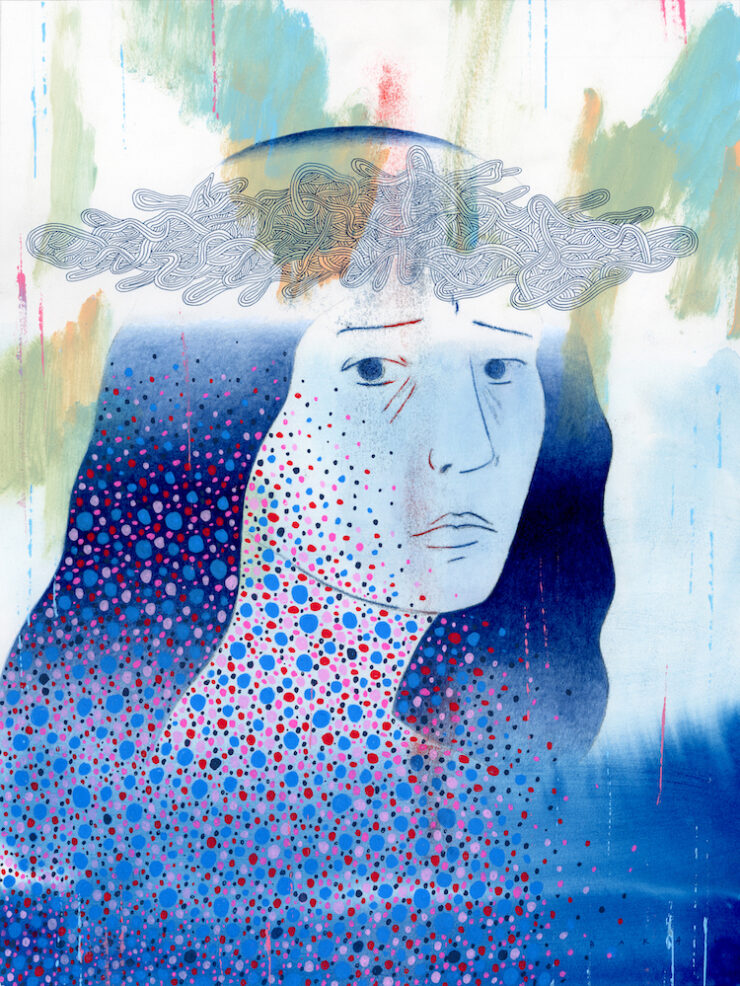

















The Left Hand of Darkness is one of those books that changed the world, so that reading it now, in the world it helped grow, it isn’t possible to have the same experience as reading it in the world it was written in and for. The Left Hand of Darkness didn’t just change science fiction—it changed feminism, and it was part of the process of change of the concept of what it was to be a man or a woman. The battle may not be over. What I mean is that thanks in part to this book we’re standing in a very different place from the combatants of 1968. Almost all books that do this kind of historic changing are important afterwards as historical artifacts, but not as stories, and they get left behind by the tide and end up looking quaint. Ninety percent of the discussion I’ve seen of The Left Hand of Darkness is about the gender issue, about the Gethenians and their interesting states of kemmer (of either gender for a few days a month) and somer (neuter for the majority of the time.) But what makes it a book that continues to be great and enjoyable to read, rather than a historical curiosity, is that it’s a terrific story set in a fascinating culture, and the gender stuff is only part of that.
The Left Hand of Darkness is the story of how the Terran Genly Ai comes to the planet Gethen to persuade Gethen to enter the Ekumen, the community of worlds. And it’s the story of the Gethenian Therem Harth rem i’r Estraven who recognises something larger than the horizons he grew up with. And it’s the story of the journey these two people take together. The book is written in such a way that you have Estraven’s journals written at the time and Genly’s report written later and various poems and folktakes and stories of Gethen inserted in the text at appropriate points, so that the world is not only a character but one of the most important characters. I love the world, I love Karhide at least, the country and the people and how different it is from its government, and the religions. The planet is in an ice age, and the adaptations to the climate have shaped the cultures of the planet at least as much as the gender thing has. They’re like real cultures, with real oddities, and the way the story is told enhances that.
If you haven’t read it, and if you’ve always seen it mentioned as a worthy feminist classic with weirdly gendered aliens, you might be surprised by this interesting story of the discovery of a planet and a journey across the ice. It is a living breathing story that happened to change the world, not a dry text with a message.
The book is set in the same universe as a number of Le Guin’s other books, many written much earlier. It has the same furniture, the ansible, the Nearly as Fast as Light ships, the long ago Hainish experimental colonization of planets with tweaked humans—were they trying to make their own aliens? The previously worked out background doesn’t give the book any problems, it makes it seem more solidly rooted.
We don’t see any of the other planets, the book is firmly focused on Gethen, also known as “Winter”. There is one narrative voice from an earlier report on the planet that’s a woman from Chiffewar, but the non-Gethenian we are given to identify with is Genly Ai, a black man from Earth. We’re not given his cultural context on Earth, though his dark skin, darker than most Gethenians, is mentioned. Neither “Genly” nor “Ai” are names I’m familiar with. A quick Google search finds me a town called Genly in Belgium, a factory in China, and people in the Philippines, China and India—Ai is regrettably unsearchable. In any case, whatever his ethnic background, Genly is our “normal” character, our filter, the one who is a gender we recognise and from a planet we’re familiar with. He’s our “unmarked” character, if you like. I think that’s cool, even though we don’t hear anything from him that makes his ethnicity other than “Terran”. His sexual preference—heterosexuality—is mentioned, and his gender essentialism is very much dated from the world the book was written in, not the world in which it is now read.
The character I’m ridiculously fond of is Estraven. I’ve loved him since I was a teenager. He’s not a man or a woman, he in exile always and everywhere, and he always sees the big picture and tries to do what he can. He tries to be as good a person as he can, in difficult circumstances. He’s one of my favourite characters in all of fiction, and when people play that “who would you invite to dinner” game, I almost always choose him. I cry when he dies, and at the end of the book, every time. I don’t know if I’d react so strongly to Estraven if I read the book for the first time now. His backstory, which is revealed so beautifully slowly, is one of the beauties of the book. His name reflects the levels of culture we have in Karhide, friends and hearth-brothers call him Therem, acquaintances call him Harth, and Estraven is his landname, which would be used where we use a title—yet when he learns mindspeech, up on the glacier, it is as Therem that he manages to hear it, and he hears it in his dead brother’s voice—the dead brother with whom he had a child. Poor Estraven, so tragic, so clear-sighted, so perfectly and essentially of his world and culture!
It’s a commonplace of SF for planets to have only one country and culture. Le Guin should be commended for mentioning four or five on Gethen and showing us two. However, there’s a Cold War legacy in the way Karhide and Orgereyn are opposed, and Orgoreyn is totalitarian, with its units and digits and work camps. I feel Orgereyn only really exists to give Genly and Estraven something to escape from, but I love their escape so much that I don’t care. I think it’s done pretty well, certainly Genly’s subjective experience of it, but I don’t think Orgereyn is as developed or as well thought through as Karhide.
The “tamed hunch” of the fastnesses, and the “mindspeech” of the Ekumen are both dealt with science fictionally rather than fantastically, but are “psi powers” of a kind rather unfashionable these days. Le Guin writes about them believably and interestingly, and I think they enhance the book by being there and providing more strangeness.
The heart of the book is the journey across the glacier, two people, from different worlds, manhauling a sledge across vast distances. There are echoes of Scott’s Antarctic expeditions—for me, echoes the other way around, because I read The Left Hand of Darkness first. She took these quintessentially useless and particularly masculine endeavours and made them over into something else entirely. She was clearly fascinated with polar exploration—she has a short story in The Compass Rose about women from South America getting to the South Pole first and not marking it or telling anyone. Here there’s a reason for the winter journey. So that’s another gender subversion.
The Gethenians have a concept they call “shifgrethor” which is like pride. You waive shifgrethor for someone to tell you something directly, otherwise you sidle around to avoid offending them. This is notably different from Earth notions of offending pride only in how conscious they are of it, of what is sayable and unsayable, of having a mechanism for waiving it. I think it’s one of the more interesting gender things—much more interesting than that they don’t fight wars—that they have this set of shifting privileges and offendable pride and that they’re aware of it. They’re touchy in a very alien way, and I think that’s really effective.
Le Guin has written essays since about the assumptions she made in writing the book. She’s also written the story “The Winter King” where she uses “she” as the pronoun for all Gethenians, rather than “he” as she does in the book, and the story “Coming of Age in Karhide.” Both of these explicitly feminise the Gethenians. They’re interesting, as are her writings about the book, but they’re afterthoughts from a different world.
It is light that is the left hand of darkness, and darkness the left hand of light, as in the yin-yang symbol, in which dualities are united. The Left Hand of Darkness is a book about making whole. It’s also a book about what it means to be a good person and where gender is significant in that. But mostly it’s about the joy of pulling a sledge over a glacier between two worlds.
VIEW ALL BY · Monday June 08, 2009 10:06am EDT
VIEW ALL BY · Monday June 08, 2009 10:34am EDT
Monday June 08, 2009 10:43am EDT
On the other hand, i've discussed this book with a number of queer and transgender-identified people, and those who are looking for very interesting or subversive things about gender are often disappointed, while those who like good science fiction are better rewarded.
The other stories you mention are indeed very different. I had thought that Winter's King was actually written first (ah, yep), and Coming of Age in Karhide much later; i agree with you that neither work very well to communicate the androgynous/bi-gender (bisexual?) nature of the Gethenians, but i actually think Left Hand only does so as well as it does due to it's length, and that the use of male pronouns radically undermines what Le Guin was trying to do. Unfortunately there are no good ways to do that in English, and the story remains hard to tell. Or rather, the story is told very well, but the Gethenians' gender(s) as i think we are meant to understand them, are not.
Monday June 08, 2009 10:50am EDT
This goes on elsewhere with different results. In The Dispossessed, there's reference to the famous Terran physicist Ainsetain.
Monday June 08, 2009 11:06am EDT
VIEW ALL BY · Monday June 08, 2009 11:15am EDT
VIEW ALL BY · Monday June 08, 2009 11:21am EDT
VIEW ALL BY · Monday June 08, 2009 11:31am EDT
I don't know how you "think we're meant to understand them" but I suspect my understanding of that is different. They're not "if everyone were transgender, or everyone were both male and female" they're "if everyone only had any gender at all once a month, and then it might be either at random". I think it's possible to argue, as Le Guin herself has argued, that she didn't make them feminine enough in the novel, and that using "he" was part of the problem, but I like them as they are, not an analogy but a bit of exploration.
Monday June 08, 2009 11:43am EDT
It is possible, however, that I'm forgetting something about the name having evolved from "Henry".
VIEW ALL BY · Monday June 08, 2009 12:05pm EDT
I've always seen it as derived from Jean-Louis (Genly) but that's probably because whenever I see a word I do not know and is not in the dictionary I tend to pronounce it the French way (after all, if you a native, you _know_ what almost any French word or name sounds like -- even if you haven't see it before, unlike English which has inconsistent rules for these things)
'Ai' is a fairly common Japanese name. So if there are people name Genly in the Phillipines, I could see someone being named Genly Ai.
Monday June 08, 2009 12:11pm EDT
Hmm, i wonder how this is translated for readers of, say, Finnish, which does not gender personal pronouns. Does it work better?
*i don't doubt that this book was quite radical when it was published in 1969, but reading it for the first time today (i probably read it first in the late 90s), by current standards i think it is less so, though obviously that depends on where the reader is coming from.
In terms of where i am coming from, i don't see "gender" as a synonym for "sex" and while Gethenians only have a sex once a month, "either at random," it may be that they have a gender all the time, just one we don't recognize. Not that this is what Le Guin intended either, i guess in the 60s gender and sex were considered mostly the same thing, but i wonder if that might be one way to think about it. Perhaps i'll re-read this soon and see if that holds up (it may not).
VIEW ALL BY · Monday June 08, 2009 12:38pm EDT
VIEW ALL BY · Monday June 08, 2009 01:47pm EDT
VIEW ALL BY · Monday June 08, 2009 02:12pm EDT
I don't clearly remember the first time I read The Left Hand of Darkness, but when I re-read it earlier this year I was interested to see how much I learned about Genly Ai's culture from his reaction to the Gethenians, though disappointed that the future he's from (if he is indeed from our future) is so misogynistic. I haven't yet read Rocannon's World; I'm sure I'll get around to that someday too.
Also, this most recent reading was part of an unplanned set of books with winter journeys (most on colder-than-Earth planets) where someone generally dies at the end of the journey. As I say, I didn't set out to read books that all matched that theme, but I found myself reading one after another of them.
VIEW ALL BY · Monday June 08, 2009 02:47pm EDT
And yes, Ai's future Earth, future Ekumen, is far more sexist and gender essentialist than our 2009, and I really do think that's partly because we've been fortunate enough to have this book.
Cybernetic Nomad: I adore your Jean-Louis idea. I've always pronounced it as "Gently" without the T, but I now see him as a dark skinned guy (with some Japanese ancestry) and totally from Montreal.
Monday June 08, 2009 06:05pm EDT
Monday June 08, 2009 08:14pm EDT
VIEW ALL BY · Monday June 08, 2009 10:30pm EDT
I wish I could share your optimism that the world has changed so much since 1968, Jo (though a few Mad Men episodes is always enlightening!). Without taking away from the great achievements since that time, I suspect that chauvinism is simply wearing a more insidious mask, and thus books like this will always be welcome and indeed necessary.
VIEW ALL BY · Monday June 08, 2009 11:32pm EDT
VIEW ALL BY · Tuesday June 09, 2009 01:12am EDT
It wasn't until a number of years after reading them that it suddenly dawned on me that the Sime-Gen relationship functioned as a metaphor (intentional or not) for the interdependent yet toxic and sometimes lethal aspects of traditional male-female roles.
VIEW ALL BY · Tuesday June 09, 2009 03:57am EDT
You can sign me up for the Estraven fan club too.
VIEW ALL BY · Tuesday June 09, 2009 10:10am EDT
http://www.ursulakleguin.com/FAQ.html#Names
VIEW ALL BY · Tuesday June 09, 2009 04:38pm EDT
If the Ace edition was really first released in 1977, that's when I read it, because that's the edition I still have on my shelf. I was 17 or 18 and the feminist themes were very clear to me. I read a lot of feminist SF in those days; Kit Reed, LeGuin, Joanna Russ, etc.
Interestingly, I've rarely reread any of the works I read back then, though I've continued to read many of those authors. Perhaps I don't want to go back to them and find that they don't have the same power for me now? Certainly at the time, I felt as if new grooves were growing in my brain (and I was already a feminist and the daughter of a feminist and went to a single-sex high school).
Now I'm just waiting for my daughter (also a feminist) to get a couple of years older so that she can tackle this book and some of the other things that were, for me, seminal (ouch) works. I wonder what they'll look like through her eyes.
VIEW ALL BY · Wednesday June 10, 2009 08:21am EDT
The pronoun issue (using "he" for Gethenians makes them masculine) seems to trouble a lot of readers. I've found that this goes away on re-reads, either through a more established idea in the mind's eye of what a Gethenian is, or by mentally adding an "s" to the beginning of each pronoun.
Wednesday June 10, 2009 09:06am EDT
I much prefer the tactic I've seen some authors use of inventing their own gender-neutral pronouns. It seems weird and awkward at first, but once you get used to it, works much better. "It" always seems dehumanizing to me (even if they do say it on Beta Colony).
VIEW ALL BY · Wednesday June 10, 2009 09:39am EDT
Finnish doesn't have gendered pronouns at all. That must be great.
Wednesday June 10, 2009 05:27pm EDT
I've decided that if I ever need to learn a truly alien language, I'm going to study Finnish.
VIEW ALL BY · Wednesday June 10, 2009 07:43pm EDT
When I first read it, I was impressed by both the way in which LeGuin held up a distorting mirror to the sexual and gender-related customs and assumptions of the time, and also by how well the book was written. One thing in particular has always intrigued me about the book: Estraven's part is a re-enactment of one of the Karhide stories told in between the action, and it is a tragedy. I vote for Estraven as one of the best characters I've ever read, because he is sympathetic, and his tragic flaw arises from the honor and empathy that make him sympathetic.
I was not bothered by the use of "he". I assumed that this was an interpolation by Genly, whose default was male, because he was a Terran, from a society not unlike the one LeGuin lived in at the time. And that was intended to be contrasted to the actual sexes of the individuals referred to, usually effectively neuter except when in kemmer, producing a tension between what was expected (our own society's default), and what was being presented.
For those who first read the book in the last couple of decades: I wouldn't expect you to read it as a political message; when it was a message, the intended recipient was the Western European / American culture of the mid-20th Century. That recipient is long-gone, in part, as Jo says, because of this book. But it remains a moving story, told within a wonderful piece of world-building, and well worth the reading.
VIEW ALL BY · Thursday June 11, 2009 09:42am EDT
VIEW ALL BY · Thursday June 11, 2009 10:51am EDT
VIEW ALL BY · Thursday June 11, 2009 12:00pm EDT
One thing I noticed about rereading it - it could be the middle of a hot summer, and I'd still end up curled up under a blanket as I read the journey across the ice.
VIEW ALL BY · Thursday June 11, 2009 07:35pm EDT
One of the lines that sticks with me: "The ice says there is nothing but ice. But that young volcano over there has a word it thinks of saying." A vivid image, somewhere between animist and anthropomorphic.
Thursday June 11, 2009 09:16pm EDT
Thursday June 11, 2009 10:22pm EDT
VIEW ALL BY · Friday June 12, 2009 12:31am EDT
I've re-read it 2 or 3 times and now it doesn't do any life-changing - it enlightens me with lovely charactrizations, beautiful language and an enjoyable story. But then, almost all of LeGuin's work affects me that way. I once read that someone described it as "pebbles underneath a flowing stream" (or close to that) and I agree.
Friday June 12, 2009 03:53pm EDT
VIEW ALL BY · Wednesday August 05, 2009 02:58pm EDT