





















Quantcast
Tor Forge

Science fiction. Fantasy. The universe. And related subjects.

Latest Posts

› archive

Latest Comments

› show all

Hot Bookmarks


Blog Archive


posted Tuesday April 14, 2009 03:26pm EDT

In God We Rust: Final Thoughts on Battlestar Galactica

Robert Bland

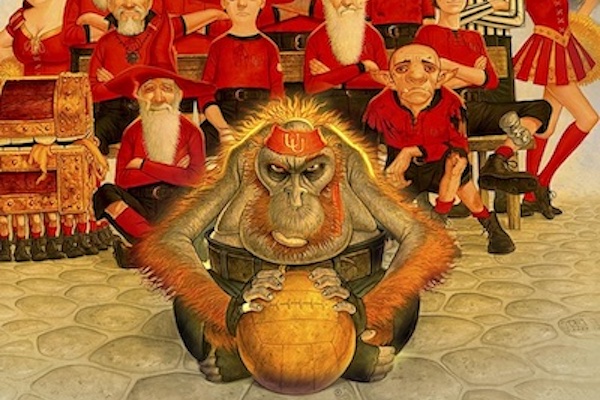
Psst. Come here, I have a secret to tell you. From one godless monkey to another: up until the point that God actually proved to be real in the BSG universe, I really enjoyed the religious aspects of the show. I found it fascinating that a race of machines could have a monotheistic culture and that the human race was polytheistic. It was not lost on me either that the monotheistic culture waged their own form of ethnic cleansing upon the religiously misguided humans. Be that as it may, what really pulled me in was the process of mulling over how a race of machines could find religion in the first place, and secondly, why the humans were polytheistic. I certainly didn’t expect that the war they were fighting was a conflict waged by proxy, with Cylons and humans as mere puppets, with Almighty God on one side pulling His strings and the six gods on the other side pulling theirs. I knew I wasn’t watching a story akin to the Iliad. I could tell that the story was driven by the characters who were actually onstage—not by God or the gods. To think otherwise would have been downright foolish.

I am only half the fool, it turns out. Understand though: I am not the fool because I was wrong. I am the fool because I thought RDM & Co. were honest brokers. Silly me. I believe it was John Joseph Adams, one of Tor.com’s bloggers and member of the BSG Roundtable, that succinctly said, “Ronald D. Moore is dead to me.”

Actually, it’s worse. His characters are dead. All of them. They’ve been gutted, fileted, and hung out to dry. Their eviscerated husks are nothing more than bitter memories of what could’ve and should’ve been. This is what happens when writers run away from their own story, when they forego the most basic rule of writing: don’t lie to your audience. Don’t dupe them. Don’t you dare take their intelligence and treat it like toilet paper. Don’t. You. Dare.

But they did.

You know what a deus ex machina is—even if you’re unfamiliar with the term. It’s when some cheesy plot device comes out of nowhere to solve all the plot problems of the story, rendering useless all the previous plot struggles that had come before it. Remember the TV show, Dallas? Bobby Ewing was dead, right? Wrong! It was all a dream! It was a dream! Some stupid moron had to have a dream in order to bring Bobby back. Science fiction doesn’t have to use dreams though, because we have way-cool high tech devices like nanotechnology, and AI—but in BSG’s case, they couldn’t even do that.  They went to God Himself.  Pah!

For those of you who respectfully disagree with the notion that God suddenly came out of the blue, that Head Six (Baltar’s seemingly imaginary friend) was somehow adequate foreshadowing that God really was at hand, my question is this: how? A predictive Head Six (who claimed she was an angel) was no more a hint of God’s true existence than the predictive Oracle of Pithia was for the actual existence of the six gods. They both felt mystical, yes; they both felt supernatural, yes; but there was nothing about these two parallel story lines that couldn’t be explained by the elements that had already been introduced in the story.

Hence, what we have here folks—God’s master plan brought to you by those two ravishingly good looking angels—is a classic deus ex machina. And a huge one at that. As H.G. Wells himself said regarding the deus ex machina, “If anything is possible, then nothing is interesting.”

Well, with God, anything can happen.

But you know what? Anything can happen in fiction, too. God could’ve been in this sci-fi story without it having to be a deus ex machina; God can be in any science fiction story as long as it’s structured properly.

Ah, there’s the rub. Structure.

You see, deus ex machinas come in all shapes and sizes. Some are annoying. Others are downright destructive. The annoying ones tend to be one or two steps beyond the interior logic of the narrative; but the devastating ones literally transform the inherent structure of the story—and that’s exactly what RDM & Co. did to BSG. They destroyed their own story.

If you don’t quite yet see what I mean, well, believe me, you’re not alone because I know damn well that RDM & Co. are absolutely clueless. This is why I’m going to address the mini-lecture to them since they’re the ones who are responsible for this fiasco.

Note to BSG writing staff: ever heard of a character story? Well, if you haven’t, then I suggest you watch your own TV show for the last four seasons up until the very last hour of the finale—because that’s exactly what you guys had been writing up until God showed up to save the day. Ever heard of an idea story? Hint: watch the last hour of the finale that you wretched souls vomited upon us and that is precisely what an idea story is. These are two different story forms which make completely different demands upon character and plot—but don’t take my word for it. Orson Scott Card elucidated upon these story types in his how-to book, Characters & Viewpoint.

BSG’s main characters were fully realized, breathing human beings—steeped in dire conflict, both internally and externally, all of whom were suffused with the desire and a willingness to change not only their station in life, but themselves. Ergo: a character story. An idea story is cut from a different cloth. It is meant to emphasize an idea, not a character or characters—in fact, the idea itself is the main character, and everyone else its subject. The characters serve as the idea’s vehicle, its agent. They must act on its behalf. Sure, the characters are determined; sure, they are idiosyncratic, but they are also two-dimensional because the idea itself must be fully explored. Characters following God’s master plan is a perfect idea story. In fact, characters following any master plan is an idea story.

Remember Isaac Asimov? He wrote idea stories. He wrote great ones, like, say, the Foundation series. Psychohistory was the idea. Psychohistory was the main character. Psychohistory was also a plan; a plan of cosmic reach, of God-like reach, sweeping across the ages to help mitigate the devastating effects of the fall of the Galactic Empire.

The key here is not that Asimov wrote a cool idea story. The key is that he constructed the story in a manner so as to inform the reader that it was an idea story. This is what competent writers do. To wit: Asimov introduces Hari Seldon (the inventor of psychohistory) and then unceremoniously leaves him behind. Because, you know, there’s a story to tell, and it sure ain’t about Hari. The narrative leaps forward in time in order to prove out the progress of the plan. New characters are introduced while previous ones fade away. It becomes pretty clear fairly quickly that Asimov doesn’t want you to get attached to his characters—he wants you to get attached to his idea. When he actually does spend some time with his characters they are necessarily clever and resourceful, but they are also necessarily two-dimensional (determined with a goal). They are never ever a threat to upstage the much more fascinating and complex main character of psychohistory.

So yes: fiction is the art of the lie, but you have to be upfront and honest about the nature of your lie; and once you have the reader’s (or audience’s) trust, you are then honor-bound to hold true to the story’s form—all the way through to its end. Let me repeat: THE STORY MUST HOLD TRUE TO ITS FORM ALL THE WAY THROUGH TO ITS END.

And that’s where BSG blew it. By radically—and suddenly—shifting the story’s emphasis from character to idea RDM & Co. not only violated the tacit agreement between storyteller and fan, but they exploded the internal engine that had been propelling BSG forward since its inception: its characters. This is not only a betrayal to the fans, mind you. This is a betrayal to the art of fiction. Look, the hard truth about fiction is this: form follows emphasis, yes; but expectation follows form. Character stories are resolved by their main characters—they themselves are the agents of their own change. Period. That’s the expectation. End of story. Therefore, I watched with boiling blood as some of the most fully realized sci-fi characters of all time, characters that I surely thought were on the verge of determining their own fate, suddenly became subservient to God’s master plan. Suddenly all their free will coagulated into an ugly red herring. All their angst, inner conflict and hard decision making suddenly lost all relevant meaning—the meaning that comes when a character affects change and he/she is ultimately the one who is responsible for it.

Folks, what I watched wasn’t the art of creating fiction. What I watched was the art of dismantling it.

As the final hour excruciatingly limped towards its end, one unbelievable plot point proceeded to follow the next: the centurions departed to find their own destiny; everyone disavowed technology; everyone spread out over the globe so they could starve to death. It was surreal. If BSG had still been an inkling of its former self, those 3 key decisions alone would have fueled enough conflict to justify 3 more seasons of the show. Instead, our tragically hollowed out characters effortlessly made their decisions and everyone else didn’t even blink; they simply followed en masse, like a hive mind, or worker bees, dutifully serving the (cockamamie) plan.

Then it got worse.

The story launched itself 150,000 years into the future. It was clumsy and jarring, but really, what else were the writers supposed to do? They had an idea story on their hands, and like Asimov’s Foundation series, they had to jump the narrative forward in order to show the fruit of God’s labor.

Which is us, of course. We are the fruit of God’s labor, and that leaves us with one last nugget to choke on: Hera. Ah, yes, precious Hera. She is our mitochondrial Eve. She was half human and half Cylon—and that has truly been our salvation, has it not? For let’s not forget, the Cylon god proved to be the one true God. And while we, as Hera’s descendants, have developed throughout the ages, building vast empires and constructing tall cities, we have obviously learned to embrace our inner machine, and in so doing, we have embraced the grace of God. For today, God is worshipped by over 2 billion people.

Wow.  Maybe it’s time for the centurions to come back, don’t you think?  We could all sing “Kumbaya.”

Let me move on.

Say what you will about Battlestar Galactica, whether you want to marvel at its gritty realism, its amazing action sequences, special effects, its top-notch acting and directing, or its inspired musical score—the heart and soul of the show was its characters. Yet no longer. Just like Kara, their very souls have popped out of existence, fully dissipated within the skeletal remains of a once potent character story. For what we have left is nothing more than an empty grasp of lost possibilities, that never-ending guessing game of the coulda and shoulda beens. Because in fiction, there’s a good way to lie and there’s a bad way to lie, and if you ask me, someone ought to develop a polygraph test for the Ronald D. Moores of the world—to keep writers like him honest—so we can keep vivid and fully realized characters true to form, to watch them live and die in the manner by which their world was built: in character.

So say we all.

ReddIt Stumble Upon del.icio.us Digg It Send via Mail
BOOKMARK
PRINT

categories: TV
tags: Battlestar Galactica, angry fans

53 comments
Sterling Anderson
1.  sterling
VIEW ALL BY · Tuesday April 14, 2009 04:01pm EDT
I didn't have too much of a problem with them ending the series in a fluffy way. I guess I could buy the Centurions just jumping out. Whatever. But yeah, spreading out over the earth... That was just ridiculous. They've got like 40,000 people and they all just agree to split up and abandon every comfort they know? That's bull.
Meagan Brorman
2.  nutmeag
VIEW ALL BY · Tuesday April 14, 2009 04:03pm EDT
What you say makes a ton of sense. I've been telling myself that though I believe in a God who is not a puppet-master, I was ok with the ending of BSG because the god it referred to may have not been the same one I believe in. But my mind still couldn't completely rest with the finale.

You're right. If BSG had been an idea story, I probably would have been perfectly fine with the puppet-master dictating every characters' moves, because we would have known that's what kind of god it was. But the story led me to believe that the god mentioned was my God, the one who doesn't dictate human actions, because these characters definitely made their own mistakes. Changing the character of God to god at the end changed the entire story-line.

RDM did lie. He lied about the most important character (according to the finale)--God.
Turnt
3.  Turnt
Tuesday April 14, 2009 04:06pm EDT
You godless blokes need to get over yourselves. We get it. The story didn't end the way YOU wanted it to. Technology and science didn't have the key to it solving it all, you're enraged that you WERE INDEED taking in a religious show.

So what? Enjoy the eps on DVD that you liked, and never watch the ending again. I'm pretty sure there is some good fan fiction out there with alternative endings.

Feast.On.That.
Turnt
4.  Turnt
Tuesday April 14, 2009 04:08pm EDT
Sterling,

The people decamping on the planet were pretty loaded down.

They had lots of technology and knowledge to make their lives completely comfortable.
Turnt
5.  TravelingAnn
Tuesday April 14, 2009 04:11pm EDT
Bravo!
I said it at the time, there is a difference in the characters being spiritual and believing in God, and having God be responsible for what happened.
But you said it much better. Thanks!
Jason Ramboz
6.  jramboz
VIEW ALL BY · Tuesday April 14, 2009 04:17pm EDT
I can only hold out hope that maybe, one day, we'll get an extended remake of the end of the series, something like End of Evangelion.

And I'm getting really sick of people making this about religious vs. non-religious people. I am a religious person who believes in God, and I still thought the ending sucked more balls than a vacuum cleaner in a McDonald's Playland. It was just bad storytelling, plain and simple.
C.D. Thomas
7.  cdthomas
VIEW ALL BY · Tuesday April 14, 2009 04:24pm EDT
"They had lots of technology and knowledge to make their lives completely comfortable."

Uh, no.

How many doctors were in the Fleet?

Without the density of villages/cities, how would those doctors serve the remaining population scattered on Earth?

Wouldn't those with chronic conditions, complicated pregnancies, traumatic injuries fester and die without the societal framework their medicine relied on?

That statement is full of more bollocks than having a weary and divisive population (remember they *mutinied* over a lesser change to their lifestyle?) vote completely to destroy their culture and live as animals on Earth. What sort of God demands that? At least Moses' people knew they could survive harsh desert conditions, and weren't on a planet where alien viri and bacteria could kill them.
C.D. Thomas
8.  cdthomas
VIEW ALL BY · Tuesday April 14, 2009 04:28pm EDT
And incidentally I *loved* BSG when it was a religious show... that dared to feature more than one god in force.

Making one god win, then destroying the culture that worshiped otherwise, is too Old Testament for my taste, especially when the heart of the show was in having people (incl. Cylons)learn how to make themselves over as better people, whether or not they were religiously minded.

Their agency as beings was important for the majority of BSG; too bad the writers punked out at the end.
Turnt
9.  Turnt
Tuesday April 14, 2009 04:29pm EDT
"Wouldn't those with chronic conditions, complicated pregnancies, traumatic injuries fester and die without the societal framework their medicine relied on?"

Human society has faced those problems for thousands of years without today's complex technology.
Turnt
10.  DG Lewis
Tuesday April 14, 2009 04:34pm EDT
Wow. I never even watched BSG, but that was a truly outstanding rant, entertaining of its own virtue.
Tudza White
11.  tudzax1
VIEW ALL BY · Tuesday April 14, 2009 04:36pm EDT
I believe the only real problem was the decision that this final planet had to be our Earth. To have our planet be the way it is now given the arrival of space travelers, the characters had to make many truly weird decisions. They had to space all their technology so it wouldn't show up in archeological digs, spread themselves thin to explain why we don't find their remains, etc

I'm not sure where this rant about god comes from at all. As I remember it, things came about the way they did by god's plan mostly because the characters said it was so. That's pretty much how it works in the real world.

Ignore the final scene with Baltar and everything is fine, the writers did in fact write a shitty last few minutes.

As for the magical disappearance of Starbuck, I will forgive them since it is totally unexplained. No one delivered a 20 minute monologue on the disappearance of Starbuck, she just went poof. The rest is left as an exercise for the viewer.
Turnt
12.  Ambulant
Tuesday April 14, 2009 04:53pm EDT
But the notion that God might be real was raised as early as the mini-series, and as you suggest concepts of faith provided a substantial ongoing theme for the show as it developed. So depending on your perspective, any of the three possible answers the writers could provide to the obvious question ('God exists', 'God doesn't exist', 'we're not telling') could be seen as lame if that wasn't your own preferred conclusion.

What I think *was* wrong with the final season was that the writers just tried to cram too much in - it was scrappy and felt like an early draft, or too many different drafts jumbled together to reach a compromise.
James Goetsch
13.  Jedikalos
VIEW ALL BY · Tuesday April 14, 2009 05:24pm EDT
You have articulated very clearly the way the finale retroactively ruined the entire series for me. I wasn't enough that they wrote a bad finale, but they had to do it in a way that poisoned all that had come previously. I so wish the show had been canceled after the first two or three seasons.
David Spiller
Sol Foster
15.  colomon
VIEW ALL BY · Tuesday April 14, 2009 05:40pm EDT
I'm not going to tell you the end of the show was perfect; it clearly had some clunky bits.

But as far as I'm concerned, the revelation that divine forces were at work was a nearly perfect surprise ending, because seemingly no one was expecting it (certainly not me), and yet it makes all the previous pieces fit into place nicely, so that you pretty much have to look at it and say, "Of course that's how it had to end."

I mean, just look at the speculation on this blog leading up to the last episode. "Starbuck is the daughter of Daniel, and she resurrected at a resurrection engine left on Earth." Right, and her Viper was secretly a Cylon, so it resurrected too? "Our heroes will travel back in time at the end of the last episode, and that's why prophecies came true." And Head Six's little detailed short-term prophecies were implanted in Baltar's mind how?

(BTW, I thought I remembered supernatural stuff from the original Galactica series as well, and a quick check on the Wikipedia page shows they encountered the a Devil-figure and a race of angels (the "Seraphs") who were looking out for humanity...)
Turnt
16.  MrWesley
Tuesday April 14, 2009 05:44pm EDT
Ignoring for a second that the last hour of the show was pretty... I guess "insulting" is the best word (and I say that as fairly conservative evangelical), I have a question:

Would ANY ending have been any more fulfilling than the one they gave us?

Knowing that THIS was what Moore was aiming for through the entirity of the show, that THIS was what all the clues and hints were pointing to, would any other resolution have been any more satisfying than the one we got? Or would we be bitching about something else?

The complaint, in it's most basic form, is that Moore tied things up too neatly for a a program where ambiguity was a primary characteristic. However, when we look at other highly admired/cult-like shows, like the Sopranos, the creators are blasted for leaving the ending too ambiguous.

Either the ending is too ambiguous or too neat. The expectations were set so high with this show, that I don't think anything he did would make us, as fans, happy. So instead, he did what he wanted, what he always set out to do.
Dayle McClintock
17.  trinityvixen
VIEW ALL BY · Tuesday April 14, 2009 06:03pm EDT
I love this explanation for why the ending was so WTF.

The important thing about God, character vs idea or no, is that the show never put him/her/it on any one group's side. The only power God had in events was in how people believed in him/her/it/them. If the show had ever considered itself an "idea" story, that idea was that God was only as influential as the strength of belief in him. Turning that around to God believes in us is bullshit.

And I keep coming back to Douglas Adams:
Now it is such a bizarrely improbable coincidence that anything so mindbogglingly useful could have evolved purely by chance that some thinkers have chosen it to see it as a final and clinching proof of the non-existence of God.
The argument goes something like this: "I refuse to prove that I exist," says God, "for proof denies faith, and without faith I am nothing."
"But," says Man, "the Babel fish is a dead giveaway isn't it? It could not have evolved by chance. It proves you exist, and therefore, by your own arguments, you don't. QED."
"Oh dear," says God, "I hadn't thought of that," and promptly vanishes in a puff of logic.
Ian Tregillis
18.  ITregillis
VIEW ALL BY · Tuesday April 14, 2009 06:22pm EDT
@17:

Speaking of Douglas Adams, it's been pointed out (in the comments here) that the BSG finale comes almost straight out of The Restaurant at the End of the Universe.

Both involve a guy in a bathtub taking the dregs of society to prehistoric Earth.
C.D. Thomas
19.  cdthomas
VIEW ALL BY · Tuesday April 14, 2009 07:22pm EDT
"Human society has faced those problems for thousands of years without today's complex technology."

Yes. And it was called 'culling the herd'.

With a population with the diseases of civilization, war, famine and stress deciding to survive on a subsistence basis, without even tech that could help their precious children survive (on Cylon and human sides)? Well, I'll let Ms. Snodgrass speak for me on this:

"Let’s see -- no antibiotics, no modern medicine, no books, no learning once you’re past the third generation. Hope everyone was looking forward to death during childbirth, astounding infant mortality rates, starvation, death due to exposure. And the argument that this commune life-style was somehow going to break the cycle of violence? Oh please, the Roman conquests, Gengis Khan, the Crusades, Jihad, the Inquisition., the holocaust. Yeah, that really worked."

And she didn't mention diabetes, heart disease, aneurysms, sepsis -- or did the people having those diseases in the Fleet sin more in the sight of God, and thus should die quicker?

To see a group of genocided people to let nature and their own self-revulsion take them the rest of the way to extinction, well, that's an ending that rejects its audience as well as its own characters' right to exist with some semblance of dignity.
Luke M
20.  lmelior
VIEW ALL BY · Tuesday April 14, 2009 07:47pm EDT
Would ANY ending have been any more fulfilling than the one they gave us?

I've seen this question before, and I still contend that everybody dying would've been better. Seriously though, starting from there you can build a much more fulfilling ending. Here's a quick rundown of my ending, which I just decided a few minutes ago:

A few people survive in Raptors and Vipers, but Galactica along with most of its crew dies a spectacular death in the battle. Starbuck, Hera, and take your pick who else make it out alive. Lee probably, but not the Old Man or Rosalyn though, they have their tear-jerker goodbye as they go down with Galactica. The rendezvous coordinates are lost, so the fleet is never seen again. Starbuck finds Earth with Hera's help and the survivors are stranded because the essential support for the Raptors was destroyed (Galactica) or lost (the rest of the fleet). The last we see of our characters, they attempt communication with the natives. The natives point their weapons at them, shouting in an unrecognizable language. Hera steps out from behind Starbuck, and the weapons are slowly lowered. Fade to black, roll credits. During the credits is almost the same robot and news report montage, sans Head character commentary.

Key points:
Starbuck doesn't up and disappear.
Head characters are never shown to exist outside of Baltar's and Caprica Six's heads, so they never pop up and say, "Tada! It was God's plan all along!"
Nobody willingly gives up all comfort to become subsistence farmers; their few ships just can't go anywhere.
Hera actually does something more important than just being Mitochondrial Eve.

Anyway, I'm no writer, but would anybody seriously have been angry if, just like the other 50+ hours of the show, God didn't directly intervene in the last few minutes?
Turnt
21.  RyanA1084
Tuesday April 14, 2009 08:08pm EDT
Amen. You nailed it. Thank you for writing this. I tried to explain to myself why the ending was so bad but you hit it dead on: they switched from a character story to an idea story at the last minute.
Turnt
22.  Turnt
Tuesday April 14, 2009 08:12pm EDT
"the revelation that divine forces were at work was a nearly perfect surprise ending, because seemingly no one was expecting it (certainly not me), and yet it makes all the previous pieces fit into place nicely"

Well said.

Everyone else is having a anti-religious moment.
Andrew Gray
23.  madogvelkor
VIEW ALL BY · Tuesday April 14, 2009 08:24pm EDT
I dunno, I still think the ending was one of the obvious ones they could have gone with based on what had gone before in the series. Some greater entity had been obviously directing things all along. There was too much coincidence for there not to be.

Now, just because that entity happened to be what the Cylons were calling God doesn't mean it was God, divine, supernatural, or anything like that. And there's still a question of what the Lords of Kobol were, and if they were real.
Turnt
24.  Brad Templeton
Tuesday April 14, 2009 08:37pm EDT
You'll find a kindred soul in my own posts on the subject, in the special sub-blog I made about BSG at [url]http://ideas.4brad.com/battlestar[/url] -- but let me quibble on a few things.

I think you can tell an idea story and a character story together. It's just hard. You need great ideas, and then you need to be very good at creating good characters who will live in your world, but not be subordinate to it.

I got so involved in BSG because that's what I thought they were doing. Dealing would good SF ideas -- the conflict of man and machine, the nature of what it is to be a thinking being, what it means to have copyable beings who can download and plain old space opera chase-through-space. And then filling that setting with characters and story that were worthwhile in their own right.

What's said is that it only takes a few minor tweaks of the story to get both. The most obvious alternate was to set it in the future (as all the clues said, and reality demands) and give it a "Planet of the apes" ending where they come to a fallen Earth with primitive humans who they learn are their long lost cousins; they learn their own home planet Kobol was a colony of a lost civilization (ours) and they have to try to make it work.

Curiously, Moore said he set it in the past and did all the stupid tricks to make Hera be our ancestor because he thought it was necessary to make the story "relevant." In fact, by doing that he made it less relevant to our reality. Now the connection to us obviously false. We are not really descended from Cylons, the God isn't real, you don't get aliens interbreeding with natives, not in reality. Set in the future the connection is much more real. As in all future SF, it's "This is something that could be our fate." Not good enough for Moore. He got, "here's something that, while obviously not our origin, I will write as our origin."

You may also like my essay on why you don't want gods in your fiction, not real ones. Gods move in strange and mysterious ways. If you can understand them, they aren't really gods, and if you can't understand them, you end up with fiction that the reader can't ever understand. Things happen and there is nothing to identify with because they just come from divine fiat.

So sad. BSG was on the verge of being the greatest SF TV ever, and it threw it all away in one hour. It remains good SF TV, but it's no longer possible to view it as great when you have to interpret it in the light of the creator's bizarre actual backstory.
Turnt
25.  Radynski
Tuesday April 14, 2009 09:27pm EDT
I just don't understand how you can find out that God was nudging Baltar and Six and Starbuck in specific directions, and then decide that it means that none of the characters had free will throughout the entire course of the series.

At no point during the series did I feel that God was in charge of the characters decisions, and that free will had disappeared. If that were the case, I wouldn't have watched it in the first place.

So then why does the ending make people want to masochistically ret-con God into everyone's decision-making?

Do you really want to hate it that much that you don't even think rationally about it?

God existed, but people weren't puppets. Free will existed, just like in the real world. God just tried to nudge them in the right direction. And for that matter, didn't always do a very good job of it.
Turnt
26.  skunkman62
Tuesday April 14, 2009 09:44pm EDT
4. Turnt "They had lots of technology and knowledge to make their lives completely comfortable."

i don't know about that. they settled on new caprica for a year before the cylon occupation and still lived in tents.

btw, i agree with the article. however, ron and company gave us are great ride for 4 seasons and most series finales do suck, so gets a pass from me.
Turnt
27.  Brad Templeton
Wednesday April 15, 2009 02:06am EDT
Radynski, if you look at all the elements of the show that turn out to be only explained by the intervention of the god, it quickly becomes immense, in fact it quickly becomes almost everything of importance. Just that "Opera House" scene requires so many things to have taken place for it to happen, all pre-planned by the god and sent to various characters as visions.

If you prefer, it was all predestined and the god just knew the future. Same difference. No free will at all in this case.

I put a list up on my blog of the things the god had to have done, but while long it is incomplete. And it eliminates the meaning of most of what the characters did. And worse, a lot of it is incoherent, in that it makes no sense, and we just have to take it as a god working in strange and mysterious ways. Gods can do that but writers should not.
Turnt
28.  stargazer
Wednesday April 15, 2009 03:53am EDT
In my life I've been a believer and an atheist both, and these days I consider myself agnostic, so the fact that I found this conclusion shockingly bad is not due to any antipathy towards religion. It's just plain bad storytelling, as many others here have said already.

The real problem with the "God did it" ending is not the presence of God, it's that it's a completely terrible and unsatisfying approach to storytelling. There's no internal consistency to the narrative. If God exists and is manipulating things behind the scenes, then why is he/she/it doing such a colossally bad job of it? If God's ultimate goal is to have Hera end up on Earth to crossbreed with early Homo Sapiens, aren't there easier ways to accomplish that which don't involve the genocide of billions? Why couldn't God have simply sent some Head character visions to Helo and Athena suggesting they get together, have a kid, and go hunting for Earth? Why didn't God make this goal clearer somehow to his/her/its Cylon worshippers ahead of time? Maybe send a vision to Cavil promising immortality as a transcendent machine mind if he would please deliver Hera safely to Earth rather than taking her apart and trying to kill everybody else? If God's plan had to involve billions of people on twelve planets getting nuked in order to create another planet full of suffering people fighting one another anyway, then (a) what was the point of all that, and (b) why the frak should we like that God, anyway?

The writers didn't even attempt to answer any of these questions. There's no evidence that they even thought about them. Moore and company simply invoke an omnipotent, unknowable being with an inscrutable plan to cover over the fact that their own plan for the series was apparently lacking from the beginning.

Look, this stuff's hard. Philosophers have been wrestling with the problem of evil and the existence of God for all of human history. If you want to say something meaningful on that topic, then you need to think it through. You need to write the Idea Story from day one. That could've been a great show - but (as has been said) that's not the show BSG started as.

The first, best parts of BSG were about how people (characters!) respond under circumstances at the breaking point and beyond; how people react and fight and struggle to keep reaching for their goals no matter what; how dire needs can push one to shocking betrayal of friends or new alliances with old enemies. Those are stories with meat and meaning. In the real world, terrible things happen, people have to deal with them somehow, and we never get to know if there's truly any reason why.

To put the characters of BSG through hell and high water, and then say it was all God's infallible plan all along, without ever remotely addressing what that means for notions of free will and suffering - that's a betrayal not only of those characters, but of any concept of meaningful and coherent storytelling at all. To have characters who fought tooth and nail to survive and maintain their society suddenly decide to revert to hunting and gathering with nary a dissenting voice adds insult to injury. It's incomprehensible, incoherent, and inconsistent with all that came before. I agree wholeheartedly with Brad Templeton @27: perhaps God can do that, but writers should not.
Turnt
29.  clovis
Wednesday April 15, 2009 08:55am EDT
Good analysis of two different story tropes. I might add a third, plot driven stories (eg James Bond where characters do idiotic things in order to allow the plot to continue, as mocked in Austin Powers). The problem with the Rendezvous with Rama sequels were that they were character driven stories while Rendezvous was idea driven. I haven't seen the Battlestar climax as I was unimpressed with the fourth series and the first two episodes of the fifth. Like Lost (gave up after first series) the 'oh god [pun intended] we've written ourselves into a corner' factor was becoming far too obvious and I understand that the writers had not set out with an overall story arc.
Turnt
30.  Mighty Marc
Wednesday April 15, 2009 10:15am EDT
Nice diatribe. But it's bull. The best you could do is perhaps argue BSG remained a character show up until the last scene. But in fact, the last scene fits nicely.

I can't remember the quote exactly, but the final comment made by Head Six was about how a repetitive chaotic system will inevitably produce something surprising. The implication of the last scene is that the characters broke the destructive cycle by abandoning technology. Something different is going to happen and we don't know what it is. And the further implication is that we actually *do* live in a chaotic system.

That's the free will angle you missed.

To say the last hour of the last show "ruined the characters" is disingenuous. You're jumping to conclusions that stem from your own interpretation of the last hour and from your disappointment that things didn't unravel the way you wanted them to. All quite understandable, and I applaud you for trying to rationalize your disappointment, even if I disagree with your rationalization.

Your post was an otherwise interesting read.
Matt London
31.  MattLondon
VIEW ALL BY · Wednesday April 15, 2009 03:41pm EDT
This finale vindicated me. I lost faith in BSG a long while ago.

The painful inconsistencies throughout the series, both plot and character, are too numerous to list. So to me, the series as a whole led quite naturally to this climax. This was not the first time RDM et al displayed a complete lack of respect for their characters. Episode to episode, Starbuck, Chief, Baltar, and Tighe time and again were twisted from sympathetic to antagonistic, back and forth with little or no regard for the arcs these characters were following. Frequently the twists were so riddled with continuity errors, it seemed obvious that the writers were guilty of cheap manipulation. Callie's half-human/half-Cylon baby? Ret-conned. Baltar giving away the nuke to allow for genocide to take place? Ignored. Daniel? Forgotten. Apollo's imaginary friend Starbuck has an imaginary friend that plays the piano? The absurdities go on and on.

This finale was an admission of guilt.
Turnt
32.  Chris T*
Wednesday April 15, 2009 07:24pm EDT
This is a good post, articulating the reasons why I was unsatisfied with the finale.

For me the most natural and best ending for the series would have been when they found earth at the end of the first half of the first series (4.0) and found a barren radioactive wasteland.

This was a punch the air moment:

* it was surprising;
* there was an emotional pay off that wasn't cheap;
* It had the relevance that Moore wanted
* and, as Brad Templeton puts it, "This is something that could be our fate."
* There was closure with the Humans and Cylons finally making the peace which we Earth people never could;
* and it was realistic: there was another colony but it didn't learn the lessons that the BSG crew did and so ultimately failed;
* ie. the BSG crew have actually become heroes through their own actions and decisions.

Sure this ending doesn't explain everything and give all the characters closure but that's ok. The BSG writers' insistence on tying up all the plot arcs in this series with a ribbon and a bow has been one of the shows most glaring and consistent short-comings.

Sure it was a bit of a downer but that was balanced out by the surprise. But most importantly for the network and us viewers it left the door open for a new series with some or none of the old characters and actors should there be any interest - and, most importantly, once someone has actually thought of a new, *interesting* story arc for a new series, one that would be more interesting than that stupid, reactionary revolution arc and the silly ending that we got.
Turnt
33.  PhilipJaques
Thursday April 16, 2009 01:32am EDT
THANK YOU!

Ever since the show's finale I've been looking for the words to express my discontent and you just said them all.

Perfect analysis. Well put. Thank you for putting my feelings into words.

Unfortunately, I'll probably watch Caprica anyway. The setting looks so cool. Aw shucks.... everyone deserves a second chance.

But that's all you get, RDM. If you mess this one up too, then you'll be dead to me as well.
Turnt
34.  clovis
Thursday April 16, 2009 09:06am EDT
I can't help but feel that J M Strascinsky (apologies for almost certainly misspelling his name) rather complicated things with Babylon 5. Since then SF series seem to have an urge to have an overall story arc which has to be resolved by series end. Now I greatly enjoyed B5 and loved the story arc element, but perhaps it needs a rest. Part of BSG's problem appears to be that a resolution was required and the makers' have failed to do so to the satisfaction of many of the viewers. Perhaps a return to self-contained episodes is called for. This would also have the advantage of it not being a disaster if you miss one. After all, Star Trek and Dr Who became the two most successful SF shows ever without story arcs or concluding stories. Sometimes an open ending can be more dramatically satisfying, personally I would cite Twin Peaks and American Gothic. Could BSG ended in this way? I don't see why not? After all, you can never go home again.
Turnt
35.  dcole78
Thursday April 16, 2009 12:28pm EDT
sigh....you know it is possible for sci-fi to be anti technology and to be anti-technology run amok. In fact that is how it STARTED. We forget but Jules Verne was an enviormental terrorist, or at least nemo was and it was obvious where Jules Vernes loalties lay. Sci-fi in NO WAY has to be atheistic to be sci-fi or does it have to be pro techonolgy.

The lie to your it doesn't fit with the characters, comes in that many many many of us predicted the ending the way it happened all most to a T. It became quite obvious even after they found the dead earth that were going to end up being our ancestors (I mean come on remember the opening to the original series).

Given how there technology had all most KILLED THEM ALL. Giving it up to go back to nature al la transcendentalism makes perfect sense. As the captin said there was more different forms of life on that one planet than there was on all the twelve colonies. Living in space without nature is NOT something to look forward to or to expect people to enjoy. Read some Le'Guin...(sigh)

I just really don't understand the hatred for this ending, will comment more later have to go teach chemistry now.
Eric Tolle
36.  ErictheTolle
VIEW ALL BY · Thursday April 16, 2009 02:24pm EDT
dcole78: Actually, Nemo was a political, not an environmental terrorist. This is the guy who used the Nautilus to slaughter a herd of "Cachelots", remember.

And while it is perfectly possible for SF to be anti technology, that's still no excuse for poor writing and characterization.
Turnt
37.  Niall7
Saturday April 18, 2009 06:32am EDT
I started watching BSG last week and finished the final series last night. The "God did it" ending that so has so many people up in arms isn't as out of the blue as some seem to feel. God's plan for humanity is an important part of early episodes. It becomes pretty obvious that there is something more than human at work when Baltar manages to guess the location of a vulnerable spot of a cylon facility on the asteroid filled with the fuel humanity needed.

It also seems obvious though that the writers started to confuse themselves about half way through the run. So much of what happened seemed needless. We never learn about the LOC and there's no adequate attempt to explain why it was God went such a convoluted way of going about getting humanity and the cyclons from point x to point y. I imagine that the writers might suggest that it was about teaching the characters the lessons they needed to learn in order to arrive at a proper understanding of humanity's past mistakes, but the problem is that only a few people arrived at the requried conclusion. The colonists abandoned technology for no apparent reason simply because a couple of leaders told them to, which was utterly weird given past events. And as for Starbuck? What the hell? She's an angel? Just like H-Baltar and H-6? If that's the case, a small scene showing her interacting with the pair and accepting her transcendence and her new position alongside H-Baltar and H-6 as a guardian of creation might have made things a little better.

Still, I do think that people seem to have lost perspective. The finale is deeply flawed, but it is only because of the high standards set during earlier episodes that expectations were so high. I've really enjoyed the last couple of weeks and while the finale could have been better, it could have been much worse.

Bring on the Lost finale.
Turnt
38.  Weatherwaxx
Monday April 20, 2009 12:57pm EDT
I'm glad you wrote this so I didn't have to. I was getting "Battlestar fatigue" from the endless grim body count. (You've explained why I never could get into the Foundation series, too. It was an interesting idea, but I never cared much about anything that happened to anyone. Read once, never again.)

I don't think objecting to the finale is 'anti-religious.' It's anti-bad-writing. And it's another case of a deity who sits back and allows immense pain and stupidity and then steps in to keep the human race from wiping itself out... apparently for its own amusement.

Well, if a human behaved that way, we'd call him psychotic. Saying it's god moving in mysterious ways... oh, puh-lease. (No, I'm not a bible-worshipping Christian. I've read it. I'm not impressed. It contradicts itself constantly and I see it as a badly edited anthology, not holy writ.)

The absolute last straw was Kara Is Teh Angel. Resurrecting Kara? Well, all right. But resurrecting a frakkin' VIPER?

I will quote Captain Kirk from one of the old Star Trek movies: "What does God need with a taxi?" Or, more to the point, what does 'he doesn't like to be called god' need with a Viper?

These people had lived in tents on New Caprica. They knew what happens when your antibiotics run out and you have NO natural immunity to the new environment. And yet all of them unanimously decided to throw their livesaving medical technology away and go back to stone knives and bearskins?

BULL! If you find that plausible, try talking your own extend family or a circle of 10+ acquaintances into a camping trip for a single weekend.

I'm not going to bother watching any more of Ron Moore's work. He dragged us and a stellar cast along for four long years, then vanished in a puff of pixie dust.

What a scam.
Turnt
39.  Cheri13
Monday April 20, 2009 02:18pm EDT
I have thought about this long and hard. The ending was not what anyone would call a "clever" ending (meaning possibly overthought). After being so caught up in the characters, I called it a "relieving" ending. I was deathly afraid that they would end like the Sopranos. I wanted closure. Call me simple, I don't mind. I tried to put myself in the characters' shoes and figured that I would be willing to take my chances on a beautiful dirtball as I would be sick of being crammed butts to balls on an aging stellar craft. Galactica was dying, options were beyond limited. She was being held together with duck tape and bailing wire, so to speak. The whole "God" thing at the end was not that strong for me to despise it. I look at it as "conscious evolution looking back on itself". Hey, we are all entitled to our interpretations. Mine is that the characters had been traumatized enough and needed something solid to value and build on. Almost hopeful, really.
Turnt
40.  Karie
Tuesday April 21, 2009 01:17am EDT
Yes. Yes, to all of this. Every single word. RDM took my beloved characters and he tore them down and down and down and then, when he should have been building them back up... he completely assassinated them. Irreparably.

Kara was one of my favorite characters. I spent the entire series watching her deal with all of the bad that was thrown at her. Her mother's influence, this so-called "destiny" being forced on her. All the while waiting for the moment when, coming full circle and realizing her worth, Kara would step out of the shadow of destiny and choose her own fate.

And what happens? In the end, some divine power lures her into suicide (for no reason other than cheap shock), brings her back, pulls her puppet strings, and then just snatches her away again.

Where was the character growth? As you said, with this ending, Kara becomes a plot device. She's no longer a character. She's a blunt instrument.

That's not what I signed on for. I fell in love with the characters way back in season one. That's why I stuck with this show, even when it started going downhill in season three. (Who am I kidding? It started going downhill in 2.5 when it started being about the plot-of-the-week rather than the ongoing arc of the characters and their story.) I expected some kind of payoff for that. I started to hope again when RDM began spouting his "it's the characters, stupid" BS. But that was all a lie. A ploy. A hook line to keep us watching.

He made a huge mistake in thumbing his nose at his audience. The disrespect he showed us will surely come back to haunt him.

One final point, just because it apparently needs to be said: I don't appreciate being called a "Godless heathen" just because I think the whole "God did it!" ploy was a cheap cop-out. I've been a Christian my entire life. If you enjoyed the ending, then I respect your opinion, and you're certainly allowed to express it. But if you can't come up with a better way to do that than to attack the faith of someone you don't know from Adam, then please, don't bother.
Ben R
41.  sphericaltime
VIEW ALL BY · Friday April 24, 2009 11:25am EDT
I'd like to focus on one little bit: A fair number of religious people have said that the ending made sense to them because "God" was foreshadowed by Baltar's head Six.

Mr. Bland points out that if you accept that the monotheistic God of BSG was foreshadowed, then the prophecies of Pythia should have been proof of the existence of the Six Gods. (You remember, the polytheistic religion that the humans follow that predicts the future multiple times?) You may focus on the fact that the ending agrees with you but it didn't fulfill the foreshadowing because not all of the mystical elements were fulfilled. Instead, one half of the foreshadowing was true, and one half was a lie.

That can't "make sense." You can't claim that it was expected. It validated your beliefs in order to try to stretch the robot point into our modern world but it abandoned the religious thread that BSG had been building throughout, which involved a serious conflict between two different religious traditions, both of which had some claim to authority.

So no, pretending that it all makes sense despite the massive story flaws just because the overtly religious explanations offered are the same ones that you believe doesn't make it work regardless. It didn't work. It was a bad ending.
Turnt
42.  Ahway
Friday April 24, 2009 04:44pm EDT
As a character driven show, the ending did not work. The character's did not react as we would expect them to do. Giving up all technology when they do not know what kind of environment and dangers they will be facing? Lee taking off and leaving his son? Baltar wandering off to become a farmer? Most importantly, Kara going "poof". She was the most empowered woman on the series. She struggled with her demons, she struggled with her identity but she remained determined and forceful. The sudden "poof" of her existence negated her character totally. Nothing was literally left but emptiness. A better ending more in line with the grittiness of the series would have been an emergency crash landing, the survivors left with nothing facing a hostile environment. Not the idealized garden of Eden portrayed in the finale. This has nothing to do with religion, only an ending that remains true to the characters. God could still have been shown as behind the events, but the characters would not have been negated.
Turnt
43.  Noneofyourbusiness
Friday April 24, 2009 11:29pm EDT
I disagree. God did remarkably little. The characters achieved everything. Of course the resurrection of Starbuck was mystical, but she chose to follow the path that she did. The story remained about the characters and their emotional places to the end, the idea aspect being of side importance.
Blue Tyson
44.  BlueTyson
VIEW ALL BY · Sunday April 26, 2009 11:55am EDT
God is real = the important women are toast?

Ellen (dead) (had a backup plan ;-) )

Laura (dead)
Starbuck (dead)
Dee (dead)
Cally (dead)
Tory (dead)
Boomer (dead)
Cain (dead)
Kat (dead)
Shaw (dead)
Elosha (dead)
Racetrack (dead)

She with cleavage (or MacGuffinage) survives?
Turnt
45.  sara2
Wednesday April 29, 2009 02:49pm EDT
You pretty much covered the bases of the things that had been bothering me. The ending was unrealistic. What happened to any pragmatic voices? Yes, weapons of mass destruction probably had no place in the new world, but they also had what we would call "green" technology. You don't throw out the baby with the bath water, especially when that action dooms you. The thought also passed through my mind that RDM had pimped out Hera to reach his conclusion. Sorry to put it that way, but that's how it seemed. By the end, we knew the Numbered cylons could reproduce if they were "in love." So why lay it all on Hera? I would like to know if RDM planned Hera as "mitochondrial Eve" from the start or if the idea came to him late in the game. I'm not sure if we'll ever get an honest answer to that question, though, because Ron Moore has flip-flopped on several explanations in the past. And the deux ex machina: yes, we'd heard Head Six tell Baltar over and over again about things being part of god's plan, but I never expected that controlling a god. What happened to free will? No, I guess they did practice that in the end, when they decided to commit suicide by leaving themselves helpless in a deceptively beautiful, but ultimately very violent environment.
Turnt
46.  Mr_Humidty
Wednesday April 29, 2009 11:38pm EDT
This is, by far, the best critique of the finale bar none. (And I wrote a good, well-received one on the SciFi forum.) You've described exactly where RDM went wrong. What's particularly frustrating is how, in the enormous delay between production and airing of the finale, we kept hearing all this promising things about it. RDM's saying, "It's about the characters." (Yeah, right.) The cast's uniform praise of it.

Now I can't help but think RDM was a hack writing above his head for much of BSG. That is, who RDM really is is the same guy who was responsible for all that god-awful Star Trek shit.

What's really frustrating is that this terrible ending makes re-watching BSG unlikely. That's because so much of BSG was built on the story's direction and meaning.

BSG was inspired by 9/11 and ran for the entire length of the disastrous Bush presidency. Like the characters, the world has suffered tremendously over the years. What the audience was owed was a moment of understanding or peace or grace on the part of one of the characters' honestly coming to terms with all that was lost, what PT Anderson called the "saddest happy ending." Instead we got a horseshit, "Wizard of Oz" ending.
Blue Tyson
47.  BlueTyson
VIEW ALL BY · Wednesday April 29, 2009 11:52pm EDT
Yep, horrible ending definitely makes it not watchable again (same goes for prequels). Or purchasable, either, of course. :)
Turnt
48.  navboy
Sunday May 03, 2009 09:53am EDT
I liked the whole thing, wish there could have been more episodes to flesh out the ending better and get more into the overarching religious part of it

i'm not religious but i am spiritual, i'm heavily scientific but see spirituality as another equally valid filter on the multiverse we live in, and when i see god or gods evoked in soemthing like BSG i don't kneejerk associate with the the Christian god from the Bible. Because my concept of god is so open and flexible, it didn't really seem like deus ex machina to me - there was a sense of wonder at the higher architecture, and of course i'm still left wanting to know about the messengers and whether AI was part of god or just god was a force of nature - at some scale of complexity, is there any difference between a supreme AI and god as a holistic effect of everything everywhere?

Maybe i'm still holding out hope that more will be explained in the new series (my worst fear is that it'll end up being some sort of Dawson's Creek bs) but we'll see. The only TV i can stomach at all is Deadwood, The Wire, Rome, BSG, and Daily Show / Colbert. I'm still very thankful for the entire BSG experience, especially considering it was on the Sci-Fi channel which is 99% crap, as are most sci-fi movies ever made.

If i found out that the writers turned out to be born-agains or fundies and had an evangelistic agenda, yes, it would utterly ruin BSG for me. But absent that knowledge, the extreme resentment expressed at the god aspect remindes me of my atheistic friends who enjoy all the wonderful intellectual and rational fruits of life, but are missing out the equally powerful and meaningful experience of experiencing life on a different level, one where words and logic are insufficient to express a concept of god, and so just the word itself it used as a signifier to something that can only be experienced, not thought about or rationally understood.
Turnt
49.  Mirko
Monday May 04, 2009 09:18am EDT
Nobody seems to have realised that the Episodes ending resembles Douglas Adam's The Restaurant at the End of the Universe wherein a Captain in a bathube takes the outcasts of Golgafrinchan society to a new world. In the story, Zaphod and Ford also decide to steal a ship from the restarant, which turns out to be a stunt ship pre-programmed to plunge into a star as a special effect in a stage show. Later, Ford and Arthur end up on a spacecraft full of the outcasts of the Golgafrinchan civilisation. The ship crashes on prehistoric Earth; Ford and Arthur are stranded, and it becomes clear that the inept Golgafrinchans are the ancestors of modern humans, having displaced the Earth's indigenous hominids.

I guess they wanted to make fun about the religious right and took the choice of Adams Hitchikers to make it obvious. Too bad, most people cared so much about the show, no one could swollow it. And really,... bad choice to use a Hitchikers idea for a dramatic SF-show! Not to think about making fun about all us SF-fans, too. Hey, we never cared for the show, soooorry.... Bah!
Turnt
50.  ColonelTigh
Friday May 08, 2009 08:29pm EDT
Come on, disillusioned BSG fans and dialectic materialists -- angelic beings are still better than super scouts and flying motorcycles.

Gods and god-like aliens have always played a big role in science fiction. This often adds to the enjoyment of the story, not detract from it.

So, what if BSG has Angels? Star Wars has the Force. Even the staunchly secular Star Trek had the Q. The Q were all-powerful beings which could be construed as gods. The Q could have influenced every event in the Star Trek universe. And the Q as deus ex machina did not make Star Trek less enjoyable.

Without the Q, there would have been no Borg. Without the Force, there would have been no Sith or Jedi. Without Angels, all of the religious conflicts would have been moot.

The BSG finale was great! Long live Ronald Moore.

I find your lack of faith disturbing. *Vader's choke*
Turnt
51.  RufuSwho
Monday October 12, 2009 11:50am EDT
God is in the first episode.
God is in every episode that includes Gaius.
A deus ex machina is an ending that includes plot devices that have not been central to the story line.
BSG's ending =/= deus ex machina.

I'm sorry the story did not end how you wanted.
Wait, no I'm not.
I did notice that you wrote 3 pages of thoughts inspired by the series.

Looks to me like as if you liked it.

You will have to look elsewhere for the answers to life, the universe and everything.
Turnt
52.  Eratosthenes
Monday October 26, 2009 09:07pm EDT
I think that just about hits it on the head. To all the suggestions that such an interventionist deity was always implied, I have to contest, simply because there is a really drastic separation between a "spooky universe" and a "universe with a wizard." There was a precedent of strange happenings, sure, but there is a drastic difference between the two in terms of ramifications for the story. A universe littered with relics, signposts, messages, and messengers with mysterious natures is a universe that characters *navigate*- a universe with a being that guides a few billions years of evolution to give our characters a chance to play "Chariots of the Gods" (but not very well) after they learned their lessons (aka had been tortured beyond reckoning) is one in which things *happen* to people. It's akin to, in, say, The Lord of the Rings, which was filled with mystery and magic, the gods coming out of the West and nuking Mordor after the humans won at Rohan, just as a gimme- the sense of writer robbery would be just as tangible. It's as if a baseball commissioner suddenly allowed guns on the field in the ninth inning and told no one- the issue isn't that an interesting game couldn't be made with baseballs and guns- though I tend to doubt it, as I tend to doubt interventionist gods can make for good fiction- its that it isn't baseball.

Now, I have to say, my ire is gentle. With a project as ambitious as BSG, you invariably have a lot of people playing over their head, and you also will invariably have substantial collateral damage as you figure out which of your big ideas are worth pursuing. I totally recognize the issue inherent in having a fantastic story, and running headlong into a page limit, or a time crunch, or the like, when really you want to keep going, or let it rest till your mind refills. I just am somewhat baffled as to their choices when there were options more in keeping with the tone.

After the fleet splitting up or nearly so three times, simply for wanting to go to Planet X instead of Y or because Person X was going to be let on their ships, and electioneering and the like, the best choice was this horribly confusing monolithic decision to have everyone settle with stone tools? Couldn't we have had a line about some heading off to explore, or hang with the baseship, or see if the Colonies are livable, or technological outposts in far corner of the world, secretive enough to be careful not to play gods with the locals- anything but turning into out of character sheep?

And didn't anyone on staff Google Mitochondrial Eve to understand she wasn't really an important individual, or even that we could ever narrow things down enough to find her-and that certainly she wasn't the linchpin of any story of human survival? And that setting it that far back means the survivors everywhere but Africa perished- and in Africa regressed so far they forgot how to paint caves, or write, or attach handles to rocks? What was wrong with placing it close enough to the modern era that something cultural- like their pantheon- might plausibly have been inherited?

And most irritatingly- in a universe filled with cycles of migration across the stars, laden with clues and riddles and artifacts, was there no way to make humans evolve once, on the right planet, and get picked up and spread asunder by the type of spooky being we were led to believe might be playing around? Just a line about "someone has been leaving us bedcrumbs, to find our way home"? Please?

And might we be spared one of those scifi-novel-codas that have none of the characters we've been spending time with?
Turnt
53.  kornelis
Sunday December 06, 2009 01:39pm EST
His characters are dead. All of them. They’ve been gutted, fileted, and hung out to dry. Their eviscerated husks are nothing more than bitter memories of what could’ve and should’ve been.quoted text

Thanks for the rant. I too thought that changing the character driven story into a silly Q plot was the greatest mistake.

With regard to some other problems with the ending,
Brad Ideas has a nice post about those.

Now I wish the series had just stopped with the radioactive Earth. Then at least the previous episodes would not have lost retroactively all their meaning. And I'm not going to watch a prequel or buy DVDs. There should be a price. In the end the writers and producers seem to have thought (as Hollywood does all the time) that they could treat their audience as dummies who surely will be satisfied with a big fight and a happy but totally incongruous ending that makes no sense at all.
POST A COMMENT Name: Email Address: Comment (bbCode allowed):