

















People sometimes ask me if there’s anything I wish I’d written. Of course, there are whole libraries of books I wish I’d written, from The Iliad onwards, but the only book I’ve ever felt that I would have written exactly the way it is is Robin McKinley’s Deerskin. Yes, it’s a dark and disturbing fairytale retelling about rape and recovery, and I wouldn’t change a word of it. It’s not an easy book. But it is an important one.
I said in my Hero and the Crown post that it’s possible to see McKinley’s whole career is telling fairytales as if they happened to real people and had consequences. Deerskin takes that to new dimensions. One of the things fantasy can do best is to tell a mythic story that is simultaneously an immediate and distinctly personal story. Deerskin does this and holds the hard balance astonishingly well.
A lot of McKinley is, or could be, YA. This one is definitely a book for grown-ups. McKinley doesn’t pull any punches at all. Deerskin begins with a child being told her parents’ happily-ever-after story. The words are those of fairytales—nobody has names, it is the King, the Queen, the Princess. And the princess (whose name, we later learn, is Lissar), is born into the ever after. She is neglected and unloved because her parents have eyes only for each other. Her mother is the most beautiful woman in seven kingdoms, and when she loses a little of that legendary beauty she dies. And as she dies she makes her husband promise not to marry anyone less beautiful than she was—and you can see that this isn’t going anywhere good. But as well as the story of the incestous rape, it’s the story of recovery. And both are on a mythic scale, as well as a personal scale. Her father is a monster, and yet he is also a confused man. And Lissar is damaged but healed by a goddess to give her time to make her own healing. That healing isn’t easy, and the scene where she denounces her father is almost as hard to read as the rape scene, but it’s an amazing achievement.
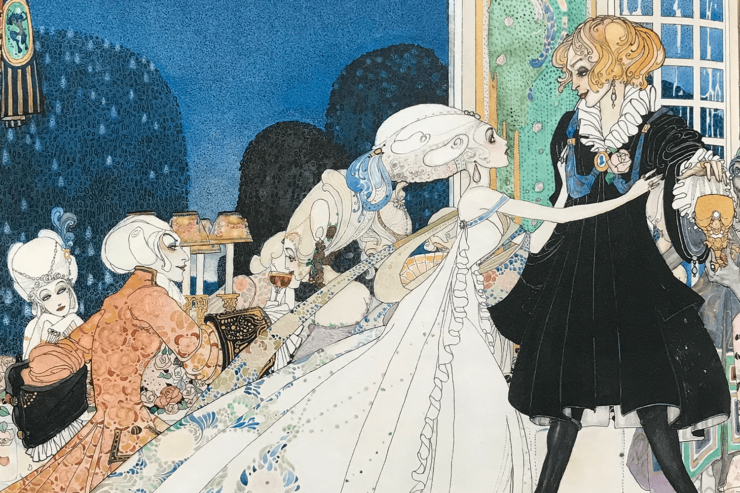
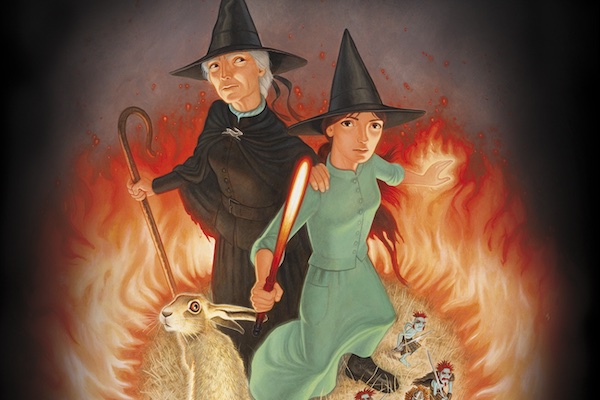
There are plenty of books in which a heroine is raped. But there are surprisingly few genre books in which rape is the subject. I don’t think this is a bad thing. It’s a very difficult subject to write about. It’s amazing that McKinley makes it work. It’s not the only thing in the book, of course. When my son’s girlfriend saw the beautiful Canty cover and asked what it was about, my immediate response was “Dogs.” This was only partly cowardice. It is a book about dogs. Lissar is given a puppy, Ash, and she becomes human in loving Ash and being loved by her. Then later a good part of her recovery comes about working in kennels and saving the lives of motherless puppies. The dog bits are extremely well done. The dogs are like dogs—McKinley’s always good at animals. And it’s a book about different ways of running a fairytale kingdom—the economics are a lot more realistic than in most fantasy of this type. As usual the details are wonderful and entirely convincing—I entirely believe the part about living in a hut in the snow and wishing for two buckets instead of just one. It’s just right. The magic is everyday and domestic, too—Lissar can find lost children, and the Goddess heals her. She’s a very interesting goddess, too, one who chooses to spend her magic helping people instead of saving it up to be a greater goddess.
The only part of it that doesn’t work for me is the romance. Romances are never McKinley’s strong point. She has written two different novel-length versions of the fairytale “Beauty and the Beast,” Beauty and Rose Daughter, and sometimes it seems to me as if that’s the only romantic story she believes in—the girl who falls in love with the man who at first seems like an enemy. Ossin here isn’t quite that, but while I believe that Lissar in some way loves him I don’t understand why—and this is the same with Luthe, and Tor, and all the heroes who aren’t in some way beasts. Odd.
I think this is an important book not just because it’s tackling a generally difficult subject and doing it well, but because it takes the darkness that is at the heart of fairytales and doesn’t flinch away from dealing with it. People ask why, in this day and age, we tell fairytales, and it’s because they express universal truths, in a metaphorical way. We all know these stories, they’re part of Western culture. They often get prettified and Disneyfied, and they’re more than that, they’re darker and older and connect to deeper parts of people. People also ask, why are we talking about kings and queens and princesses. The answer to that is sometimes that it’s a magnified way of talking about families. Fairy tales are about families, about growing up, about love, about danger, about being a child and being a parent. This one is about a dysfunctional family, in a dysfunctional kingdom, but McKinley balances that with a functional family in a functional kingdom, and links the two with the love of a dog. It’s brave of her to tell a story like this one and make it real.
VIEW ALL BY · Saturday January 24, 2009 01:28pm EST
VIEW ALL BY · Saturday January 24, 2009 01:42pm EST · amended on Sunday January 25, 2009 06:30am EST
Deerskin is the reason I read McKinley. Which is good, because it lead to me reading Sunshine. Both of which are books that I buy every couple of years to replace the copy I'd lent out or misplaced. (The result being I think I have five copies of Deerskin at this point.)
Saturday January 24, 2009 10:37pm EST
Saturday January 24, 2009 10:49pm EST
VIEW ALL BY · Sunday January 25, 2009 08:41am EST
(As-you-know-Jo, I disagree about the balance of realism and fairy-tale in this book, but I agree that it's got some very powerful bits.)
VIEW ALL BY · Sunday January 25, 2009 09:40am EST
VIEW ALL BY · Sunday January 25, 2009 10:15am EST
VIEW ALL BY · Sunday January 25, 2009 10:22am EST
Sunday January 25, 2009 12:17pm EST
VIEW ALL BY · Sunday January 25, 2009 06:11pm EST
VIEW ALL BY · Monday January 26, 2009 12:10am EST
It also has a deeply weird romance, that sort of pops out of the woodwork after she finishes her brother's shirts.
Monday January 26, 2009 12:01pm EST
VIEW ALL BY · Monday January 26, 2009 08:41pm EST
VIEW ALL BY · Monday January 26, 2009 09:54pm EST
Monday January 26, 2009 11:33pm EST
Bujold has also recommended a book called Women's Work: The First 20,000 Years by Elizabeth Wayland Barber. Not my field, so I can't really judge it, but I did find it fascinating. Do you know it?
And now, back to our regularly scheduled thread . . . sorry.
VIEW ALL BY · Tuesday January 27, 2009 03:12am EST
VIEW ALL BY · Tuesday January 27, 2009 07:30am EST
Thursday March 05, 2009 04:27pm EST