

Fri
Mar 1 2013 4:00pm
Star Trek: The Next Generation Rewatch: “Masks”

Star Trek: The Next Generation Masks rewatch“Masks”
Written by Joe Menosky
Directed by Robert Wiemer
Season 7, Episode 17
Production episode 40276-269
Original air date: February 21, 1994
Stardate: 47615.2

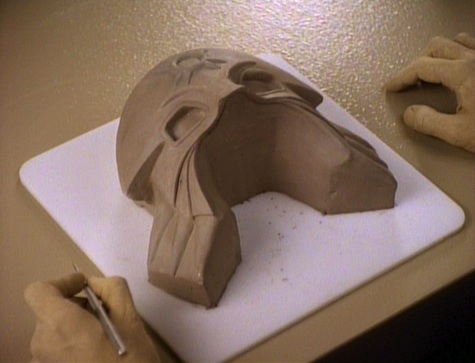
Captain’s Log: Troi is guest teaching an art class, where the students are making sculptures that represent their feelings. Data is also in the class, oddly, and after he sculpts a perfect padd, Troi challenges him to sculpt music. He makes a G-clef, which Troi figures is a good start.

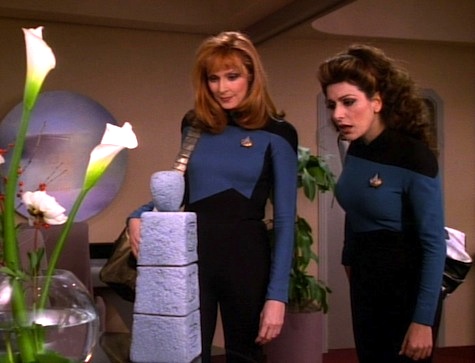
The Enterprise has found a rogue comet. As Data examines it, the Enterprise is hit with a bright light, which Data figures is a sensor echo. Meanwhile, Crusher and Troi stop by the latter’s quarters en route to the morning mok’bara class only to find a mini-obelisk that Troi has never seen before. They don’t think anything of it, at first, as they’re running late; Crusher theorizes it’s from a secret admirer.

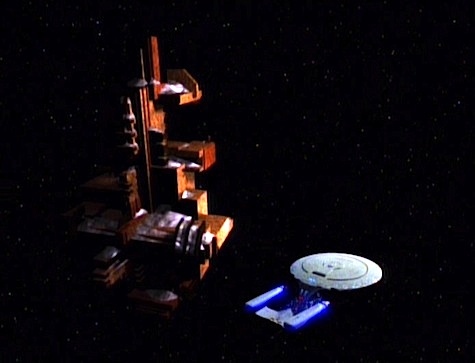
Later, back in the classroom, Data has sculpted a mask that has a marking on it similar to that of the obelisk in Troi’s cabin. They soon discover that similar symbols are just showing up on computer displays. Something has been inserted into the computer core. Data recognizes the symbols, but he has no idea from where—he is able to translate the symbols, much to his surprise.
Star Trek: The Next Generation Masks rewatch

Phasers burn away the comet’s surface to reveal an object of some kind, and it’s definitely transmitting information into the sensors and replicators. Data has an intuitive understanding of it all, which has everyone concerned that he’s as compromised as the Enterprise computers. By the same token, this may be the device’s way of communicating, and this could even be a first contact, so they approach things cautiously.

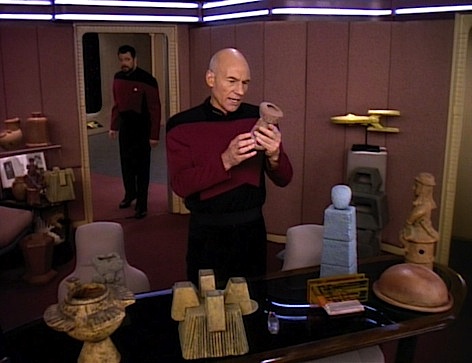
The replicator starts producing many more objects like the ones Troi found in her quarters. Picard is collecting them in his ready room, and he theorizes to Riker that these have cultural significance, and that what they found could be an alien library of some sort.
Star Trek: The Next Generation Masks rewatch

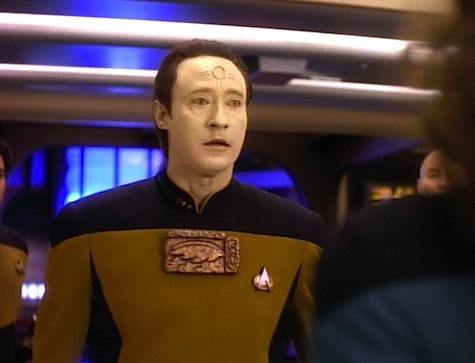
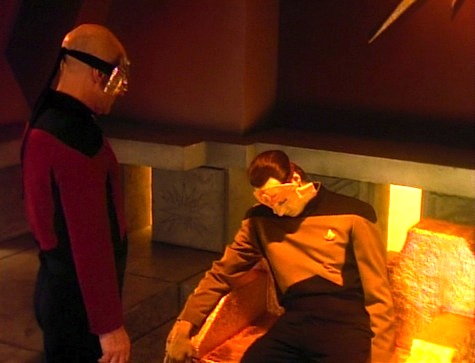
La Forge examines Data’s positronic brain, but after they finish, Data has one of the symbols from the library etched on his forehead, and his voice has changed. “Masaka is waking,” he declares, and then sits on the warp core until Picard shows up. Data identifies himself as Ihat, and now has another symbol on his chest. Picard’s attempts to question Ihat are stymied by his impish nature. But when Troi walks in, Data takes on a different personality (the symbol on his chest having changed) and kneels before her, identifying her as Masaka and saying he’s hers.
Star Trek: The Next Generation Masks rewatch

Picard confines Data to quarters. La Forge theorizes that the library is placing multiple personalities into Data’s positronic brain. Picard goes to Data’s quarters, and talks with several different people—the chest symbol changing each time—one of whom is scared to death of Masaka.

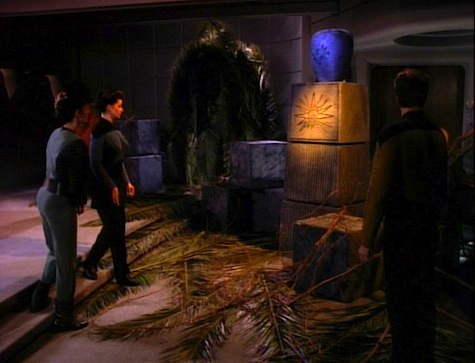
The library hits the ship with a tractor beam, cutting power to the ship. Ten-Forward has been transformed into an altar of some kind—and other parts of the ship are being changed as well. The library is somehow altering matter, changing the ship into something else piece by piece.

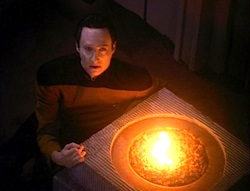
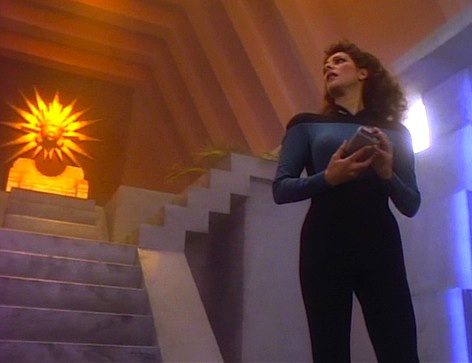
While La Forge attempts a technical solution, Picard tries a diplomatic one. He wishes to talk to Masaka, so he goes to Data’s quarters, where he’s channeling Masaka’s father, an elderly gentleman clutching a lit brazier. Data pings back and forth among three different personalities—Ihat, Masaka’s father, and the scared one—but he learns how to summon Masaka: building her temple. La Forge technobabbles his way into sending the symbol Data showed Picard into the transformation program on the library, which changes an entire deck into Masaka’s temple.
Star Trek: The Next Generation Masks rewatch

Ihat told Picard that Korgano is the only one who can control Masaka. Picard, Troi, and Worf try to find the symbol that they think represents Korgano in the temple—which Picard has actually seen all over in small form amongst other symbols. As they do so, Data puts on the mask that he made in Troi’s class, takes down the two security guards posted to his quarters (seriously, why were the two guards so utterly unprepared to deal with him? it’s not like his sooooper android speed and strength is a big secret), and then shows up in the temple. He is now Masaka, but will not listen to anyone. La Forge finds the one instance of Korgano’s symbol by itself and plugs it into the transformation program, which provides them with another mask.

Picard puts the mask on and bluffs his way through being Korgano to confront Masaka, which does the trick, changing the ship and Data back to normal. Data feels oddly empty, as there were thousands of personalities inside him—but he still has the clay mask he made, which he has painted and kept as a memento of the incident.
Star Trek: The Next Generation Masks rewatch

Can’t We Just Reverse the Polarity?: The library somehow transforms parts of the ship into stone artifacts, masks, symbols, and, at one point, an entire deck into a temple that has a higher ceiling than the deck itself, and manages to do this without transforming the outside of the ship, nor altering life support or the structural integrity field or even the configuration of the ship, which is utterly miraculous.

Thank You, Counselor Obvious: Troi guest teaches a sculpture class where she tries to get people to sculpt what they’re feeling. She tells Eric, one of the kids, to go less for realism in his bird sculpture and more to convey the feeling of flying with what he creates. Similarly, she tries to get Data (whose presence in a class filled with little kids is never explained) to sculpt music, a concept the literal-minded android struggles with at first.

If I Only Had a Brain...: As an artificial life form, Data is the perfect repository for the personalities stored in the library, though he only channels four of them outwardly. Oddly, no parallel is drawn between that and the journals of the colonists of Omicron Theta that he also has downloaded into his positronic brain....

There is No Honor in Being Pummeled: Worf aids Troi and Picard in trying to figure out the symbology of the temple. He also immediately calls for the transporter when he and La Forge are trapped in engineering, and just generally is refreshingly competent in this episode. The same cannot be said for the two people he assigns to guard Data....

Star Trek: The Next Generation Masks rewatch

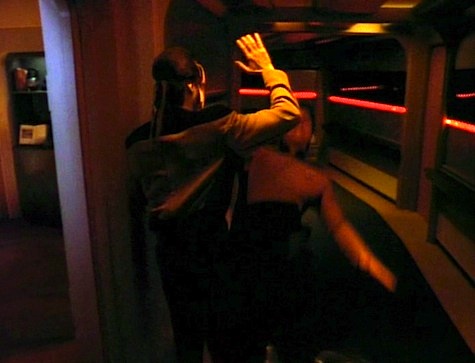
I Believe I Said That: “Worf says he’s gonna teach us some mok’bara throwing techniques today.”

“More like falling techniques. Last time we did that, I was sore for a week.”

Crusher and Troi dreading Worf’s class.
Star Trek: The Next Generation Masks rewatch

Welcome Aboard: This is the only TNG episode that has nobody listed in the guest credits whatsoever, jumping straight from the title to Peter Lauritson’s associate producer credit. The only guest is Rickey D’Shon Collins, who does a nice job with his brief role as one of the kids in the sculpting class.

Trivial Matters: The script was based on a concept Michael Piller had had to do a science fictional version of the Library of Alexandria. Menosky’s first draft had used archetypal forms, but that proved hard to do on television, so he went with actual characters. Menosky had left the staff of TNG at this point and was living in Europe, so Naren Shankar did an uncredited polish on the script.

Make it So: “Masaka is waking.” For the second week in a row, we have a Data showcase episode that I had no memory of. In fact, I had absolutely no recollection of any part of this episode, not even fleeting impressions, leading me to wonder if I ever watched it. In any case, this was a rare case of an episode that was more of a watch than a rewatch.
Star Trek: The Next Generation Masks rewatch

Joe Menosky is the guy, you’ll recall, who wrote “Darmok,” and his resumé has plenty of other stories that deal with symbology and archaeology and odd ways of communicating, often via possession of some kind (e.g. “Clues,” “Interface,” Deep Space Nine’s “Dramatis Personae”). This story is, in many ways, vintage Menosky, and it’s a delightful idea.

Unfortunately, the execution is a total disaster. I can—barely—suspend my disbelief that this millennia-old (at least) computer can effect full transformations of matter, but that it can do so to a spacefaring ship without causing any permanent damage cuts off my disbelief’s air supply. How is nobody killed or even hurt? How is the ship not damaged, except to plot-convenient parts of it?

I might be willing to forgive it if other elements were more compelling, but beyond the (very) vague archaeological fascination and Brent Spiner mugging for the camera, there’s not much to hang one’s interest on. Plus, that very lack of damage drains the suspense from it, because it eliminates the feeling of any danger. Adding insult to injury, the episode is oddly empty. When Worf checks the disturbance in Ten-Forward, there are only two people in the ship’s bar, which is impossible to believe. Worse, when La Forge and Worf are in engineering trying and failing to modify a torpedo, they’re the only ones there, and then when the senior staff has their meeting in the bridge thanks to the observation lounge being turned into a swamp, there’s nobody else on the bridge, which makes no sense. Where is everybody?
Star Trek: The Next Generation Masks rewatch

And again, this might all be forgiveable if the performances were strong, but this is a rare instance of Spiner letting us down. Putting this episode right after “Thine Own Self” is problematic enough from a story perspective—hey, look, Data isn’t himself again!—but Spiner himself has said that he had inadequate time to dig into these four new roles he was playing all at once after such a hefty amount of screen time in “Thine Own Self,” and it shows. He gives us caricatures rather than characters, really only scratching the surface. Of course, if these are supposed to be mythical, archetypal characters, surface characterization makes sense on the face of it, but that still gives us a performance—or, really, four performances—that are inadequate to watch on a TV episode.

It’s frustrating, because the concept behind this episode is an excellent one. But concepts ain’t stories, and as a story, this one fails.


Warp factor rating: 4


Keith R.A. DeCandido has two new books out, neither of which are actually SF/F: the novel Leverage: The Zoo Job, based on the TV series about criminals who help people, and the baseball book In the Dugout: Yankees 2013, which he co-edited with Cecilia M. Tan, all about New York’s American League baseball team.

40 comments
Lisamarie LiGreci-Newton
1. Lisamarie
I might actually give this one an even lower rating. What exactly was the point of it? This computer thing starts turning the Enterprise into a temple and having Data act out various people in its mythos (and how could they even have anticpated something like Data, anyway)...and then Picard acts like somebody else in the mythos and the changes all get reverted. What was the point? WHY was the ship transforming, and WHY did it transform back?

It is very likely I missed something (and I have a foggy memory of the episode at this point) but I just couldn't figure out a reason for any of the things to be happening. What were the motives? Why did the ending work the way it did?

I think this is where I felt season 7 really started to go down hill -it's the first of a few episodes where I felt like it had potential (I was interested at first in the mystery and really was hoping we'd learn more about this mythology and culture and why they were doing what they were doing) but the end or twist just fell flat to me. Actually, Sub Rosa might also be in that category. But at least from here on out, I am not sure we get a really good episode again until Preemptive Strike (which I really liked, curious to see what others think when we get there).
Jack Flynn
2. JackofMidworld
I actually liked this episode. Wait! Let me explain...

Part of it's because when I watched this ep, I had recently played through Mass Effect and Mass Effect 2, so I was already in the mindset for ancient computers and their ability to keep on functioning and doing bad things.

I'm also a fan of Lovecraft and his eldritch horrors, and (even tho I can't pinpoint any one specific thing) for some reason, it really, really struck me as a Star Trek/Lovecraft crossover. I totally pictured Masaka as some kind of Cthulhoid being from the depths of the universe and that Data was channeling her entire cult.

Maybe it was the Lovecraftian thoughts I was having, but it made sense to me that NOBODY was around. If the ship was being changed bit by bit, it would make sense to keep non-essential personnel in their quarters and my brain-editor just made it so.

I figured I'd be in the minority with liking this one and I've been looking forward to getting this far along, just to put my thoughts out there and see if I'm actually in the minority or if I'm the only one who liked it.
Lisamarie LiGreci-Newton
3. Lisamarie
Oh, and agreed, this is one of the few (maybe only) episodes where Spiner just annoyed me with some of the over the top rendition of some of the characters at times.
tigeraid
4. tigeraid
God I loathe this episode. Suspension of disbelief is impossible.
Lisamarie LiGreci-Newton
5. Lisamarie
@2 - your description actually makes the episode sound more interesting than it was to me. I just want to know, to what end was all this supposed to be happening! I was never quite sure what the point was - was Maska somehow trying to take over the ship to revitalize her cult and be worshipped again? I still wanted a little more information about the nature of these beings/figures (if they were indeed real at all).
Thomas Thatcher
6. StrongDreams
I view this episode as an ancient culture trying to teach us about themselves by teaching us one of their central myths. (So it's Darmok crossed with Inner Light, maybe). The Masaka/Korgano bit is obviously a sun/moon mythology like Helios and Selene. (It's fortunate that the culture that sent the library came from a planet with just one moon, like Earth, otherwise it might have taken Picard a lot longer to figure it out.) Masaka takes over the world every day and is banished by Korgano every night.

The episode's greatest weakness for me is that it is yet another culture using mysterious means to tell us about themselves. And much like Inner Light and Darmok, now that Picard has figured out enough of the myth to give the proper response to the stimulus, what happens next? The library shuts down? Does the Federation send historians to check it out, or does the Big-E just fly away again?
Christopher Bennett
7. ChristopherLBennett
I like this one a lot. I guess I'm more forgiving of the execution and more intrigued by the concept. I love these surreal Menosky scripts where the adversaries our heroes must battle are abstract ideas and symbols reified by technology, like this and Voyager's "The Thaw." It gives them sort of a Twilight Zone flavor. And I liked the resonances with mythology and the archetypes that recur in it.

I don't believe Masaka and the others were real entities. Rather, they were mythological archetypes. As Picard said, the builders of the archive were a ritualistic culture built around symbol and myth. Re-enacting the events of myth was presumably important to their culture, much as with Menosky's other creations the Children of Tama ("Darmok"), and so they built their computer archive to embody the mythic personas and act out their story. Essentially they were like holodeck characters, simulated personalities programmed to behave in certain ways. Those character programs got downloaded into Data and ran on his positronic brain, essentially "possessing" him.

So the "why" of it isn't some conventional motive about power or conquest. It's the kind of motive you find in a lot of Menosky stories -- the impulse to tell stories, to act out archetypes. In Menosky's body of work, the act of storytelling is a powerful and important thing; this comes through most clearly in "Darmok" and in VGR: "Muse." "Masks" is the kind of Trek episode where the "villain" is actually benevolent, or at least doing harm only by accident, and the characters take time to figure that out and realize what they have to do to resolve the situation peacefully. In this case, the library's only motive was the motive of any library ever: to share the knowledge of its culture.

As for the transformations, I figured the software was manipulating the ship's own transporter and replicator systems to achieve them. Maybe that's why they didn't do any structural damage to the ship -- the transporter probably has built-in safeguards to prevent it from accidentally beaming away part of the hull or something. Then again, if the library's only motive was to project its cultural knowledge, its own programming may have precluded damage to the ship.
tigeraid
8. Gilbetron
Christopher: Great thoughts! I also love the Menosky episodes, but I've never been able to articulate why quite as well as you managed in your comment. I too have always been fascinated by this episode, as you say, more for the concept than the nuts and bolts.
tigeraid
9. RobinM
@2 I didn't feel Lovecraft at all in this episode it wasn't scary just straight archtyple myths of the Sun and Moon. I figured the alien library was tapping into the ships replicators to create objects and it has built in saftey features but the fact that at one point there is open flame in the middle of the ship drives me crazy. FIRE BAD on ships of any kind let alone a spaceship! I found Spiner's performance flat on this one he seemed tired. Great we learned a new myth I love mythology it would have been stronger with some context of any kind .
Alan Courchene
10. Majicou
The D'Arsay myth cycle is clearly a mere Campbellian recapitulation of the archetypal Celestia/Luna dynamic, albeit with a variation in that the level-headed moon-figure banishes the willful sun-figure, possibly indicating a corruption in the memetic transmission of the underlying concepts to D'Arsay culture. Also, they are not winged unicorns, so there's that.

Seriously, the archive seems a bit odd to me. Okay, we've already seen the Kataan probe use a somewhat forceful method of educating passers-by about its long-gone culture, but at least the Kataanians were thorough. Here, the crew don't learn much about the D'Arsay in the end. All they do is get the bare minimum necessary to get away from the archive. Somewhere, an ancient alien game designer is screaming "Dammit, they didn't do any of the optional story content! They just read a walkthrough and critical-pathed my rich tapestry of narrative!"
Christopher Bennett
11. ChristopherLBennett
@9: Fire isn't necessarily that dangerous on a spaceship; if you turn off the gravity and air circulation, the flame will smother itself in its own combustion products.

Then again, with a very few exceptions, Starfleet ships seem incapable of losing gravity under any circumstances, even when every other system is dead.
tigeraid
12. JimW
I have been looking forward to your review of this episode. I was hoping that you could help me make sense of it all. Alas, not so much. The first time I watched this I had a WTF moment. I get the Sun and Moon symbolism but the whole thing is a mess.
adam miller
13. adamjmil
@1,

I loved preemptive strike. I think you're right that most of the episodes between now and then aren't that good - although I liked Journey's End myself. Unfortunately we also have Genesis, Bloodlines, and Emergence coming up....
Theresa Wymer
14. Tekalynn
I liked this episode a lot when it aired (haven't seen it since), but I was in a minority, as the rec.arts.startrek crowd didn't care much for it either.

IIRC, the cast was reported as saying that, collectively, they had NO idea what the plot was supposed to be or what they were doing, so they were more or less winging it.
Amanda Martino
15. isismaat
@2 and @7 - You're not alone; I really like this episode. I am and always have been a history buff, but when this episode first aired, I think I was 14(?) so I was a less critical history/mythology buff than I am now; the suspension of disbelief wasn't a huge problem for me. I also saw the episode as more of a set of mythological archetypes, so the lack of character development of those archetypes wasn't a huge problem for me - I actually thought that was the point - as different as we are, we're all pretty much the same underneath. I also thought that even if the files were deleted from the Enterprise computers, the library itself was still there so Starfleet would still be able to study the culture, which made the ending feel less abrupt to me.
Scientist, Father
16. Silvertip
Dude. G-clef. Most parental-controls filters will remove references to the G-cleft.

S

p.s. I'm enjoying the rewatch, looking forward to DS9 (at least the years while they still believe in shades of gray), keep up the good work.

[edited for typo]
tigeraid
17. Mark Pontin
I remember thinking it was an interestingly nutty episode. On that simple basis -- as cumulatively bizarre spectacle -- I somewhat forgave it the lack of believability that a poster upthread mentioned.

Arguably, too, the fact that Masaka etc. have no ordinarily comprehensible motivations is acceptable: all this activity is just the playing-out of an ancient alien program. In principle, indeed, there needed to be one episode of Star Trek -- out of 175 episodes of just STNG, without mentioning the other flavors of the franchise -- that was just bizarre, alien spectacle.

Still, given the fact that this episode is only bizarrity founded upon bizarrity, without any more logical thrust than that, God knows how patient I would be with it if I saw it today.
Jeremy Clegg
18. Cleggster
I always really liked this episode. I remember thinking that it was one of the stronger examples of what writers could do if they didn't have to worry about appealing to the common denominator. Something new and creative, since they didn't have to think about another season. I still enjoy it for reason Mr. Bennett already expresed. I loved seeing the alien mysticism. The idea that they would see there myths as a more important record then recordings of real life. You never can never know the alien mind.
Christopher Bennett
19. ChristopherLBennett
@18: Exactly. Today we think of "myth" as meaning "something that isn't true," or at least something that's widely believed but factually questionable (in fact I just finished rewatching an episode of Mythbusters). But traditionally, myths were the foundation of a culture's beliefs and ideology. They codified how a culture defined the world and how it defined itself. So the idea of a culture, even a scientifically advanced one, choosing to present its myths and rituals as the essence of what it valued and wished to preserve about itself isn't so implausible.
Keith DeCandido
20. krad
Christopher: While I agree that this was an excellent concept -- as I said in the rewatch itself -- a concept isn't a story. A good idea is useless unless it leads to a good story, and this was very much not a good story. There's a reason why I roll my eyes at wannabe writers who are so very scared to death that someone might steal their ideas, not getting that an idea is not a commodity worth anyone's time to steal. There's a reason why high school students study Shakespeare's Macbeth and only a handful of scholars and nerds like me even know about Holinshed's Macbeth, even though they're both the same idea.

So it being a good idea was enough to bump it up to a 4, but not to actually consider it a good episode, nor worth my time to ever watch again.

---Keith R.A. DeCandido
tigeraid
21. Krautty
Damn you KRAD for pointing out everything wrong with this episode. When I first watched it (in reruns), I thought Brent Spiner was great transitioning from one character to another. Now I see the flaws.
tigeraid
22. JLPSAP
Krad, excellent point about the Enterprise feeling empty! I felt that while watching it before, but never really "noticed" it before. Another weird thing in a weird episode.

I would give this ine a 2 out of 10. It really is done lifelessly, boringly, and it took a great concept and puked on it. The only reason i give it 2 is because the first 10 minutes I thought were actually quite interesting. Everything after that is a solid 0 of 10.
tigeraid
23. Ashcom
This episode annoyed me from the get go. The idea right at the start that Data was unable to understand an abstract artistic concept, despite the fact that we have seen many times in the past that he has a firm grasp on nearly all concepts of art and has produced abstract works himself, immediately suggested to me lazy writing.

And I think that sums up what we have here. I agree with Krad, this is a fine idea let down by the fact that the writers never really thought anything through. It's like a child's writing. "This will be cool. Oh and this, and this." Yes it will, but it won't make any real sense.
alastair chadwin
24. a-j
Count me amoung those who enjoyed this episode and I agree with everything that ChristopherLBennett has written above.
As to the aliens' motives, I read it as a Solaris type thing. They're alien and their motives and actions are incomprehensible to us.
I have a memory that Michael Dorn cited this episode as a reason why TNG should have had just six seasons but as said above, I rather enjoyed the 'end of term, let's try this and see if it works' vibe that this season has even though, if memory serves, the hit rate is considerably lower than the misses.
Sara H
25. LadyBelaine
The only real substantive comment (and it it really substantive, Belaine?) I can make about this episode is that it is the inspiration for this absurd banter my husband and I have whenever we decide to head out for Greek food.

That's right, you guessed it - one of us will say to the other, in a nasal done "Moussaka is waiting!!"

We're really both dorks, you might have realized.
Christopher Bennett
26. ChristopherLBennett
@24: The problem with the "incomprehensible aliens" idea is that their mythology as portrayed in the episode is based on some very common human mythic archetypes.

@25: I hate to spoil a good (i.e. bad) pun, but unfortunately the line was actually "Masaka is waking," not "waiting." Not sure how to make that work with Greek food. ("Moussaka is baking?" Is that something that's baked?)
Heather Dunham
27. tankgirl73
#7 - Thanks for that insightful explanation of WTF was going on in the episode. It makes perfect sense. Too bad the episode itself didn't actually explain any of that...

All it needed was a few more scenes explaining that. Like we got the explanation of what was really going on with The Inner Light. Here, nothing.

Without that explanation the episode becomes just DUMB.

And what about the changing crest on Data's chest? Where did that come from? How is it changing? It's never actually pointed out that it's changing with each character -- as I recall, the first time I saw this I didn't even notice that. There's "nice" subtle, and then there's "so what's the point" subtle.

The fact that they never actually show it changing leads me to believe they never really figured it how it was changing either... It was tied in to Data's mental procurement of the characters, so how did that cause a physical material change in the thingy?

Oh and whoever said lucky thing about it being a single-moon planet (for some reason I can't find that in the comments now I'm just blind) - brilliant! I never thought of that.

Absolutely just a 1 or 2 warp rating.

And yes, G CLEF. No bloody Q, R, S, or T.
Michael Burstein
28. mabfan
For some reason, this episode scared me. I don't recall watching it in its entirety when it aired, and if I come across it I avoid it. Like the other two or three episodes I've mentioned in that category.

-- Michael A. Burstein
Jenny Thrash
29. Sihaya
I had an easy time understanding and enjoying this episode the first time around, for many of the reasons that Christopher mentioned. But I was an anthropology major at the time. The folks in my little corner of Nerdsylvania were atwitter with delight the next day, I can tell you. We went over to the classics department to high five each other smugly for being worthy of pandering.

I have to admit that I didn't think that the device in the story was meant merely to pass on history. I figured it was meant to create a forceful conversion to both the religion and the culture. Its purpose may have been genocidal, to wipe out a space-faring culture that used to roam that particular area by means of forced re-education. Or it may have been meant to do something opposite, a violent act of cultural spread, used by a dying society to keep it afloat. The society of "The Inner Light" wanted merely to be remembered. The society of "Masks" wants to last forever.
Christopher Bennett
30. ChristopherLBennett
@29: But how could a forceful conversion have taken effect? There was no real intelligence guiding the constructs; they were just acting out their preprogrammed scripts (otherwise "Masaka" wouldn't have fallen for Picard's Korgano act). Without conscious beings to teach and enforce their version of what the faith means and how it's practiced, it's nothing but a re-enactment of the myths, just a much more elaborate and computerized version of Egyptian wall carvings.

Maybe there was an element of that old Trek standby, the test imposed by powerful aliens. Masaka's takeover is a challenge, a test to see if a species is able to deduce the necessary response, i.e. acting out Korgano's part of the ritual. Those who show their understanding are granted access to the fuller range of knowledge within the archive.

Then again, it could simply be that the 87-million-year-old technology was malfunctioning and acting up in ways it shouldn't have, so what was meant to be simply a cultural slide show played out more invasively.
Jenny Thrash
31. Sihaya
Well, to some cultures recreation of a myth is the same as ritual. And in may cultures, participating in a religion's rituals is what identifies someone as a member of the religion rather than a belief in that religion's precepts.
Joseph Newton
32. crzydroid
I may have liked the mythology and mystery aspects of this when I first saw it, but I honestly can't remember now.

The thing nowadays that makes me cringe with this episode is that multiple characters thing. That kind of exercise is maybe good for middle or high schoolers to do, but it is less than entertaining for me here, unless it were done exceptionally well. Spiner is a great actor, but I feel that playing the whispy-voiced old man and the stereotypically scared little girl are not a good showcase for his abilities. Like you said, it seems he didn't really have time to develop them and so they become caricatures rather than characters. Same thing goes for SG-1's "Lifeboat."

I wonder why the thing had to transform the deck into the temple; when I watch this I keep expecting them to put the temple symbol into the holodeck computer to recreate it, like they seem to do on other episodes.

Also, thank you for sneaking a correct usage of "symbology" in there. On more than one occassion I've heard someone say "symbology" when "symbolism" was what was meant.
Christopher Bennett
33. ChristopherLBennett
@32: The "stereotypically scared" character is identified in the script as "a frightened Boy." What made you think it was a girl?
Joseph Newton
34. crzydroid
@33: Hmm...interesting. I just got the impression it was girl. But boy or girl, I still feel as though it's not a well-developed characterization here. I can't even really put my finger on why I think this falls flat...I definitely used to be into this kind of acting in the past. I think it's just because it all seems a little too trite to me by this point. I definitely think that Spiner is capable of portraying characters better than this.
Mike S2
36. MikeS2
24. a-j http://en.memory-alpha.org/wiki/Masks_(episode)#Reception
At a Creation Entertainment convention in South Bend, Indiana around 1997, Michael Dorn cited this as his least favorite episode of TNG.
Say it with me...

Worst. Episode. Ever.
Keith DeCandido
37. krad
Sorry for the lack of a rewatch yesterday, folks. Real life, and all that crap. "Eye of the Beholder" should go up later this afternoon, and we'll be back on track with "Genesis" on Friday.

---Keith R.A. DeCandido
Rowan Blaze
38. rowanblaze
@16, @27: Yes, it's "clef," but what parental filters are you using? I'm just curious. Googling "G-cleft" basically leads to a number of instances where they made the same initial mistake KRAD (or the editor?) did. While Wikipedia acknowledges the anatomical meaning that is why your filter blocks it, it is only one of several. Is this a Scunthorpe problem?

My impression of this episode wasn't entirely negative, though I am wondering how they got the temple-deck back to normal, or did it just automatically return to normal at the end of the scene, I can't remember now.
Christopher Hatton
39. Xopher
I thought this was dopey. But then I also hated "Darmok."

But one question is easy to answer: How did they get the decks to transform and transform back with no harm done? Holograms, of course! Holograms can do anything.
Christopher Bennett
40. ChristopherLBennett
@39: As I believe I said above, it could've been done if the archive had taken control of the ship's transporter systems -- reprogrammed them to dematerialize parts of the ship and rematerialize them in new forms, like a replicator.
Rob Rater
41. Quasarmodo
I knew I'd missed this one back when it first aired. I remembered seeing the promos for it, but then wasn't able to see it when it aired. So I didn't get to see it until I watched S7 on dvd, but then I found out there was a buttload of other eps that I'd apparently missed as well

Regarding the guards placed outside Data's quarters: they were in fact prepared for Data. Unfortunately he came out wearing a mask...

Subscribe to this thread

Receive notification by email when a new comment is added. You must be a registered user to subscribe to threads.
Post a comment