

Fri
Jul 29 2011 1:48pm
Malazan Re-read of the Fallen: House of Chains, Chapter Four

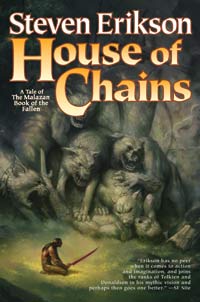
House of Chains by Steven EriksonWelcome to the Malazan Re-read of the Fallen! Every post will start off with a summary of events, followed by reaction and commentary by your hosts Bill and Amanda (with Amanda, new to the series, going first), and finally comments from Tor.com readers. In this article, we’ll cover Chapter Four of House of Chains by Steven Erikson (HoC).

A fair warning before we get started: We’ll be discussing both novel and whole-series themes, narrative arcs that run across the entire series, and foreshadowing.

Note: The summary of events will be free of major spoilers and we’re going to try keeping the reader comments the same. A forum thread has been set up for outright Malazan spoiler discussion.

Chapter Four

SCENE 1

After a few days of travel, Torvald and Karsa enter a village and Torvald purchases a sword, complaining that the merchant spoke Malazan but wouldn’t admit it. Karsa says the Malazans in Genabaris had mentioned that Seven Cities would rebel and says this is why the Teblor way is better — instead of conquering they let the enemy keep their land so the Teblor can raid over and over. Torvald says the imperial way is “Possession and control . . . no doubt the Malazans have thought up countless justifications . . . It’s well known that Seven Cities was a rat’s warren of feuds and civil wars, leaving most of the population suffering and miserable and starving . . . and that with the Malazan conquest, the thugs ended up spiked . . . or on the run. And the wilder tribes no longer sweep down out of the hills . . . And the tyranny of the priesthoods was shattered, putting an end to human sacrifice and extortion. And of course, the merchants have never been richer, or safer on the roads. So, all in all, this land is rife for rebellion.” Karsa stares at him, then replies, “yes, I can see how that would be true,” to which Torvald responds: “you’re learning friend.” When Karsa refers to the “lessons of civilization,” Torvald says “just so. There’s little value in seeking to find reasons for why people do what they do . . . Hatred is a most pernicious weed, finding root in any soil. It feeds on itself.” As they walk through the village, they pick up signs not all is right, then realize they are walking into an ambush. They are caught between two groups (Arak tribesmen) totaling about 50 men with bows. Karsa asks how much damage the bows could do and Torvald says enough: “a year ago and Karsa would have attacked nonetheless. Now he simply reslung his bloodsword.” They are shackled and chained, Karsa so tightly as to cut off the blood to his hands and feet. Silgar appears, leading the men, and says he’s fine with that result. Karsa is knocked out and wakes tied to a sled amidst the Arak camp, his hands and feet numb and already turning blue. Torvald stuffs his and Karsa’s clothes with grass and nudges them against the small campfire sending up easily noticed flames/light. The Arak quickly decamp, muttering “Gral” with fear.

SCENE 2

As one of the Arak puts his knife to Torvald’s neck, a group of Gral suddenly attack. The Arak slices Torvald’s neck then is killed. Damisk and Silgar escape via magic with Karsa, leaving the writhing Torvald behind. They arrive in a city and Silgar orders Karsa unshackled as the city is under Malazan control and they don’t abide slavery unless the slave is branded a criminal (which Karsa is not). When they unshackle him, Karsa screams in pain, then continues, throwing off the magic Silgar tries to hit him with. He goes unconscious just as he hears a group of Malazan soldiers confronting Silgar and demanding to see Karsa’s brand when Silgar claims they are just subduing an escaped slave.

SCENE 3

As he swims back into consciousness he hears a Malazan healer saying he’d never seen such fast healing before and that any normal person would have needed their limbs amputated. The two Malazans wonder if he is a Fenn due to his size. Karsa pretends to still be unconscious as the Malazans leave, then sits up to find himself sharing a small room with a stranger who speaks a Seven Cities language, then switches to Malazan. The stranger tells him Silgar and Damisk have been arrested and are in the stocks, but had told them Karsa was en route to the Otataral mines and had cursed the ship to destruction. Karsa is being sent to the mines again, as is the stranger. He mentions Silgar has been collared on the ankle with an Otataral anklet, which he explains is a powdery rusty-colored substance that defies magic. Karsa says they use something similar to make their blood-oil, which they use on the swords, armor, and taste before battle. When the stranger asks how well magic works on him, Karsa replies not very well at all. The stranger tells him the Malazans control Otataral production very tightly and believe it to only be found on Otataral island and warns Karsa to not let it slip there is another source or the Empire will try to crush his people. When Karsa says “The Teblor have many enemies,” the stranger laughs at what they call themselves. Before he can say why, though, a group of soldiers enters to transport them. They tell Karsa he’s been tattooed as an escaped prisoner: “’shattered, the other prisoner said, ‘the brand makes your face look like it’s been shattered.” As they move, the soldiers discuss how their Fist is “cowering in his keep” and how they worry that regiments (such as the Ashok we met earlier) from Seven Cities might join the rebellion if it happens. When they were passing Silgar in the stocks, Karsa asks what will happen to him. When the soldier mentions Silgar’s claim that he is rich back in Genabackis and Karsa mocks a system that would let Silgar buy freedom, the soldier tells him that doesn’t happen under Imperial law if the crimes are serious, but he may be just fined — which for a merchant hurts a lot. Karsa is chained (more humanely) alongside his cellmate, who proposes the two partner to guard each other’s back in the mines. At night, Torvald Nom appears with some Gral and trading agents of the House of Nom. He frees both Karsa and his partner. Torvald tells Karsa the Gral saved him to try and ransom him. He adds his kin have offered him a place, but the Gral won’t take Karsa, as he is too noticeable. The stranger offers Karsa a place of safety and Karsa agrees to go with him. As the alarm rings out, Torvald gives Karsa his bloodsword that he’d saved from before and tells Karsa to come to Darujhistan in a few years to visit. The stranger leads Karsa out of the city, passing through a doorway held by a man named Mebra. Outside, the stranger tells him it will take some days of travel to reach safety. Karsa warns him he will not be taken prisoner again and the stranger says Karsa is free to head off his own way at any time.

SCENE 4

The next day Karsa and the stranger are pursued by horsemen; the stranger suspects Mebra betrayed him. When they can’t lose them, the stranger concludes they have a mage. Karsa decides he will attack them at dark.

SCENE 5

Night falls and the stranger and Karsa spy on the pursuers, which include Silgar and Damisk. Karsa attacks, killing several and driving others off. He cuts off Silgar’s hands and feet, then binds them so Silgar doesn’t die: “he has not earned swift death. He is as a mad dog, to be driven into a hut and killed . . . once I have driven him mad.”

SCENE 6

Eight days later they cross a path and look over the desert Raraku. Karsa asks why his people’s name — Teblor — continually amuses the stranger. The stranger tells him: “Your kind walked this earth when the T’lan Imass were still flesh. From your blood came the Barghast and the Trell. You are Thelomen Toblakai.” He then names himself Leoman, and says he serves Sha’ik.


Amanda’s Reaction to Chapter Four:

Hmm, a pointed jibe at Keeper from Laseen, I think: “Has a drowned Napan’s body ever surfaced?” I’m glad people said in the comments that it was merely a minor aside and not really something I should have been picking up because I was really worried I’d missed something major, since I couldn’t identify anyone who might have been masquerading as Keeper!

The start of Chapter Four only reminds me more clearly (on top of our other visit to Seven Cities and Raraku) of Arabian culture — dark skin, tribes, rebellion, admired horses, etc. I like to see Erikson exploring multiple cultures. He certainly can’t be accused of just sticking with the faux medieval setting that many fantasy novels suffer from.

The point: “Oh, no doubt the Malazans have thought up countless justifications for their wars of expansion” really does push home the question of why exactly the Malazans are constantly invading and setting out their rules on everyone. Warfare tends to occur because of either greed (more land), control (over a people, culture) or religion. The Malazans don’t seem to follow any of these — except maybe control, and creating a world where every country fits the mould of zero slavery, just government, etc. But even that seems a bit daft!

Torvald’s sense of humour and gentle teaching of Karsa in the ways of “civilization” really tickles me. I love it where he says, “So, all in all, this land is rife for rebellion” after listing all the ways that the Malazans have benefited Seven Cities.

The Daru people really do have a very distinctive character, don’t they? And we’ve seen Torvald’s predictions come to pass, concerning how the Darujhistans dealt with the threat of invasion — lots of talking, lots of politicking and, eventually, causing the Malazans no end of trouble.

Karsa is growing as a person, isn’t he? By not taking on stupid odds in a fight simply because he believes himself to be better than the lowlanders?

Poor Karsa and Torvald, with the latter’s muttered “Beru forfend, not again” when it comes to chains. They really have suffered, haven’t they? Although if they hadn’t been through everything that they have, I think Karsa would have charged into those conducting the ambush regardless of odds. The constant captivity has allowed him the freedom of thought.

Ah, Silgar, how I hate you. Let me count the ways....

Erikson puts his character through the wringer: “Karsa’s face was a mass of bruises, his eyes almost swollen shut, his tongue and the inside of his mouth cut and nicked by his own teeth. He looked down at his hands. They were blue, the finger-tips darkening to black.” Ugh!

Heh, Gral brings back terrible memories of Graal from the Sword of Truth series....

Oh my God! Torvald! Dead? I mean, I know Erikson and it is a case of ”wait until you see the body,“ but he also likes his shocking sudden deaths. I don’t want Torvald to die!

This is the second time that Karsa has been questioned about being a Fenn. Is that going to be another name for the Teblor? Or is there another offshoot of the Teblor people that are called Fenns? For Erikson to say it once could be just part of the flavour of the novel. I feel that when something is said twice, we are meant to take note. “Giants no-one’s seen for decades at that.”

He thought back to Torvald Nom’s death. There was a coldness surrounding the memory, but he could sense all that it held at bay.

Karsa really does feel liking and compassion for Torvald, doesn’t he?

Hah, nice to feel, for once, waaaay ahead for the game where Erikson’s hints and tips are concerned. I am pretty smug about the fact I spotted the Otataral/blood-oil link from the first chapter. *grins*

Hmm, I’m struck with some foreboding and foreshadowing when I read the line, “Reveal nothing of this to the Malazans. If they discover there is another source of otataral, a source they do not control, well, they will send into your homeland — wherever that is — every regiment they possess. They will crush your people. Utterly.”

Is he laughing because he knows that Teblor = Toblakai?

A shattered face... A tattooed face... That is tickling something in my memory, but I have no clue what it is!

I have to confess to a great deal of pleasure at seeing Silgar and one of his minions in the stocks. Something he definitely deserves, after the very nasty treatment of Karsa! Who... hang on... rapes and murders. Oh. Just call me “confused.”

Ah, the fact that the blue-eyed stranger’s name is being withheld suggests that either it will be a shocking revelation or he will not remain in the story for too long.

Torvald! *crows* Still alive!

Wow, such a shocking little aside: “All this talk and I’m surprised everyone else in this line isn’t awake—”

“They would be, only they’re all dead.”

Oooh, I remember Mebra! In Deadhouse Gates, wasn’t he the one who guided Kalam into Raraku when he was to pass over the book? (Apologies, slightly rusty recall of the start of Deadhouse Gates). Heh, I do remember Membra being less than trustworthy and so he proves again...

Now this really is savage. I approved of Silgar being in the stocks, but this is truly barbaric, as his limbs are cut off by Karsa and the blood stopped so that he will suffer a slow death. Geez, and we thought Karsa had grown as a person! Can’t see much evidence of it here!

“You are Thelomen Toblakai.” Yay! I also realised that quite early on. But OH! I did not guess that Karsa is the Toblakai who accompanies Sha’ik! Wow *admiration* All the hints have been there, haven’t they? And I even skirted round some of them as I read up to this point. Good job, Erikson. *grins*


Bill’s Reaction to Chapter Four:

Torvald’s little summary of events in Seven Cities is an interesting one. We’ve seen it remarked upon several times that the Malazan Empire, whatever its intent (which we’re not quite sure of I’d say) does bring some material benefits when it conquers. And Torvald lists a slew of them — an end to tribal feuds and civil wars, to raids by outlying tribes, seemingly effective imposition of law, reduction of governmental and religious corruption, safer roads, better and more lucrative trade, reduction in general starvation and misery. What are the tradeoffs for all of this? And what drives people (outside of those who profited in some way by the older ways) to rebel against such benefits? Sheer cussedness at having things — even good things — imposed upon them? Automatic dislike/hatred of “the outsider”? Shame at having been conquered? Resistance to assimilation, to a broad movement toward more similarity and less diversity? (Though as Whiskeyjack pointed out at one point, the Empire at its “best” revels in diversity.) We had this discussion before with Rake and Brood et. al. Are we as readers meant to see the Empire is mostly, if not entirely, a benevolent creation/actor? Or are we supposed to see it as more grey?

“...form an opinion, say it often enough and pretty soon everyone’s saying it right back at you, and then it becomes a conviction, fed by unreasoning anger...”

Glad this only happens in a fantasy world. And glad that fantasy is nothing but “escapism” with little to no connection to our real world or lives, with little to no opportunity/ability for commentary on our real world....

I like how the ambush is set up so smoothly and subtly: Torvald noticing the penned goats, Karsa sniffing horses, the road narrowing into an arch, the lack of locals, shuttered windows

Karsa. Chains. Again.

Poor Torvald. He did say his act might cost him his life. Though we don’t know if Torvald is dead — a knife tearing across a throat and blood “spattering” are never good signs, but he was still alive when Karsa last sees him. Friends of Karsa (hmm, FoK for short? Probably not a good one to use....) don’t seem to last very long, do they?

Speaking of which, here comes another jailtime romance. I love Karsa’s dry “Are you, by any chance, from Darujhistan?” when the stranger’s word play reminds him of Torvald.

Replaying the same pattern we’ve seen before, after a few subtle hints to a running mystery, we get a much more clear set of answers — in this case to the connection between blood-oil and otataral. It does raise the question as to where the otataral in Karsa’s homeland comes from. Could it be from the convergence of power/force that was the Spirit Wars. They did, after all, involve a (at least one) Jaghut, lots of T’lan Imass, Icarium, and a Forkrul Assail. That’s a high-powered meeting.

Somebody else who finds the name Teblor amusing.

Hmm, so Karsa’s tattoo makes his face look “shattered.” Probably no significance though....

The reappearance of Torvald — that didn’t take long. I confess though, I wasn’t a fan of this little play with the reader, even though it only lasted a few pages. The whole knife tearing his throat and blood spattering but thanks to the guy being “distracted” it wasn’t fatal felt just a little cheap to me. Not a big deal, but still... However, I am glad Torvald didn’t die; I do like him. Which makes me sad he drops off so early here.

Another direct connection to Deadhouse Gates: our old friend Mebra. Mr. Reliable.

And this, I think, is where if one hasn’t made the other direct connection to DG and Karsa, that connection starts to come into view. The pieces are all there. Karsa as a Toblakai. A stranger he partners with who is a rebel leader against the Malazans, who knows Mebra, who is connected to the Whirlwind.

Another little bit of irony with regard to the “barbarian” and those who are “civilized: it was also obvious that among the lowlanders, there was no sense of any other sort of loyalty. Karsa was Uryd, but he was also Teblor. The lowlanders seemed so obsessed with their differences that they had no comprehension of what unified them.”

And just as we credit Karsa with some good qualities, he goes and lops off the hands and feet of Silgar and saves him from bleeding out so he can drive him mad. So we’ve seen cruelty in battle before from the Teblor — we saw Bairoth and Delum cutting off the hands and feet of the Rathyd warrior if you recall. But is this the same or different? Could this be “civilization” having a deleterious effect on Karsa’s moral code? Karsa himself perhaps wonders that, as when the stranger asks “What value senseless torture” Karsa hesitates and sighs. And then we get a direct connection to that dog in the opening: “The slavemaster is not as a soldier — he has not earned swift death. He is as a mad dog, to be driven into a hut and killed.” Of coure, just because Karsa uses the same language as our narrator doesn’t mean our author means Karsa’s answer has to be THE interpretation, or even a correct one. Anyone?

And then we get the big reveal — the stranger is Leoman and Karsa is Deadhouse Gates’ Toblakai. As I said earlier, the pieces were there to pick up on a few pages back, but I do think this was a very effective moment in the book and a nice way to make a reader who maybe had been struggling both with character (“Boy I hate this Karsa guy!”) and plot (“what happened to Picker and Blend and Fiddler and Rake and Paran and and and”)

I’ll be curious if folks breathe a sigh of relief as they turn the page and move away from Karsa for a time....


Bill Capossere writes short stories and essays, plays ultimate frisbee, teaches as an adjunct English instructor at several local colleges, and writes SF/F reviews for fantasyliterature.com.

Amanda Rutter contributes reviews and a regular World Wide Wednesday post to fantasyliterature.com, as well as reviews for her own site floortoceilingbooks.com (covering more genres than just speculative), Vector Reviews and Hub magazine.

31 comments
Steven Halter
1. shalter
On my original read, I didn't figure the Leoman/Toblakai=Karsa until I got to this chapter either.
I also liked Torvald's listing of the virtues of the empire leading to it being ripe for a rebellion. People just aren't happy being well off. They always want that little bit extra. That's a kind of particularly apparant fact given the whole debt ceiling crisis right now.
Torvald's "death" did seem a little unnecessary. But, it did draw a nice contrast to Karsa's reaction to Torvald's death vs. Bairoth's. With Torvald, he felt a kind of sadness. With Bairoth, Karsa was just mad at Bairoth. Show's a bit of growth.
Tricia Irish
2. Tektonica
...Resistance to assimilation, to a broad movement toward more similarity and less diversity? (Though as Whiskeyjack pointed out at one point, the Empire at its “best” revels in diversity.).....
---Glad this only happens in a fantasy world. And glad that fantasy is nothing but “escapism” with little to no connection to our real world or lives, with little to no opportunity/ability for commentary on our real world....

Snark.....exactly! Very powerful stuff, SE.

I know Karsa's punishment of Silgar is very cruel and isn't very "civilized", but geez...that guy deserves something worse than the stocks. He is a baaaaad man with a thick head. You know Karsa wasn't the first man he enslaved and sold. I'm not sure he could be "reformed" in any way. On my first read through I wasn't thinking about the deep moral implications of Karsa's actions, I just cheered that Karsa finally got to punish Silgar. Gulp. But yeah, pretty drastic.
Tai Tastigon
3. Taitastigon
Shattered, broken face.
Always taken for granted, that description.
First time I really look at this like: What else is shattered and broken ? What/who works through this ? What does it portend for Karsa´s future ?

Come to think of it, SE rubs it in your face, doesn´t he...?
karl oswald
4. Toster
i love the awakening of karsa's dry humour in this chapter. his little darujhistan quip to leoman, his discussion with torvald.

we do see him decide to put up his sword when faced with overwhelming odds, and that does show growth, but he makes this decision, i think, because he has no compelling reason to attack. we'll see that overwhelming odds really do not bother him later on in the series.

also, i believe gullstream appears for the first time in the prison scene, which is sweet, cos the guy makes it all the way to the final book of the series iirc.
Steven Halter
5. shalter
In addition to the in series ties, the shattered tatooing on Karsa's face brings to my mind the tattooing that is done to
Gully Foyle in Bester's "The Stars My Destination." Foyle is another character with a lot of development potential.
Jordanes
6. Jordanes
I too didn't work out on my original read that Karsa was Toblakai from DG until it was revealed, and I was really glad for it too, as it brought about a stupid big fat grin on my face. I'd been itching to see more of faithless Leoman too, one of my favourite characters from the series.

Amanda, the Fenn have been mentioned as early as Gardens of the Moon. Bellurdan Skullcrusher was a Fenn, though in GotM he was referred to as something like a Thelomen giant from the Fenn mountains of Quon Tali. It seems the Fenn are another collection of Toblakai who ended up living on the Quon continent. The Teblor are, thus, clearly not the only tribes of giants. Indeed, we'll see another yet another group in Midnight Tides.

SE's really is the greyest of greys, isn't it? So Silgar put Karsa through hell, and would have been happy to see Karsa's hands and feet drop off, but we still wince and withdraw when Karsa exacts his extended punishment on Silgar. I doubt you'd find many readers who'd nod and say, yeah well, he's getting his just comeuppance.

Sometimes you think you know who you can root for, but you're constantly wrongfooted. You think, well, the Malazans at least are pretty good right? And then we meet Malazans who, actually, are nasty and dishonourable. Perhaps just the Malazan armies then? Well, Esslemont will later throw us a curveball there.
Sydo Zandstra
7. Fiddler
Amanda:

“You are Thelomen Toblakai.” Yay! I also realised that quite early on.
But OH! I did not guess that Karsa is the Toblakai who accompanies
Sha’ik! Wow *admiration* All the hints have been there, haven’t they?
And I even skirted round some of them as I read up to this point. Good
job, Erikson. *grins*

Great 'Oh!' moment, no? :D Well done by SE.

It's interesting to read Karsa saying here that he would visit Torvald's city, and he does, in TTH. I leave it at that.

Silgar seems to be very crippled after Karsa is done with him. Just saying...

More later :)
Joe Long
8. Karsa
@7 & Amanda re Karsa and the suprise.

I too was suprised and loved it. Somebody actually spoiled in a comment earlier in the re-read. I was going to lambast them because I had enjoyed the moment so much, but decided to let it go with the hope that it wouldn't be noticed...
Julian Augustus
9. Alisonwonderland
For those who love Torvald, this is not the last time we meet him. He reappears in a later book, and I really enjoyed his sections.
Julian Augustus
10. Alisonwonderland
I also didn't catch on until this chapter that Karsa was Shaik's Toblakai in DG. As I said on an earlier thread, on my first re-read I struggled through the first part of the book in part because, quite apart from Karsa's delight in rape and murder, which I found repugnant, I couldn't see his connection to the story to that point, and couldn't see why I was spending time with the brute. This chapter is what connected him to the familiar story, and I have since warmed up to him a bit. Not much, but a bit.
Chris Hawks
11. SaltManZ
The end of Book I might just be the best "reveal" in the entire series. I get chills even rereading it.
Jordanes
12. alt146
I remember having my mind blown by the end of this chapter, nice little twist there.

Torvald's invititation for Karsa to visit him in Darujistan is a nice nod forward several books.

As for the the reason why the Malazan Empire does what it does, that is rather a murky subject. The empire has been fairly successful thus far and has (on the whole) benefitted from its conquests. I think at the core of it though is this - Kell and Dancer needed the resources of an empire to be able to do what they needed to do, so they went and made one.
B T
13. amphibian
Edit: I stupidly wrote what I thought was a better reveal, but I'll just compliment it when the reread arrives at that point.
M D
14. Abalieno
With the current pacing there's no way I can keep up at 150+ pages a week and the re-read/commenting was already eating most of my reading time anyway. So I decided to take a break for at least a few months and rejoin you later. In the next few days I'll try to finish commenting MoI, then when I'll rejoin I'll restart from where I left, so HoC.

Maybe there will be someone else taking my polemic role and keep the discussion alive ;) I definitely need a break to read some non-Malazan stuff, and also some Malazan stuff that isn't re-read, even if the discussion here has been fundamental for me to understand certain important things. It was precious.

One thing on the sideline I was planning to check out in HoC (even if there are FAR more and more interesting things to deal with, this is my favorite book between the first 4) is the "timeline". When I read the book the first time I didn't noticed anything wrong, and I was actually amazed at the jigsaw puzzle (the re-link of Karsa's story with what's going on Genabackis and then with DG). I knew that HoC laid the foundation of these problems with the timeline, and so I assumed that the later books didn't conciliate well with the dating used here but that HoC, on its own, was at least self-consistent. Instead someone explained to me there are a few things that do not make sense even if one considers HoC alone.

As I said I haven't re-read this yet, so I'm hoping someone can look this up.

Karsa's journey is well framed as it ends with the events in DG and we have a date about the starting point.

So:
1159 Burn's Sleep, the beginning of Karsa's Journey

The events of DG take place in 1164, and the fall of Pale happened in 1163, a year before.

The problem is in the mention of the fall of Pale in this book. It happens relatively early in Karsa's journey, yet it should be crammed very close to its end because of the dates. I think in DG and HoC it is mentioned that when the events resynch "Toblakai" has been with Leoman for quite a while. But then there's only a year or so in that gap (between the siege of Pale and the events of DG), and Karsa was still on Genabackis when Pale fell. He only had a year to do the other chunk of journey, meet up with Leoman and pass with him some time.

It doesn't seem matching up very well. The other problem is that there are four years between the beginning of Karsa's journey and him being captured by Malazans in Genabackis. Reading those pages one could guess a few months passed at best, so what happened in those four years?

What is weird in this whole issue (if there isn't some logic explanation or elements I'm missing) is that when Erikson wrote HoC these events were relatively straightforward. There wasn't a whole lot of juggling that may have caused these kinds of mistakes. He just had those two "pointers" that he needed to nail down, the fall of Pale and DG. So he could have easily placed Karsa's journey to "fit". The only possible reason I could guess is that the book was written and then Erikson decided to adjust some dates, and this caused some "ripples" in the timeline that were then missed.

I'm wondering because Erikson shows a great skill handling this intricate structure and back and forth, only to then mess it on the most simplistic aspects (mentioning the fall of Pale, chapter Three, page 170, could have been avoided without any consequence, or just being "moved" forward). So I wanted to take the opportunity of the reread to pay attention to these details and figure out what's the deal (since the issue I was aware of was about the date used in the Prologue and the events in the Nascent).

Am I wrong somewhere?

Since I'm at it, I'll mention GRRM point of view on the general issue, since he also struggled a great deal with it. It's a quote from a recent Q&A in New York:

Despite notes and Ran, he does occasionally make mistakes – the two he cited being a character's magically changing eyes and a horse's sex change – which he hates, because they obfuscate the intentional mistakes of character memory, such as Ned's and Jaime's different descriptions of everyone's favorite kingslayer's finest moment. He hates when "George the Author" detracts from the work of "George the Brilliant Artist."

Quoting this because it illustrates my point of view. These "mistakes" may be irrelevant but they also lead to unnecessary obfuscation that takes a toll on everything else. Malazan is dense in DELIBERATE limited PoV and misdirection, and the presence of author's mistakes make the deliberate parts take a hit. Maybe it's also a reason why there's not a whole lot of activity on the internet like wiki sites that try to reconstruct the details of the history, it risks becoming an exercise in frustration (and the reason why I think the rumored encyclopedia wouldn't be a good idea).

Erikson has explained that he stopped caring and obsessing over these sort of details, and for sound reasons, but I still think that these choices leads to certain consequences anyway. So we can mock Martin for taking years to complete a book and rewrite endlessly the same scene without making substantial progress, but it's also true that he pays lots of attention and care to aspects that in Malazan wouldn't be considered of much value. Martin certainly can't be accused of "undercooking" his stuff and I think this apparently wasteful approach still has a certain payoff. Readers will notice it.

Channeling someone else's opinion (not my words):

Erikson, in his own words, pleads for the readers trust and insists how important it is and yet he abuses it time and again. I love putting together puzzle pieces but the closer you examine Malazan the less sense it makes. The broad history of the empire is super sweet but none of the details make sense. Which is very disappointing because if done right it could be so, so good.

On the other side, I think the discussion we had about the cosmology was extremely interesting, and especially with other readers' contributions, as Erikson didn't want to expose so much. I was very much satisfied with those perspectives as I think that the lack of anthropocentric PoV would make everything crumble. So the idea that the anthropocentric perspective may still build the rest, like a projection, while still being in a flux, is quite interesting and surprisingly coherent.

I remembered that I had similar discussions about LOST (the TV series), and especially a wikipedia page, that relates quite well to that kind of debate. So worth pointing out:

http://en.wikipedia.org/wiki/Turtles_all_the_way_down

;)

Especially because I was writing how LOST dropped the ball, using Malazan as a comparison to demonstrate how it was possible to deal with it successfully.

P.S.
I was also able to find the original post I read about these issues. Hopefully it won't annoy people here too much:
Leoman says Karsa is 17 in Deadhouse Gates, in HoC we find out Karsa is 80. According to the beginning of Karsa's section in HoC the date is 1159. A few weeks into that section he hears about the fall of Pale, which is in 1163 according to Gardens of the Moon (which also fits the rest of the dates in the series). GoTM doesn't take that long after the prologue. The events happen in rapid succession and it is a fairly small geographical area. Karsa spends a decent length of time messing around with the Malazans before being sent to Seven Cities. Kalam and crew depart for seven cities immediately at the end of GoTM. So them and Karsa should arrive at approximately the same time. That means when Sha'ik is assassinated Leoman and Karsa have only recently become her bodyguards. Of course, later on Karsa talks about how him and Leoman have been together for years.

Karsa Orlong=timeline wrecking ball.
M D
15. Abalieno
Ah, I was forgetting another point. Later in the book there's also a dialogue between Cotillion and Crokus that needs to be "checked".

It was another sort of "caper" or ret-con on the events of the first book.

The worst part is that Cotillion's answers are quite infuriating as he hints at motivations too complicate to explain...

And because I was putting LOST and Malazan again side by side, this parody has a certain truth for both:

http://www.youtube.com/watch?v=B-LEXmsd7wg

(and then later, the subplot of Drift Avalii in HoC will be like the whole of LOST contained in this book, it's quite amazing)
Joe Long
17. Karsa
the timeline isn't wrong -- the dates at the beginning of the chapter are wrong.

or whatever.

:P
Chris Hawks
18. SaltManZ
There's something fishy with the dates in HoC anyway. In the preview in the back of the Tor MMPB of MoI, the prologue is dated 1139 B.S. In the hardcover/TPB editions of HoC (both Bantam and Tor, near as I can tell) the number is omitted, and it just says "Burn's Sleep". In the MMPB of HoC, it's been altered to 1159 B.S.

So obviously certain dates were off at some point, and got changed in later editions. Which means maybe some wrong dates never got caught.

And that's without bringing the whole "time moves differently in the Nascent" argument into play...

Capetown @16: Fantastic. :)
Emiel R
19. Capetown
@Amanda. Come on, this is not the first time we've encountered the Gral in this reread. :-)
Jordanes
20. Jordanes
@ Amanda and Bill (and all the other readers!)

I was wondering, now that we've finished the first book of HoC, what did you all actually think of SE's decision to alter his narrative style for this book? Good idea, bad idea? Could it have been done any other way (e.g. flashbacks)?

SE actually tries a new narrative theme/technique in every book, though the one in HoC is probably the most obvious.
Jordanes
21. KarlLovesHandies
@14-Abalieno

The timeline isn't important. The forums pound this idea into you. And once you free yourself of those chains (see what I did there?) you will enjoy this series that much more. Any and all conflicts can be explained away very easily, and you can, again, read the forums for those explanations. If that makes you unhappy, go read a dictionary. Fiction is for those with a penchant for suspension of disbelief.

That said, the direction SE took with book one of HOC convinced me I was reading one hell of a series. Midnight Tides threw me all over the place afterwards, and ICE's books are causes for headaches, but I have since recovered, finished the Crippled GOd three days ago, and I tell you, just read the freaking books. It will all make sense, I assure you.
Sydo Zandstra
22. Fiddler
Capetown@16:

Too many words.

*bows*
Jordanes
23. mh
The "ripe for rebellion" part also recalls Monty Python's "what have the Romans ever done for us" - intentional, I wonder?
Dustin George-Miller
24. dustingm
@20 --

Yes, this is true. But just wait until you get to DoD. That takes it to an almost (but yet awesomely) absurd level.

Come to think of it, I just finished Crack'd Pot Trail, and that also has a widely divergant writing technique. It was actually outwardly distracting to read, which is not somthing I say often about an Erikson work.
Brian R
25. Mayhem
@23 dammit, you beat me to it.
But to quote for those few that might not know it, it resonates even more with the discussions between Brood & Rake.

All right ... all right ... but apart from better sanitation and medicine and education and irrigation and public health and roads and a freshwater system and baths and public order ... what have the Romans done for us?

Brought peace!

What!? Oh ... *Peace*, yes ... shut up!

I really love that sequence, it shows how Karsa is really waking up to the subtleties around him. Especially when followed by the "Now he simply reslung his bloodsword", you see he's now willing to consider surrender. Of course, since it backfires, after escaping he swiftly goes back to his old ways.
"But know this, I will not be taken prisoner again".

Followed by yet another triumph against outrageous odds, as the reader has come to expect, but which his companions are always astounded by.
"You cannot attack two squads on your own."
"Then consider it a diversion and make good your escape, lowlander"
It also serves as a nice elliptical return to his escape from the slave hut,
but this time his companion sticks around to see the result.
Jordanes
26. Bulwyf
@ #16 -
Best post ever. Just perfect. =)
Amir Noam
27. Amir
Wow. Less that 2 weeks into the re-read and we're already done with 25% of the book. I guess we'll be going into Midnight Tides in about a month and a half then :-)
Amir Noam
28. Amir
Oh, and I have to say that "Has a drowned Napan’s body ever surfaced?” is one of the best chapter openings in the series.

It ranks up there with Brood's "Yes. You never learn" to Kallor

These are the sort of opening sentences that you read in a new light when re-reading the series :-)
karl oswald
29. Toster
don't have my book with me, but Gamet and Blistigs exchange in the next chapter is brilliant.

"Captain of the house guard, aye, but I'd damned well earned it!"
"So you're as happy to be here as I am."
Hugh Arai
30. HArai
@Bill:
Are we as readers meant to see the Empire is mostly, if not entirely, a benevolent creation/actor? Or are we supposed to see it as more grey?

I don't think we're supposed to see it as benevolent so much as competent. What the Old Guard managed to bring into being is an Empire capable of going head to head with pretty much anything, often on multiple fronts.
Mieneke van der Salm
31. Mieneke
Jordanes @20: I think SE's taking a chance with the narrative was a bold move. It takes a lot of trust, both for the reader and the writer. The writer needs to trust that he's managed to get to reader invested enough in his story that they'll bear with him until all becomes clear. The reader needs to trust the writer to know what he's doing and that it will all become clear in the end, even if the end might be seven books away!

For me personally this first book was challenging, both because of Karsa's character and because I wanted to get back to where we were at the end of MoI. But this book was definitely worth sticking with it and the eventual pay off when we get back to our "known" characters is so worth it!

Subscribe to this thread

Receive notification by email when a new comment is added. You must be a registered user to subscribe to threads.
Post a comment