


Mon
Jan 31 2011 11:21am
The chief argosy of your command: Patrick O’Brian’s The Commodore

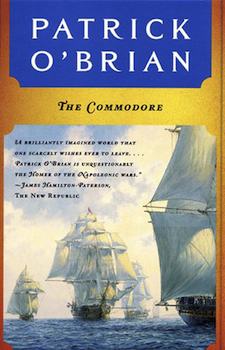
The Commodore by Patrick O’Brian

The Commodore is the seventeenth volume of the Aubrey-Maturin series, and I think it would be a very odd place to start. But as with The Wine Dark Sea, if there was nothing else around to read and you picked this up, I think you’d want the rest. I always remember the very wet camping holiday in Brittany when I was reduced to reading what everyone else had brought with them, which turned out to be The One Tree, Kajira of Gor, Wide Sargasso Sea and a Wilbur Smith book. If you’re in that situation and The Commodore is what’s available, just thank your lucky stars. But being volume seventeen, I don’t think I can say much about it without spoilers for the earlier books in the series.

Spoilers ahead.

The Commodore is a terrific book, one of my favourites. The book begins as the Surprise returns from the long voyage that has taken up so many volumes and so many imaginary years. Suddenly, we’re back in England and back in realtime—it’s 1814. Wray and Ledward are dead, but their shadowy backer, the Duke of Habachtsthal is malicious and means harm to Stephen.

Stephen and Diana’s daughter Brigid is autistic, or something like it, and Diana has played her usual trick of running away from trouble, leaving the child with Clarissa. (Oakes has been killed at sea, of course there’s been time for them to come home and for him to go out again and die!) Fortunately Padeen almost at once forms a bond with Brigid and brings her out of her inward world—I have a theory Padeen is one of the Sidhe, which makes sense of the time-difference thing and also of this curing autism, which isn’t scientifically curable. The speed of this cure over the course of the book also strikes me as implausible—O’Brian doesn’t usually rush this kind of thing. Stephen takes Brigid and Clarissa and Padeen and his fortune (in gold) to Spain, where they will be safe. Brigid loves the boat.

Jack is sent as a commodore—which was established back in The Mauritius Command as a job not a promotion—to the African coast to harry and prevent the slave trade. While there he does a great deal of that, and Stephen meets Governor Wood of Sierra Leone, and his wife Christine, who is a naturalist. (She is known in our house as “the potto woman,” because Stephen gives her a tame potto.) The fleet then sails back in time to intercept a French fleet, which they chase into Ireland, where Stephen finds Diana and is reconciled with her.

In S.M. Stirling’s Island in the Sea of Time, the island of Nantucket is suddenly thrust by mysterious and never-explained means back to 1300 BC. There’s a Naval officer character who reads O’Brian and who suddenly realises that being stuck back in time she’s never going to get any more. She decides that The Commodore is good as a proper endpoint. I once asked Mr Stirling about this, as he’s not noted for being kind to his characters, because The Yellow Admiral, which ends on a cliffhanger, would have been published in time for her to read it, and he said that this was one of those things that happened because publishing takes time; he wasn’t being nice at all. However, I think of her whenever I finish The Commodore. It is a natural ending point in a way that almost none of the other books are—they are back from their voyage and reunited with Sophie and Diana, everything begun in this book is brought to a more-or-less successful conclusion. It isn’t the end. But if you were stuck in 1300 BC, you might be glad to believe it was.


Jo Walton is a science fiction and fantasy writer. She’s published two poetry collections and eight novels, most recently Among Others, and if you liked this post you will like it. She reads a lot, and blogs about it here regularly. She comes from Wales but lives in Montreal where the food and books are more varied.

Re-reading Patrick O'Brian's Aubrey-Maturin series: ‹ previous | index | next ›
17 comments
HelenS
1. HelenS
I always thought Brigid was supposed to be emotionally disturbed due to Diana's neglect of her (though admittedly that's what people used to think autism was). But I haven't read this volume for a long time. It's one of the ones I can never place due to its generic-sounding title (well, I'm not very good with Aubrey/Maturin titles in general).
HelenS
2. peachy
I've always thought that Blue at the Mizzen was an almost perfect ending - for Jack, anyhow, as it concludes his series-long character arc. So imagine my surprise when I discovered that O'Brian didn't intend that to be the end...
Jo Walton
3. bluejo
HelenS: Diana neglected her because she was in Diana's words "rather stupid" presumably meaning "unresponsive". Stephen observes her as seeming to be in her own world, responding only to the dog, and then to Padeen.

I can't find Diana's behaviour forgivable. Typical of her, but I'm surprised Stephen could forgive it.
Claire de Trafford
4. ClairedeT
I'm not sure what to think about this book (look I've finally caught up with the re-read! but not for long as someone else is checking them out of the library and I'm hold 2 :( ) I certainly like it more than Wine Dark Sea which was good but not as griping as the rest of them so far. Everything seems to be getting a little rushed? Or is it just me?

We don't get to spend much time with Sarah and Emily, Brigid, Padeen and Clarissa as they are all rushed off to their various hostelries. We don't see enough of Jack's children and their charming nautical phrasing. What happened to poor Martin after being rushed off home from S. America - do we ever find out? Oakes is dead? Diana just suddenly gets back with Stephen right at the end. Jack does wonders in Africa and then rushes back to Ireland. Christine makes a flash in the pan appearance and I can't get a feel for her yet. And the evil duke (who I was totally wrong about in my last post) just dies and sorts everything out at the end.

Diana - hum. I've had postnatal depression and I can relate to the desire to just leave everything behind and forget about the child. But I am surprised that Stephen is so forgiving of her - what has she ever really done for him? Far more criminal to sell up her lovely horses - why would she do that!
Darius Bacon
5. Darius
The fleet then sails back in time to intercept a French fleet

I made a double-take on reading this -- what, I don't remember time-travel! How curious if O'Brian had written that sort of novel. What'd keep them from sailing back in time to suppress Napoleon at his start?
HelenS
6. reaeverywhereelse
And the evil duke (who I was totally wrong about in my last post) just dies and sorts everything out at the end.

He doesn't exactly just die--Stephen and Blaine discuss having him murdered in Chapter 4, Stephen gives Blaine and Lawrence (Jack's attorney in Reverse of the Medal) a power of attorney to access his funds, and sure enough, by the end of the book, he dies under mysterious circumstances. It's seems to me moderately clear that Blaine used Stephen's money to hire it done.
HelenS
7. a-j
I always thought The Wine-Dark Sea would have been an all right place to end with Jack's marvellous affirmation:

'...but,' he said laughing with joy at the thought, 'I am so happy to be homeward-bound, and I am so happy, so very happy, to be alive.'
HelenS
8. Donald Simmons
I like them taking on the slave trade in this book. Stephen of course believes it's an abomination, while Jack is on the fence somewhat because Nelson had said that the slave trade was essential for England and Jack's incapable of thinking that Nelson could be wrong about anything. But after his first encounter with a slave ship he shuts up about it forever.
Marissa Lingen
9. Mris
Good heavens, Jo. That's a reason never to go camping again. (Granted, my world is *full* of such reasons....)
Jo Walton
10. bluejo
Mris: The life lesson I learned was "take more books".

A-J: That's a very good point.
Claire de Trafford
11. ClairedeT
Hi reaeverywhereelse,

I'm more objecting to the fact that the duke comes and goes so swiftly. I'm sure that Stephen and Joseph did hurry along his suicide, but it just seems too pat that he is enough of a threat to move the plot along, then sorts everything out at the end.

And Jo, I bet you've always packed a few more books than you think you need after that holiday! Wilbur Smith takes me right back to when I was young enough to enjoy the books - not sure which fairy may have kissed them subsequently and I won't try ( I also have very fond memories of a series featuring kid detectives with a robot horse that they operated and won loads of show jumping classes - any takers?)
HelenS
12. HelenS
http://www.sffchronicles.co.uk/forum/42694-man-invents-robot-horse-to-win-grand-national.html mentions
Mylor, the most powerful horse in the world, by Michael Maguire. There was one sequel per
http://www.janebadgerbooks.co.uk/misc/michaelmaguire.html, but not a series as such. Were these the books you were thinking of?
HelenS
13. Pam Adams
I just went to Chapter 4 to confirm the story of the Duke. I'm not sure that Stephen has anything done. Heappers to be unwilling to commit treason. Sir Joseph, on the other hand.....

"It all hinges on him," said Blaine. "If he were eliminated, he could do no favours and all this reluctance about the pardon would vanish; and the moment they are granted the blackmailers have no hold on you whatsoever." He fell silent, but his look conveyed all he meant it to convey.

"Certainly," said Stephen. "He is as much the enemy as Ledward was, and Wray, and some other men that I have killed or caused to be killed with a tranquil conscience. But here the case is altered; and with my commitments in this country I do not think I can consider any such course."
Pamela Adams
14. Pam Adams
Of course, on my way to Chapter 4, I had to stop and re-read the bit about Jack's admiral's commodore's uniform, and of course, the wonderful bit about Mrs. Williams becoming a bookie.
Claire de Trafford
15. ClairedeT
Thanks HelenS. It sounds almost right but I'm not sure. I'll have to see if I can acquire a copy someday!

I must also agree with Pam: the uniform bit, and the Mrs Williams becoming a bookie parts were wonderful.
Pamela Adams
16. Pam Adams
Brigid is probably our best timeline for how long Jack and Stephen were gone- she's got to be four or five, judging by her language skills. Oddly, Jack's children don't seem to have aged as far.......
HelenS
17. Mary Ellen
On my latest re-reading of the series, I found the strange nature of Stephen and Diana's relationship began to get to me, so I started digging on the web to learn more about the enigmatic O'Brian. Two biographies are out there, one by Dean King and the other by O'Brian's step-son, Nikolai Tolstoy. I doubt I'll read either book, though King's other companion volumns to the Patrick O'Brian series are terrific. Still, just judging from the reviews (see Amazon.com; Patrick O'Brian The Making of the Novelist) O'Brian was more than a little weird in ways that shed light on both Maturin and Diana.

Stephen's intense secretiveness mirrors O'Brian's quite pathological reclusiveness. It seems, too, that O'Brian abandoned his first wife and two children, one of whom had spina bifida. The parallel with Diana's behavior is too glaring to ignore. I suspect that both Stephen and Diana are dark figures of O'Brian's soul. That he kills off Diana so abruptly seems to flow from a kind of self-loathing; yet throughout the series he keeps trying to redeem her (himself) through Stephen's generosity and forgiveness. More than a little sad.

Subscribe to this thread

Receive notification by email when a new comment is added. You must be a registered user to subscribe to threads.
Post a comment