


Mon
Jan 17 2011 12:08pm
She is under your protection: Patrick O’Brian’s Clarissa Oakes (AKA: The Truelove)

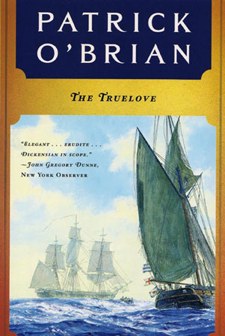
The Truelove or Clarissa Oakes by Patrick O’BrianClarissa Oakes (which has the stupid variant title The Truelove in the U.S.) is the fifteenth volume of Patrick O’Brian’s Aubrey-Maturin series, and it was the first one I read. As you can tell, I kept on reading, but I wouldn’t recommend it as a place to start. But perhaps I would—all of these books, once the series gets going, have a quality I call “forever bailing,” from Eliot’s The Dry Salvages. I mean that the books begin in the middle of things, they end similarly in the middle of things, there are ports but there is no destination, what you want is to keep sailing forever. From that perspective, Clarissa Oakes was a good place to start—I certainly wanted to know how they got there and what happened after.

On their way from Australia towards Chile, which has been their supposed eventual destination for several previous volumes, Jack is asked to look in on a colonial problem on the Pacific island of Moahu where the French are making a nuisance of themselves. Stephen, recovering from his playtpus bite, has Padeen aboard, and much worse, Oakes, one of the midshipmen, has smuggled a woman aboard, Clarissa Harlow, a runaway prisoner. Jack at first is inclined to take a dim view of things, but eventually he relents, marries her to Oakes, and puts up with having her aboard when he finds out that she is a gentlewoman and educated.

Unfortunately, she sleeps with all the officers, just to be friendly, and reveals to Stephen her abusive childhood. She’s an interesting character—not the kind of young woman you normally find in nineteenth century literature, but this is very much a modern novel. She has had an abusive childhood, she does not care for sex, she has an idea of the proprieties only as something people pretend to observe. She can’t understand why her friendliness has led to hatred and general dislike on the ship.

The affair on the island is very well done, the French and one group of islanders on one side, the Surprises and the other group on the other. The massacre when it happens is quite shocking. They do not take most of the French and Americans, who escape on the Franklin, with Surprise in pursuit. They do take a whaler, the Truelove, which Oakes is given as a command to take back to England.

This is the only book that O’Brian chose to name after a person, and it’s regrettable that the U.S. publishers chose to change that and name it after a ship, and such an insignificant and suggestively named ship at that. If they thought people didn’t want sea stories with women’s names, fie upon that.

It’s interesting that Jack’s orders usually tell him to consult Stephen and this time they don’t, because they come from New South Wales and not London, and this (along with the Padeen incident) causes a slight coldness between the men—this is soon amended, fortunately, and there are some of the best bits between them in the series as they sail on. I also like the calm way Stephen deals with cannibalism by saying human meat is taboo for them when he recognises body parts in his soup—of course it wouldn’t upset him, veteran of such dissections. Sarah and Emily are great here—indeed, the whole crew are in great form. Even after reinstatement Jack’s still feeling it a little that the Surprise is a hired ship and has no marines.

We’re still sailing out of time here. I was trying to estimate how many months and years this voyage took in terms of their lives. Stephen has just had the news of the birth of Brigid, who must have been conceived at the end of The Letter of Marque, and even allowing for delays in the post it can’t be much more than a year or let us say eighteen months since then, for the news to come? But it seems much longer than that, and O’Brian doesn’t want us to be able to work it out. It was 1812 when they left and it will be 1813 when they return, and I think six or seven years of their lives—nobody can keep track of seasons in the Southern Hemisphere, but I sometimes wonder if Jack might have looked at the stars in a wild surmise.


Jo Walton is a science fiction and fantasy writer. She’s published two poetry collections and eight novels, most recently Lifelode. She has a ninth novel coming out on January 18th, Among Others, and if you liked this post you will like it. She reads a lot, and blogs about it here regularly. She comes from Wales but lives in Montreal where the food and books are more varied.

Re-reading Patrick O'Brian's Aubrey-Maturin series: ‹ previous | index | next ›
18 comments
HelenS
1. HelenS
If I remember correctly, this is the only book of the Aubrey/Maturin series that I really dislike (and due to the name change, I probably encountered it a second time without realizing "Oh, this is the one I didn't like"). I cannot recall it well enough to remember why (I don't think it was Clarissa's history, though that was of course difficult to read about).
Rob Munnelly
2. RobMRobM
I should note that I haven't been commenting on these lately but I enjoy them. I did the full Aubrey/Maturin all the way through the last partial reconstructed book two years ago and I liked and I like hearing your take on them. Keep going, Jo.
Claire de Trafford
3. ClairedeT
Up to the Ionian Mission now and closing in fast. Perhaps I'll catch up by the end?
HelenS
4. a-j
This has my favourite medical diagnosis by Stephen when Jack asks him for advice as he feels 'damnably hipped':

'As I thought, it is your liver that is the peccant part; or at least the most peccant of your parts. It is turgid, readily palpable. I have disliked your liver for some time now. Dr Redfern disliked your liver...'
Jo Walton
5. bluejo
A-J: That's one of my favourites too. I wish doctors talked like that now!
HelenS
6. peachy
"Though upon my word," he added with a sigh, "there are times when it seems to me that nothing short of a radical ablation of the membrum virile would answer, in this case."

"That is very generally the peccant part," said Mr Florey.
HelenS
7. Christopher Byler
Any fool can hate your guts, but only Stephen can dislike your liver.

(Although Stephen has also been saying all along that Jack eats too much and drinks too much, which I'm sure is quite correct.)
Pamela Adams
8. Pam Adams
I always love the little touches- for example, the Hawaiian queen's snoring. Between the two of them, the thatched roof must have been shaking.
HelenS
9. Pendard
This is one of my favorites of the A/M series. I always appreciated the way that O'Brian can write about modern topics -- abuse, homosexuality, the ugly side of war -- in a 19th century voice. You know that writers of that period would never address the subjects in this type of story and, by adopting their vocabulary and style, O'Brian kind of gives the impression of going back to correct an accidental omission. This book is probably one of the best examples of this. Not to mention the fact the Clarissa remains a very interesting character when she reappears, especially in The Commodore.

I also love the victory celebration at the end when the Surprises show up for the feast that the islanders are throwing and discover only at the very last minute that the dead Frenchmen are on the menu! Yuck!

And I'm probably the only one who thinks so, but I think The Truelove is an excellent title, a nice bit of subtext, and much more in the keeping with the grand sounding titles of the other books in the series than Clarissa Oakes is.
Pamela Adams
10. Pam Adams
It's interesting that Jack, despite his love for the ladies, manages to resist the temptation of a woman on board, and is actually oblivious of the goings on. It's not until Pullings lays it out that he sees the problem.

Pendard@9, Clarissa's childhood is what's really going on in the background of all those Gothic novels.

Does anyone else think that Clarissa is the one Stephen should have married? She's brave, sensible, and unlikely to stomp off in a huff to Sweden, just because her husband is seen with a beautiful Italian woman. Heck, he could even recruit her as an agent.
Sylvia Sotomayor
11. terjemar
@10 Pam Adams
Re Clarissa as Mrs Stephen Maturin, no. I believe she's disqualified by interfering with his naturalizing, though if I remember correctly, she at least realizes that she is doing so and apologizes. I much prefer Christine.
Jo Walton
12. bluejo
Pam: But she's indifferent to sex, which wouldn't really be an asset in a wife.

My theory in Stephen's love life is "anyone but Diana" though.
Pamela Adams
13. Pam Adams
terjemar@11, Christine who? We haven't gotten to Africa yet!
Sylvia Sotomayor
14. terjemar
No, we haven't, have we? Sorry. Between O'Brian's stretched timeline and my own mental defects, I forget what happens before what. But I do like the scenes we have yet to encounter with Christine.
Pamela Adams
15. Pam Adams
Thinking about it, Oakes has certainly changed from the scruffy boy that Jack almost refused to take off the beach in Nutmeg. (or was it Thirteen-Gun Salute?)
Claire de Trafford
16. ClairedeT
Just finished Clarissa Oakes (my local library obviously has a mix of UK and US versions as some lists refer to it as Truelove and others as C.O). O'Brian's writing is so subtle, I love that you have to pay attention to see what is going on. Clarissa, I believe, was concerned about syphillis which was commonly treated with mercury, and who can blame her with the life's she's led so far. Her recap of her life at Mother Abbott's was fascinating and I shall do some more research into this; the total flip side of the regency romances. I believe that the two dukes she mentions were the Duke of Devonshire (fairly obvious - his celebrated menage with Georgiana and Bess Foster) and the Duke of Richmond (I think that I've seen him referred to as having a limp and he was certainly part of the Holland House set). I'm just onto the Wine Dark Sea so will see if my suspicions are correct.

Also I take it that Jack slept with the Hawaiian chief? Her response that she would treat King George with the respect that she treated her late spouse with made me chortle. Such an Aes Sedai thing to say. The obvious response should have been, 'and how did you treat your husband?'.
HelenS
17. justlila
Nitpick: it is not the bite, but the spur of the platypus that is venomous. (O'Brian got it right, of course.)
HelenS
18. Vincenzo
Alas, a year late to the party!
@Justila. While not wanting to be a party pooper, since I love the series and revere OBrian's writing as much as the next fan, I must add here that O'Brian does make (sometimes serious and jarring) mistakes, especially geographical ones: thus, e.g., the trip taken in Nutmeg of Consolation by Stephen and Martin up the coast from Sydney 1) ignores the crossing of Broken Bay, 2) ends in the Hunter Valley which is way past Bird Island (said to be near the cousin's property), 3) is later travelled to in a 5 hr boat trip, which 4) is OK (at a stretch) for the real Bird Island but less than half way to the Hunter Valley; 5) said boat trip is assisted by the usual and favorable south-easter sea breeze (whereas in reality the usual sea breeze in that area is a *north*-easter which you need to tack against when sailing north in New South Wales). And Shelmerston moves around disturbingly, even for a fictional town.. all the way from Hampshire to Cornwall.

Subscribe to this thread

Receive notification by email when a new comment is added. You must be a registered user to subscribe to threads.
Post a comment