

Tue
Feb 2 2010 2:50pm
“What everyone knows is true turns out to be what some people used to think”: Ursula Le Guin's Tales from Earthsea

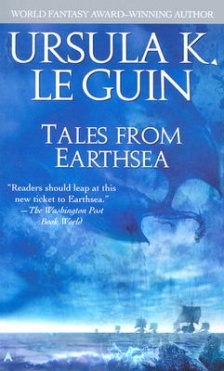
Tales from Earthsea (2001) is a collection of stories set in Earthsea, written between Tehanu (1990) and The Other Wind (2002), and clearly meant as a bridge between those two novels. Le Guin says in the introduction that “a great deal about Earthsea, about wizards, about Roke Island, about dragons had begun to puzzle me”. These stories are uncertain, questioning, puzzled stories, as different from the certainty of the first Earthsea trilogy as you could find. Le Guin is questioning the things she took for granted, and finding tentative answers, answers that go against the grain of story. This was a brave thing to do, but not always a successful one. These stories are beautifully written and contain flashes of wonder, but I neither really like them nor really believe in them. The first three books are rock solid and makes a world that feels like a real place. These stories are set somewhere wavering. Even as I get caught up in them I am thrown out of them.

“Finder” is about the founding of Roke. I quite like the beginning of it, Medra’s talent for finding and how he is enslaved and escaped, but once it gets to Roke it feels forced and I can’t believe it. Also, and this is a small thing, I really liked not seeing Havnor. Havnor’s the central and most important island, and we never went there. There’s a moment in A Wizard of Earthsea when people on some distant island ask Ged about Havnor because it’s the only place in the archepelago they’ve heard of, and he’s never been there and he has to talk about a white city he’s never seen. I liked not seeing it. It was part of the way the world was. So I was disappointed to see it, not just disappointed to see it full of pirates and evil wizards, but to see it at all.

“Darkrose and Diamond” is a love story that depends on the wizardly celibacy that was unexamined in the original trilogy and revealed in Tehanu. It’s not a bad story, but it doesn’t need to be Earthsea.

“On the High Marsh" is the best story in the book—a broken mage comes to a remote village to cure a murrain among the cows. Ged feels like himself and all the characters and the world feel solid.

“Dragonfly” is the direct bridge between Tehanu and The Other Wind and I cannot like it. I don’t like Irian, so passive. If a girl was going to go to Roke and ask to be let in, why did it have to be her? And I don’t believe she’s a dragon—it’s too easy and insufficiently grounded. I’d question why Thorion has to be a bad guy too. The only bit of this that feels authentic to me is the Master Namer being distracted by etymology.

Again—Le Guin at her weakest is always beautifully written and thought provoking, and a million times better than I’ll ever be. But I cannot like this book, and I have even more problems with The Other Wind.


Jo Walton is a science fiction and fantasy writer. She’s published eight novels, most recently Half a Crown and Lifelode, and two poetry collections. She reads a lot, and blogs about it here regularly. She comes from Wales but lives in Montreal where the food and books are more varied.

8 comments
Tony Zbaraschuk
1. tonyz
Yeah, that pretty much sums up my reaction as well. ("Dragonfly" feels right in some ways, in that, yes, some young wizards probably would pull stuff like that, but everything else about the story is just wrong.)
skinnyiain
2. skinnyiain
What did you think of the story about Ogion? I liked it, but he was always one of my favourite characters.
Jo Walton
3. bluejo
Skinnyiain: He's one of my favourite characters too.

I thought the story didn't ring true.

It's as if the early stories unconsciously didn't have any positive women in them, and in trying to address that she put the positive women in but lost the thing that made them stories. So that one: she said Ogion tamed the earthquake. Then she revised it so that he didn't do it alone, and it was a woman's skill and teaching that did it. OK. But it's kind of pointless as a story.
skinnyiain
4. mairreading
It's so funny. I read the original trilogy as a teenager, then Tehanu, the Tales and The Other Wind as they came out. My daughter (now 22) read them all as a teenager.

I love them all uncritically. I especially love Dragonfly and The Other Wind. In The Other Wind I think it's the patience of the story that I love so much.

My daughter grudgingly appreciated the original trilogy, resenting what she felt was a kind of betrayal of girls. She forgave UKL everything with Dragonfly and particularly The Other Wind, which is her favorite by a mile.

I know a lot of people like the original trilogy best, so I just wanted to put in a word the other way.
skinnyiain
5. Calimac
I agree with much of this. The stories are beautifully written, but tendentious. What bothered me most was the reactions of the male masters of Roke on being faced with a woman student. Their objections and concerns were totally unlike those of, say, the masters of Oxbridge when they were first faced with women wanting higher education.

Now this is a fictional world, so it doesn't have to follow reality. But a study of reality could have made them real characters, not silly straw men who sputter ineffectually.

The Other Wind was much better in this regard. There, even the foolish characters are sympathetic and understandable.
Terry Lago
6. dulac3
I've only read _A Wizard of Earthsea_ and remember enjoying it quite a bit, but all that I've heard about the stories and books that came after the original trilogy makes me not want to read any more of the series.

It sounds like Le Guin betrayed her story in the name of didactics. It's fine for her to decide that stronger female characters were needed, but why couldn't she have done that by making her fictional history move forward instead of being a revisionist over what already occurred?
skinnyiain
7. Calimac
dulac3 - Tehanu, I thought, did an unusually good job (as these things go) of retroactively re-reading the earlier Earthsea without undercutting those books' original meaning. Others disagree, but this is a case where it's best to read it yourself and make your own judgment.
Stephen W
8. Xelgaex
"Dragonfly" just sat with me wrong. It seemed pretty clear that Le Guin was trying to address some of the problematic gender dynamics in the earlier books, but the way she chose to do it didn't really work for me. I mean, you think this is going to be about the first woman to study what had previously been restricted to men, but then you find out that she's not human? That seems almost worse.

It's been a while since I read the books, but aren't dragons said to have an innate connection to the language that gives wizards their power? Irian doesn't really address the question of whether women's magic is truly "weak" and "wicked" because her magical ability is literally inhuman. Starting out, I thought I was reading a "it takes Jackie Robinson to integrate baseball" story, but the final effect is more like a "Jackie Robinson was a cyborg" story. So, yeah...

Subscribe to this thread

Receive notification by email when a new comment is added. You must be a registered user to subscribe to threads.
Post a comment