







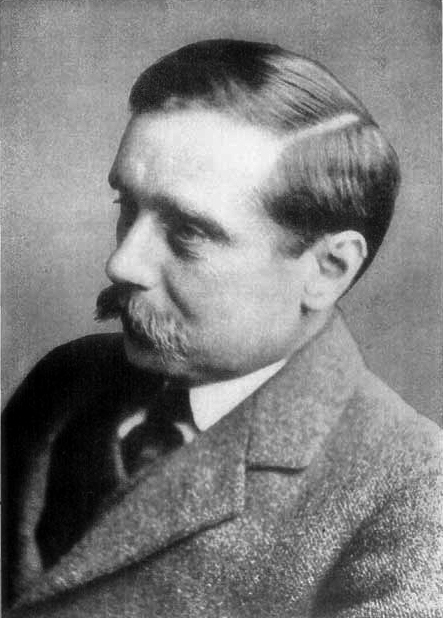
It’s H.G. Wells‘s one hundred and forty-third birthday, and Google has chosen to celebrate it with a lovely Google-Doodle. (I liked it so much I woke my husband to come and look at it.)
It’s no exaggeration to say that Wells invented English-language science fiction. More than that, there’s a sense in which Wells invented the future. Jules Verne had written science fiction in French earlier, but Verne was writing what we’d now call “hard” science fiction. All of his inventions were plausible and one step away from reality. He could have been published in Analog, if there had been an Analog. Wells was different. He wasn’t afraid to dream further. Verne’s system of propulsion for reaching the moon worked according to the best science of the day. Wells freely created anti-gravity cavorite for his. Wells didn’t just think up science fictional devices and put them into stories, he invented the whole genre and suite of techniques for writing about them. He achieved so many firsts—the first time machine, the first alien invasion, the first uplifted animals. But far more important than the specifics of his stories was the sweep of them. He didn’t just have a story with a time machine, he included Eloi and Morlocks and the ragged claws at the end of time. He didn’t just have Martians invade, he had an entire rationale for why they were the way they were. He wrote about characters the reader could identify with taking weird science or strange futures for granted with a breadth of vision that was amazing.
Wells was an immensely popular writer in his time. He didn’t just write science fiction—though it is his science fiction that’s remembered and his mainstream books that are hard to find. His science fiction can still be read today with enjoyment. It’s hard to picture how revolutionary he was as a Victorian writer. Orwell said he was telling truths nobody else would tell and making promises that there would be a future. The “truths” were partly because Wells was a Fabian socialist (though at the time Orwell was writing that he was deeply opposed to Wells’s current politics) but mostly it was because Wells had this belief in the future that blew people’s heads off. He knew we wouldn’t necessarily have tanks (“land ironclads”) and time machines and Martians, but he knew the future was there and everyone was heading towards it. He saw that science was important and change inevitable. And he told his readers that, not in prosy homilies but in exciting stories in prose both poetic and honed as sharp as a scalpel.
No one would have believed in the last years of the nineteenth century that this world was being watched keenly and closely by intelligences greater than man’s and yet as mortal as his own; that as men busied themselves about their various concerns they were scrutinised and studied, perhaps almost as narrowly as a man with a microscope might scrutinise the transient creatures that swarm and multiply in a drop of water. With infinite complacency men went to and fro over this globe about their little affairs, serene in their assurance of their empire over matter. It is possible that the infusoria under the microscope do the same. No one gave a thought to the older worlds of space as sources of human danger, or thought of them only to dismiss the idea of life upon them as impossible or improbable. It is curious to recall some of the mental habits of those departed days. At most terrestrial men fancied there might be other men upon Mars, perhaps inferior to themselves and ready to welcome a missionary enterprise. Yet across the gulf of space, minds that are to our minds as ours are to those of the beasts that perish, intellects vast and cool and unsympathetic, regarded this earth with envious eyes, and slowly and surely drew their plans against us.
Everybody read him and talked about his work. He shaped everybody’s imagination. He didn’t so much invent science fiction as plant the seeds that science fiction could later reap.
If he’d been in cryogenic sleep (another of his imaginations) for the last sixty years and could be woken today he’d find a lot wrong with our society—in particular he’d be saddened by the social inequities that still persist. But he’d also find much to marvel at in the advance of technology, and in the advance of science fiction. I can picture Wells today lamenting the absence of flying cars as he’s downloading Greg Egan on his iPhone.
Jo Walton is a science fiction and fantasy writer. She’s published eight novels, most recently Half a Crown and Lifelode, and two poetry collections. She reads a lot, and blogs about it here regularly. She comes from Wales but lives in Montreal where the food and books are more varied.
