




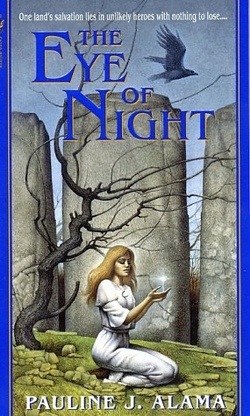
A disillusioned priest wanders from town to town in a land cursed by destruction and sorrow. He discovers a beautiful lady with an infantile mind, her dwarf servant and caretaker, and the Eye of Night, a powerful artifact destined to save—or destroy—the world.
Pauline J. Alama’s The Eye of Night is a different kind of high fantasy tale, a panacea for every stereotype you run into repeatedly in what I term the traveling-party-on-a-mission-from-God sub-genre. A less kind person might call them Tolkien rip-offs.
Fortunately, at its best, The Eye of Night is no Tolkien rip-off.
For one thing, there are no elves, Tolkien dwarves (just human dwarfs), or orcs. The best people are not hallowed and noble elves, but humans; the worst people are not homogenously bad orcs, but humans. Nor is there, for that matter, a 99.9999%1 noble people in any hold or city. No rulers are fair, either; the sanest group of people, in fact, are in beleaguered isolation and still looking for the lost scion of a king whom they no longer, in fact, need.
In that sense, the world of The Eye of Night is certainly more anchored in reality than most entries in the Lord of the Rings of the Month Club. But there are ghosts, magic, and gods—indeed, the religion is a well-developed player in the quest, if only under subversive means.
And then there is, uniquely, the Eye of Night. If there are any other magic objects in this world, they never appear, and the ones reputedly magical are shown to be frauds. Magic is used even more sparingly than in Lord of the Rings.
Usually when you’re marching a magical artifact to the Trouble in the North, it’s a given that getting the artifact to its final destination will save the world, and just about everybody who isn’t linked to the Big Villain will help you once misunderstandings pass. But the Eye of Night is itself a mystery as to what it means, what it will do, whether it will save the world or end it. What drives the mission is not a need to save the world, but a need to bring about destiny (and maybe make the prophetic nightmares stop). Naturally this doesn’t sit well with most people that the three main characters run across.
As for the big villain—the world’s agony is more a natural disaster than the result of craven desires of any one man.
And the character for whom this is a journey of development? That’s Jereth, the not-quite middle-aged priest, rather than the wiser but far shorter Hwyn. Hwyn has had a difficult life, beginning with an abusive father, and while she is the one carrying the Eye of Night and its driving urge to meet destiny, she is far more world-wise than any hobbit or young farmer for which this might have been a Bildungsroman. I’ve also never read a fantasy Bildungsroman for those out of their 20s, but if there is one, The Eye of Night is it.
(The developing character is definitely not the idiot, Trenara, who is often treated as a random pet in high-born lady silken skirts. She’s not great for conversation or doing anything that requires concentration or skills, including cutting her own food, unless it’s dancing or listening to you vapidly for hours on end. She’s sort of the Bill the Pony of the group, except far more amusing and, to me, sweet. Innocence has a high price in The Eye of Night, but on the other hand, she does not get eaten by a grue.)
The first half of The Eye of Night is certainly the best part of the book, as Jereth, Hwyn, and Trenara walk from town to town and city to city, interacting with people in this still well-drawn world, and learning from each other (well, at least on the parts of Jereth and Hwyn. Trenara does at least know which berries aren’t poisonous). The controversy of the Eye of Night, considered a blasphemy even by the people who don’t want to kill them, keeps things interesting.
And then we hit the middle of the book, hard. While it certainly is different for the characters to spend a full third of the book in a tiny, and I mean tiny, as in there are fishing villages in late 19th century Japan that have higher populations, farming community mostly secure in the highlands. Not that there’s anything inherently wrong or boring with this, and indeed, if the middle was perhaps half as long, there would have been enough plot tension.
But instead, the tension of the journey’s mission is left by the wayside for an in-depth look at the relationship incrementally blossoming between Jereth and Hwyn, one of whom is not young, and the other of whom is not at all pretty, playing against stereotype successfully again.
The thing most lacking is the execution.
Fascination starts to ebb as Jereth and Hwyn endlessly talk, and while there is tension between them (Jereth doesn’t like Hwyn’s new village position), there’s nothing that dampens tension better than complete repetition of previous character development points multiple times in lackluster dialogue.
Now, imagine the equivalent of 200 pages of that.
Eventually the plot does pick up its baton and runs on to a smashing ending…
… wait …
… it’s not an ending! The book goes on for over 100 more pages post-climax, and then wraps itself up in one of the most personal-costs-removing really-stretched-out Happily Ever Afters I have ever read. It’s nice that everybody gets what they deserve, but while that plays against a lot of high fantasy, that is, um, actually a good attribute of high fantasy.
So. What can I say? An extremely promising first third, a lackluster second third, and an exciting and unsatisfying last third with a literal deux ex machina.
On the other hand, the good characters are certainly happy. You can’t say that for Lord of the Rings.
1
Wormtongue, I’m looking at you.
