




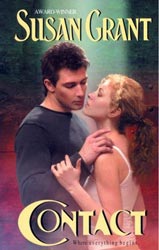
Science fiction romance author Susan Grant came onto the scene with Contact (2002), and the direct, no frills title suitably fronts a story with a very dark premise.
First Officer Jordan Cady is a commercial airline pilot whose aircraft is captured by an unknown force en route to Hawaii. When the captain dies of a heart attack, Jordan assumes the mantle of captain as well as the responsibility for the lives of her passengers.
Adversity becomes the word of the hour as Jordan and her charges investigate the tragic turn of events. Even more disturbing than the identity of the captors is the catastrophe that follows.
The passengers of Flight 58 inherit the dubious status of being the only living survivors when Earth is destroyed following their capture. Gone are their loved ones and the only habitat they’ve ever known.
Employing a style that Publishers Weekly called “masterful realism,” Susan Grant paints an intense picture of how such a scenario might unfold. The realism is underscored by Ms. Grant’s background as a commercial airline pilot and the contemporary setting. Both elements heighten the tension because it makes the characters and situations instantly accessible. For example, Jordan loses her six-year-old daughter (whom she affectionately refers to as “Boo”), but has nary a moment to grieve because the passengers need her more.
In other words, it paints a very realistic picture despite the fantastical plot.
Contact is one example of a story exploring themes of loss and abandonment in science fiction. Only the stakes are a hundred times more immediate and about as high as they could become when planet Earth is also a victim. It’s one thing to be separated from this beloved planet—the only one millions of us will know in our lifetimes—and quite another for it to be lost to us forever.
Susan Grant takes the time to explore some of the psychological processes resulting from such trauma. Even as the characters strive to adjust to their new surroundings and must face an uncertain future, the keenness of their loss is ever present and undiluted. The romance between Jordan and Kao, one of the captors, is also rendered realistically. It provides a flicker of hope, a candle that helps drive away the darkness, but it does not sugarcoat the predicaments of Jordan and her intrepid passengers.
Other stories have also explored the themes of humans being separated from Earth, Earth’s destruction, or its location lost to history. These include shows like Battlestar Galactica, Star Trek: Voyager, Farscape, and Space: 1999, to name a few. Books in this category include Isaac Asimov’s Foundation and Empire series; Dan Simmons’ Hyperion Cantos series; The Hitchhiker’s Guide to the Galaxy by Douglas Adams, and the Dumarest saga by E.C. Tubb.
I hope that Earth never becomes lost or destroyed, or that anyone must endure the trauma of separation from our home world. However, Contact and stories like it are part of what makes speculative fiction so fascinating and also relative, casting our emotions of loss and grief in sharp relief, on scales both large and small.
If you have a favorite story that explores these themes, please feel free to share them.
