






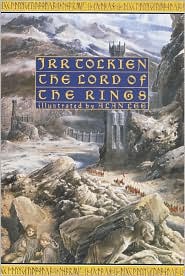
In comments to a prior Lord of the Rings re-read post, we’ve been talking about the narration’s assertion that Tolkien was the translator of a Middle-earth manuscript. Then, last night, I was looking for something else in a collection of criticism* and came across Verlyn Flieger’s “Tolkien and the Idea of the Book,” something I’d skimmed previously but not found relevant. Since it is now, I thought I’d summarize it for your consideration.
Flieger examines Tolkien’s “intentional, interconnected efforts to bridge the fictive world of the story and the outside, real world, to connect inside with outside and fantasy with actuality through the idea of the book.” She starts with a bit of trivia I hadn’t known: in the title-page of LotR, the header and footer translate as: “THE LORD OF THE RINGS TRANSLATED FROM THE RED BOOK OF WESTMARCH BY JOHN RONALD REUEL TOLKIEN(.) HEREIN IS SET FORTH THE HISTORY OF THE WAR OF THE RINGS AND THE RETURN OF THE KING AS SEEN BY THE HOBBITS.”
Something else I hadn’t known: the Red Book of Westmarch was modeled in name after “the great medieval manuscript books whose names sound like an Andrew Lang color series for the Middle Ages . . . most important(ly) . . . the real Red Book of Hergest.” Yet Tolkien’s Red Book is more coherent narratively and more specifically traceable back to earlier manuscripts than most of these. These qualities were not always present: it was not until the second edition of LotR that the Red Book covered history as far back as the First Age, or was given a line of named “author-redactors,” or was said to consist of the hobbits’ personal diaries plus Bilbo’s three annexed volumes.
Why these changes? Flieger “draw(s) the fairly obvious conclusion that Tolkien’s final scheme envisioned the combined set of these three volumes (Bilbo’s ‘Translations’) plus The Hobbit and The Lord of the Rings as comprising the ‘ideal’ or archetype Red Book of Westmarch. Moreover . . . this archetypal ‘book’ was intended to encompass the entirety of his published fiction.” In other words, the not-yet-published bits of the Red Book would have been “The Silmarillion” (scholarly convention appears to be to distinguish the encompassing mythological work Tolkien never finished from the published posthumous work by putting the former in quotation marks).
Flieger then discusses how Tolkien’s view of Bilbo’s sources changed over time, which I will pass over for the effect of Tolkien’s conception, which was to have an imaginary construct (Bilbo’s “Translations”) that he hoped to make an actual thing (“The Silmarillion”), thereby “buttress(ing) his story.” Flieger argues that Tolkien was influenced by the coincidental discovery in 1934 of a “real-world analogue,” the Winchester College manuscript source of Malory’s Morte D’Arthur, another extended mythology.
This, according to Flieger, may have had two effects on Tolkien. One was internal to the story: she proposes that “the Winchester manuscript was the model for the book Sam Gamgee conjures . . . on the Stairs of Cirith Ungol,” that is, “a great big book with red and black letters” being read “years and years afterwards”—a perfect description of the Winchester manuscript. The other was external: “the successful publication of the Winchester might have suggested to him that there could be an audience for so large a mythological work.” This, Flieger suggests, may be why Tolkien had so hoped to have “The Silmarillion” and The Lord of the Rings published together, which otherwise seems “impractical and unrealistic.” It may also explain another peculiarity of Tolkien’s, the denial that the Matter of Britain was a proper English mythology: he may have been thinking of it, consciously or no, as a rival to his work.
Flieger concludes by noting the irony that, for all that the non-publication of “The Silmarillion” during Tolkien’s life grieved him, the delay actually enhanced its resemblance to its real-world models.
This paper doesn’t give me a lot of guidance in how to read LotR as a translated medieval manuscript (not that that was its goal), but it does give me an additional sense of just how important the conceit was to Tolkien.
* The Lord of the Rings, 1954-2004: Scholarship in Honor of Richard E. Blackwelder, ed. Wayne G. Hammond and Christina Scull, Marquette University Press, 2006.
