

Note: In this post I will use both the Wade-Giles and Pinyin systems of transliteration. Yeah, I’m a rebel.
Also also note: I guess I am supposed to say this book review contains spoilers. Of course it does. It’s a book review. The book came out in 1592, so you may have had a chance to read it.
Xiyouji, or The Journey to the West, ranks with The Romance of the Three Kingdoms, The Story of the Stone and Outlaws of the Marsh as one of the four great classics of Ming Dynasty literature most gweilo will never read.
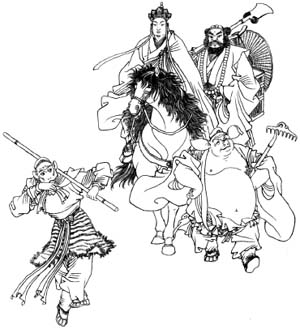
But its relative obscurity among ghost-faced big-nosed foreign devils is no reason not to enjoy it. It is a fantastic story, in every sense of the word. It tells the tale of a Buddhist monk and his four supernatural disciples (a monkey, a pig-man, a disgraced general from heaven and a dragon made into a horse) as they travel from China to India. In the course of 100 chapters, the disciples fight demons, anger gods, steal from immortals, escape from wild traps, and often cause more trouble by trying to solve a problem than they would have by leaving it alone.
Xiyouji can be read by those who know nothing about Chinese religion or folklore as an epic adventure, full of humor, monkey violence and poetry. For those who study Asian culture, the story provides an even richer experience, as the subtext offers a fascinating look at the perplexing religious multiplicity of Chinese society. And poop jokes.
Some readers will only see absurdity in Xiyouji; others will focus on religious or social satire. As with Gulliver’s Travels or The Odyssey (its closest Western equivalents), no single focus of interpretation can suffice. The true nature of Xiyouji is the harmonic of lyricism, religious musing, manic bloody adventure, childish humor, wanderlust and satire.
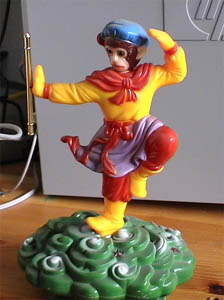
I think this combination is the reason the story has been immensely popular in Asia for centuries. It’s been made into TV shows, opera, video games, manga, cartoons (including Dragonball Z) and several movies. I got a Monkey King doll in Hong Kong that lights up, spins around on a green cloud and plays “It’s a Small World” for no apparent reason. Coolest toy ever.
I’m told an early concept for the fourth Indiana Jones film centered on Xiyouji, but rather than go with that marvelous idea, Spielberg created “Indiana Jones and the 123 Minutes You’ll Never Get Back.”
About the Guy Who is Probably the Author:
As with many classical Chinese works, the precise authorship of Xiyouji is impossible to verify, but it is generally attributed to the poet Wu Cheng-en of the late Ming Dynasty (that’s the 16th Century to you and me, Rusty). Wu Cheng-en, a scholarly son of a merchant, failed the civil service exam several times and spent two years in prison on a charge of corruption that was later found to be bogus. All of which may have led to Wu Cheng-en being a wee bit cynical. And who better to write a satire than a bitter and literate ex-con?
Some Buddhist History Stuff You Can Skip if All You Want to Know About is Monkeys:
Long, long ago, in a subcontinent far, far away… Shakyamuni (aka Siddartha Gautama, AKA the Buddha, AKA that guy you see statues of in various home décor stores) attained enlightenment and spent the next several decades figuring out different ways to explain what he understood to people of varied capacities.
After his death by dysentery (which makes me glad that, unlike Christians, Buddhists don’t use a representation of their founder’s death as a symbol) the Buddha’s teachings were passed on as oral tradition for a few centuries before being written down in Sanskrit or Pali. Along the way, several schisms and schools developed, the major divisions being the Hinayana (lesser vehicle) and Mahayana (greater vehicle). As you can probably guess, the Mahayanists came up with those names.
When Buddhism spread outside of India, the Mahayana schools traveled first and the Hinayana followed much later. Because of that, the introduction of Buddhist sutras into China came in multiple versions and in no particular order. Debate raged for centuries as to which teachings were complete and what the order of the teachings really was.
Several prominent Chinese monks made pilgrimages to India, hoping to answer the age-old question, “Which came first, the Buddha or the Dharma?” The most famous of these pilgrims was Xuanzang (602-664) who traveled through India and central Asia for seventeen years, translating some 75 sutras and recording his experience in the Record of the Western Regions of the Great Tang Dynasty. The account is scholarly—similar to an anthropological study—and cannot be considered an intentional work of fantasy. Over the centuries, however, the true story of Xuanzang’s journey became aggrandized and mixed with folktales, resulting in the strange and magical Xiyouji.
(Part one of three.)
VIEW ALL BY · Thursday December 11, 2008 04:07pm EST
(Haven't read the others, either, since neither reading Barry Hughart's _Story of the Stone_ nor putting _Romance of the Three Kingdoms_ upstairs on the to-be-read shelf counts . . . But one of these days, honest.)
VIEW ALL BY · Thursday December 11, 2008 04:21pm EST
VIEW ALL BY · Thursday December 11, 2008 04:51pm EST
So what's with all the reclining Buddha's then?
I'm not sure Dragonball Z counts as a retelling of the story, but Dragonball sure does. At least it seems to me that while the characters in Dragonball seem to be going somewhere, all the characters in Dragonball Z seem to do is talk about the next goofy superpower battle while standing still.
VIEW ALL BY · Thursday December 11, 2008 04:54pm EST
VIEW ALL BY · Thursday December 11, 2008 04:58pm EST
I'll take your word on the Dragonball thing. All I know is that the series is related to Journey to the West...beyond that I don't know much at all about Dragonball or Dragonbal Z.
VIEW ALL BY · Thursday December 11, 2008 05:04pm EST
http://www.youtube.com/watch?v=Yr5ZWYRaAyw
VIEW ALL BY · Thursday December 11, 2008 05:17pm EST
That was damn cool!! Thanks!
Thursday December 11, 2008 07:12pm EST
Did you know that the Wu Ch'eng-En book was the basis for a British cult TV series in the '70s called Monkey or Monkey Magic? Here's one of the DVDs on Amazon.
VIEW ALL BY · Thursday December 11, 2008 07:17pm EST
Monkey Magic, Vol. 3: The Quest Begins
Actors: Kathleen Barr, Don Brown, Ted Cole, Richard Ian Cox, Michael Dobson
Writers: Ch'eng-En Wu
Producers: Dorine Maze
Studio: Bandai
ASIN: B00000K4Z7
VIEW ALL BY · Thursday December 11, 2008 08:30pm EST
VIEW ALL BY · Thursday December 11, 2008 09:22pm EST
The Theravada school went south to Sri Lanka and then stalled out for a while before gradually expanding into Southeast Asia. Mahayana went up into Afghanistan and hit the Silk Road, which mainlined it into China. Strange fact: there were eighty meter-tall cliff statues of the Buddha in Afghanistan up until the 1970s, when the Taliban dynamited them.
tudzax1 @ 3: I've seen perhaps two or three episodes of Dragonball Z, but I can tell you you're leaving out an important episode type: the incredibly anti-climactic showdown. One episode I saw consisted entirely of the main character thinking, "Oh no! He's too strong! I must use [superpower_megaawesome]! But it takes about half an hour to charge. Hm!" then getting thrown through various major geological features while trying to maintain his concentration until, at the very end, the other guy goes, "Oh ho ho, I see what you're trying to do there sneaky boy! Doink!" and pokes him on the forehead. Then all the hero's power dissipates and the episode ends. Excitement!
VIEW ALL BY · Thursday December 11, 2008 10:27pm EST
VIEW ALL BY · Thursday December 11, 2008 10:48pm EST
I'll look forward to the rest of your review.
VIEW ALL BY · Thursday December 11, 2008 11:35pm EST
@13
That's fabulous. Rock on, ghost-face. Postmodernism and Ming lit. How fun is that? I'd love to know more. Maybe Jacques Derrida could do a cloud somersault.
@ 10 & 11
Regarding the whole Hinayana/Mahayana thing...It is unfortunate that a group became known by a pejorative. For a while there's been a general sense among Mahayana practitioners that it's not too cool to use the term Hinayan (though I can't say they're in any hurry to stop using Mahayana to describe themselves).
It's also pretty common, and less dismissive, to say Northern and Southern schools. Northern being the schools that developed in China, Japan and Korea, mainly, and the southern being the schools of southern India, Sri Lanka and various southern Asian countries. I generally think this is a better way to delineate the major divisions, but I figured if I said Northern and Southern in my post, very few people would know what the hell I meant.
@11
The Taliban thing was terrible, no doubt. Are you sure about the 70s, though? I thought it was much more recent than that. Or did they do it more than once?
There were times (especially during the Mauryan Dynasty) when Afghanistan was among the most religiously open societies the world has ever known. To me, the tragedy of what the Taliban did has less to do with the destruction of the statues (which was lousy enough) but more with the death of a spirit of tolerance and acceptance that had once been such a strong part of the culture there.
VIEW ALL BY · Friday December 12, 2008 12:22am EST
Nope! Could have been much more recent. I'm quite sure about the Taliban part, though.
Afghanistan has a fascinating history--actually, most of central Asia does. A professor of mine showed us a blurry picture he had taken of a Buddha statue flanked on one side by what is clearly Heracles, club and lion-skin and all. The classical depiction of the Buddha comes from Greek statuary traditions brought to Afghanistan by Alexander. That's where the funky snail-shell hair comes from--tight Greek curls carved by people who have never seen them. Neat, huh?
VIEW ALL BY · Friday December 12, 2008 01:02am EST
VIEW ALL BY · Friday December 12, 2008 01:27am EST
Ok. That's about what I thought. I just wondered if maybe that sort of thing had happened more than once.
@heresiarch
I had no idea about the Hercules thing. Very cool. I love studying the mixing of cultures. Speaking of Greco-Buddhist crossovers, have you ever read the Milindapanha? I've read portions of it. I hope to read the whole thing some day.
VIEW ALL BY · Friday December 12, 2008 11:54am EST
People probably know this story very well, they just don't know it yet, heh.
VIEW ALL BY · Friday December 12, 2008 01:04pm EST
It's like this: two of the most popular singers in recorded history are Ashe Bonsle and Oum Kalthoume (spellings vary). If I were to mention them in a website devoted to foreign films or belly dancing, they wouldn't be obscure at all to those audiances. Know what I mean?
VIEW ALL BY · Friday December 12, 2008 03:36pm EST
I didn't know she was that popular, though.
VIEW ALL BY · Friday December 12, 2008 04:25pm EST
Your Dad sounds cool!
In the Arabic world, she's astoundingly popular. My grandmother was Lebanese, so that was my intro to her.
Here's a story about how beloved she was...I don't remember the exact details, but during the political troubles in Egypt in the 60s, there was this huge turmoil over who should lead the country. Oum Kalthoum voiced her support for one of the faction leaders, and after that, bam, the dude was in charge. Everyone figured if he was good enough for her, he was good enough for the country. She was that well loved. Amazing, eh?
VIEW ALL BY · Friday December 12, 2008 04:44pm EST
I know what you mean, I also feel like I've heard about it happening earlier, regardless of whether I remember that particular incident the best. However, I couldn't find anything in my (admittedly cursory) search for reference.
VIEW ALL BY · Friday December 12, 2008 10:12pm EST
jasonhenninger @ 17: "I had no idea about the Hercules thing. Very cool. I love studying the mixing of cultures. Speaking of Greco-Buddhist crossovers, have you ever read the Milindapanha?"
Is that the Greek king/Buddhist monk dialogue? I've heard of it, but never read it. Fascinating, though!
VIEW ALL BY · Saturday December 13, 2008 08:43am EST
Are you perhaps thinking of this show: Saiyûki?
Dubbed into English, and somehow maintained the campy feel of the original*. I *really* wish I could find subtitled versions of the Japanese dialogue.
(*) I mean, really, given the quality of the costumes, sets and acting, this was obviously not a show that took itself seriously.
VIEW ALL BY · Saturday December 13, 2008 12:26pm EST
Dragonball Z or Dragonball is totally different from The Journey....
They only use the same name of main role(Monkey King). Of course, Dragonball bowes to The Journey....
VIEW ALL BY · Saturday December 13, 2008 12:41pm EST
Actually, The Story of the Stone is one great classic of Qing Dynasty literature. Your list is four great classics of Chinese classical literature. The four great classics of Ming Dynasty literature should be The Journey to the West, The Romance of the Three Kingdoms, The Golden Locus(Other conventional transcription: Jin Ping Mei, or The Plum in the Golden Vase, or The Adventuros History of Hsi Men and his Six Wives) and Outlaws of the Marsh.
VIEW ALL BY · Saturday December 13, 2008 12:49pm EST
This Buddhist only has three disciples actually (a monkey, a pig-man, and a disgraced general from heaven), the dragon is only one servant, who ate the Buddhist(Tang Sanzang)'s white horse, so he is subdued by Monkey King(Sun Wukong) and is changed into the white dragon horse for the Buddhist to ride on the way.
VIEW ALL BY · Saturday December 13, 2008 01:27pm EST
In other words, way to bring the mutha fuckin' ruckus :) I think I need to go revisit the 36 Chambers now...
VIEW ALL BY · Saturday December 13, 2008 02:41pm EST
I'm very glad you're enjoying it!! Hope the next two parts are engaging as well.
@armrow
You obviously know your stuff, and I stand corrected on the date of the Story of the Stone, but I disagree about the horse/dragon. In the strictest sense, ok, he isn't a disciple in the formal manner the three others are. But as with the other three, there are transgressions atoned for through service to the T'ang Monk and in the end he's rewarded, just as are the other three. So, really, how is that not a disciple?
VIEW ALL BY · Saturday December 13, 2008 08:40pm EST
VIEW ALL BY · Saturday December 13, 2008 08:49pm EST · amended on Saturday December 13, 2008 08:57pm EST
Edit: And by the by, I created what I think are better versions of the Munseys free ebooks. Here they are, in ePub and Kindle/Mobipocket. One might want to settle in with an ebook, because Journey to the West is some 1200+ pages in print. (It reads very quickly though.)
VIEW ALL BY · Saturday December 13, 2008 09:02pm EST
Actually, Oprah is the Arabic Oprah.
VIEW ALL BY · Saturday December 13, 2008 09:26pm EST
VIEW ALL BY · Sunday December 14, 2008 12:07am EST
That's very cool that you put them up as ebooks!!
I've never read the Jenner translation. How does it compare to others? In the next part of my post of Xiyouji, I talk a bit about translations.
@davidlev
I also like the sort of serialized chapter endings. It's a fun addition.
And I know what you mean about the priggishness of the monk, in fact I'll talk a little about it in the next segment.
Or will I?
VIEW ALL BY · Sunday December 14, 2008 05:45am EST
Jenner preserves all the verses alongside the prose. He doesn't do the "Arthur Waley SMASH!" thing where all the verses are prosified.
On another note, I have also read various translations of The Tale of Genji. One of them was Arthur Waley's version. No. Just, no.
(P.S. To people wanting to try out The Tale of Genji, I would go with the Royall Tyler translation.)
VIEW ALL BY · Sunday December 14, 2008 11:46am EST
"Arthur Waley SMASH!"
Heh heh...that cracked me up. "Don't make me angry...you wouldn't want me to translate when I'm angry..."
I'm certainly no fan of Waley, as I'll make pretty damn clear in my next segment. Glad to know I'm not alone in that!
Whose Genji translation do you prefer?
VIEW ALL BY · Sunday December 14, 2008 12:02pm EST
We can't use the "rewarded" as the judgement rule of the disciple. As one formal disciple, he should get one Buddhist Name, like Wu-Kong(monkey), Wu-Neng(pig-man), and Wu-Jing(disgraced general from heaven) in Chinese Buddhism. It is different from Indian Buddhism.
VIEW ALL BY · Sunday December 14, 2008 12:25pm EST
The progression of translations seems to have gone like this:
1. Arthur Waley SMASH!
2. Edward Seidensticker sticks pieces back together with crazy glue
3. Royall Tyler sands down crazy glue bits sticking out of the joints, and paints over the cracks with almost-original color
Waley and Seidensticker did their best to avoid the original text's, how can I describe this, dream-like surreal ambiguous chattiness cut with Japanese Heian era poetry, because it was just too hard. It was court language; everything was ambiguous. Most characters don't even really have names in this book, being instead referred to by their position, occupation, trees in the palace gardens that they liked... and yes, those things change throughout the novel. And then there's the extensive indirection...
You could do it by turning everything into prose and cutting out the "irrelevant" pieces (Waley), or you could do it by a straightforward literal translation (Seidensticker). (I suppose at least Waley's wasn't boring.)
Royall Tyler did his best to bring back the original tone of the novel, all of its text, while making sure that modern readers could understand what was going on without relying on footnotes the whole way. As a result, his version actually reads like a proper story that you could see having been written in that place and that age.
Anyways. Genji is a multi-generational twisted romance, and Journey is an adventure novel. I think Genji is showing its age because the story is so tied to that era in almost every way, but Journey seems to persist because it's more down-to-earth. Everyone can understand throwing demons into rivers; not everyone can get into the significance of the suddenly changed set of inner sleeves in court dress.
VIEW ALL BY · Sunday December 14, 2008 12:48pm EST
As you make much of Tenji, I recommend that you read The Story of the Stone, you will find one new world.
VIEW ALL BY · Sunday December 14, 2008 02:38pm EST
I've already read it. *grin* That little series that started with Bridge of Birds is one of my favorite series ever.
VIEW ALL BY · Sunday December 14, 2008 07:53pm EST
May we hold off on further discussion of the horse's status? In the third section I go into more detail on my feelings about the characters. Do you mind picking up the discussion again at that point?
@arachnejericho
I want to give the Genji another try. What I read was a)long ago, b) abridged and c) I have no memory of who translated it.
VIEW ALL BY · Sunday December 14, 2008 08:28pm EST
I have this crazy idea for a story set forty or fifty years in the future where Oprah has become a sort of an underground Mary figure within Saudi Islam. "I heard from my mother, who had it from her cousin, who heard it from her sister, who read it in an illegal copy of O that Oprah said..."
VIEW ALL BY · Sunday December 14, 2008 09:28pm EST
Also, Maya Angelou might be there, or it could be John Travolta...the vision is a little cloudy.
In any case, go for it :)
VIEW ALL BY · Tuesday December 23, 2008 02:52pm EST
My first exposure to "The Journey to the West" was a Shaw Brothers(?) cinematic adaptation that my grandmother took me to, then there was the B&W comic version (published pre-1980) which had all 100 chapters, before getting my hands on the abridged Waley, then watching the TV series.
This & Tolkien were seminal influences & shaped my taste as a young reader.
Sunday December 28, 2008 01:43pm EST
VIEW ALL BY · Friday January 02, 2009 04:59am EST