



Sometimes, not every month, but every few months, I come over all Victorian and have pains in my stomach and want to spend a day lying on the couch reading Jerry Pournelle. When I feel like that there really are very few books that satisfy me—I want black-and-white military fiction with good and bad clearly delineated, guns, obstacles, military training, things blowing up, glory, death, and the good guys definitely winning. Also, it has to be written to a certain standard. I don’t want rubbish just because I’m in that particular mood.
It isn’t only Jerry Pournelle that scratches this itch. He’s the best, especially when he’s writing on his own. He can bring tears to my eyes with lines like “The sergeant survived? Then the Legion lives!” There’s also Piper, Weber, John Barnes’s Timeline Wars books, and more recently I’ve discovered W.E.B. Griffin, whose books are not SF but straight military historical fiction. (“Wow,” I thought when I read Semper Fi, “a whole book about Bobby Shaftoe!”) I can also thank this reading mood for my discovery of Lois McMaster Bujold, who I adore even on days when I don’t want to bite something.
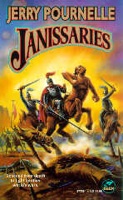
But when I’ve got those cramps and that urge, the canonical most perfect book in the world for me is suddenly Janissaries.
Janissaries would push a lot of my buttons at any time. There’s a planet, Tran, where groups of people from Earth have been taken by aliens at 600-year intervals to grow drugs. So they have brilliant weird cultures, because they came from different parts of the planet and at different tech levels. There are Romans who have copies of Roman books we don’t have. They also have interestingly weird tech, because it’s merged oddly. So when our heroes give them gunpowder, things get interesting. You get new military formations, for instance. And beyond all of that and the good guys and bad guys and the things blowing up, there are fascinating hints of a wider universe and Other Things Going On. Oh, and it’s got a girl. I mean, of course it’s got a girl, even W.E.B. Griffin has girls, but it has a girl who isn’t just there as a prize and a sexual partner—well, it has one of those too, but it also has a major female character who does significant things.
They don’t make military adventure fiction better than this, and you get bonus extra history of tech stuff thrown in for free.
There are some sequels, by Pournelle and other people, or by other people on their own, which I have read once and never felt the urge to pick up again. My original copy of Janissaries has been read so much it’s in danger of disintegration.
A little while ago as I was putting it back, I admired the serendipity of alphabetical order, that allows Marge Piercy, H. Beam Piper, Plato, Karl Popper, Jerry Pournelle, and Tim Powers to sit so peacefully on the shelf together.
VIEW ALL BY · Thursday September 18, 2008 10:16pm EDT
I'm with you on John Barnes too - the timeline wars books are perfectly in that sweet spot where books are a bit rubbish, but the *right* sort of rubbish.
The ultimate comfort read is still Modesty Blaise novels, but I've practically got them all memorised by this stage, and there are no more forthcoming. (Which is the only reason I've ever gone looking for fanfiction, hoping to find some new MB stuff which is like the old. Sadly I've found MB + James Bond Crossovers, MB + Buffy fighting demons in hell, but nothing that tries to be like the originals)
Thursday September 18, 2008 10:30pm EDT
But I've never read Janissaries, so now I'm tempted to try it.
VIEW ALL BY · Friday September 19, 2008 03:36am EDT
However, when I am in need of really being cheered up, nothing beats Lucifer's Hammer. I have found that nothing gives you a real boost more than reading about the end of the world... John Wyndham tends to have a similar effect.
VIEW ALL BY · Friday September 19, 2008 06:17am EDT
Though not on the list, Battle Cry by Leon Uris would be an example of a good mil. book :) plenty of good action stuff, the whole growing up routine, and a bittersweet ending
VIEW ALL BY · Friday September 19, 2008 12:12pm EDT
For me, Keith Laumer and H. Beam Piper are the people who scratch that itch Jo talks about, as well as Heinlein o a certain extend.
Friday September 19, 2008 12:14pm EDT
Lucifer's Hammer may be the book I have recommended the most over the years.
VIEW ALL BY · Friday September 19, 2008 12:19pm EDT
VIEW ALL BY · Friday September 19, 2008 02:32pm EDT
And I agree that his politics are very much evident in his storylines - a fact that I am a little bit reserved about also.
For a lazy afternoon read, it has to be Peter F Hamilton or Iain M Banks for me.
VIEW ALL BY · Friday September 19, 2008 04:12pm EDT
Bujold does something a little different, but I'm still addicted to Miles vorKosigan and his habit of sliding down the bannister of life knocking down anyone crazy enough to get in his way. Moon I admire immensely for showing the military for the human institution it really is, and still making us respect the warriors in it. I've only read the Barnes stories twice now; they led me to the "Giraut Leones" books which I enjoy enough to reread at least one of them a year.
The only one of my favorites that hasn't been mentioned here is Drake's Hammer's Slammers stories. They're gritty and there's maybe a little too much information about the consequences of a weapons hit on a human body at times, but it's good to be reminded about the life of the grunt occasionally.
Friday September 19, 2008 09:35pm EDT
As far as Top Ten Worst SF (whether s/fiction or s/fantasy) I defy anyone to deny the ultimate badness of Samuel R Delaney's "Dhalgren". After finishing it, I threw it against the wall and vowed to never put another penny in his pocket and haven't. Incredibly well-written pointlessness.
Finally, one would have to be pretty far Left not to recognize Pournelle in his real life as anything but a strong Libertarian (not the party but the ideology). As far as his military sf, I suppose the iron logic embedded in it would make many see him as a fascist. However, as one who works on a college campus I find that the term 'fascist' is most generally aimed by the Left against anyone who fails to toe their line. And, of course, none of them will admit that actual Fascism is a product of Socialism (Mussolini) and national (as opposed to Marxist international) socialism. Odd, that.
My father was on of Carlson's original Raiders (one of the fortunate ones who survived all the battles and the war) and he thought W.E.B. Griffin got the 'feel' right, even if he occasionally got details wrong. Dad was never sure how many of the little 'mistakes' he found were just things needed to make the plot work, and felt they didn't detract from the general 'truth' of the narrative. He liked them a lot.
VIEW ALL BY · Friday September 19, 2008 11:52pm EDT
VIEW ALL BY · Saturday September 20, 2008 04:45am EDT · amended on Saturday September 20, 2008 05:31am EDT
My impression is that he is an individualist,in the sense that he has a deep distrust of the masses (and therefore,democracy) contrasted with the admiration for those few individuals who have the courage to act when the situation requires it.
Plus,he sees the Army and its discipline as a moral compass in a chaotic world.
Seeing the army as the moral backbone of a society that would otherwise be invertebrate and decadent is a common aspect of all forms of fascism,from Fascio to Nazism to the Falange to the Iron Guard.
That said,I don't really care about Pournelle one way or the other,but I take issue with your statement about fascism.
At best it can be said that Fascism was a populist third-way movement which sought to add socialist-derived propaganda,in order to captivate the disenfranchised masses,to a nationalist framework.
With your level of analysis,in a few years the Northern League,a xenophobic party which promises work for the Northern Italians and seeks the expulsion of Immigrants and Southern Italians from the North,could be seen as a socialist movement.
From The Doctrine of Fascism:
Fascism is therefore opposed to Socialism to which unity within the State (which amalgamates classes into a single economic and ethical reality) is unknown, and which sees in history nothing but the class struggle.Fascism is likewise opposed to trade unionism as a class weapon.(p.15)
Fascism [is] the precise negation of that doctrine which formed the basis of the so-called Scientific or Marxian Socialism. (p. 30)
Mussolini founded Fascism after having been expelled by the Socialist Party,and was opposed from the very beginning by his former companions.
Filippo Turati,Anna Kulischov,Carlo Rosselli,Future Italian President Sandro Pertini spoke vehemently against Fascism,and were forced to go into hiding or flee the country.
Turati,the founder of Italian Socialism,even advocated an alliance with the Conservatives against the common enemy.
Giacomo Matteotti denounced publicly the corruption,violence and irregularities which brought Mussolini to power,concluding his last speech in Parliament with the phrase "I have said what I had to say.Now It's up to you to put together my Funeral Speech".
Ten days later he was kidnapped and murdered.
http://en.wikipedia.org/wiki/Giacomo_Matteotti
To say that Fascism is a product of Socialism is profoundly disrespectful to the memory of men and women that were a much better example of "grace under pressure" in very difficult times than some cardboard fictional soldiers.
So much so that I'll take a leaf out of your rhetoric book and say that,if the "Righties" have such a cliff-notes understanding of Historical and Political matters as you do,it's no wonder that the Republican Presidential Candidate thinks that Zapatero is the President of some country in South America and his Vice doesn't know what the Bush doctrine is.
VIEW ALL BY · Saturday September 20, 2008 08:01am EDT
I've just finished writing three alternate history books with a 1941 turning point, and I am so sick of fascism you wouldn't believe it.
I believe Mr. Pournelle's personal politics have changed over time, as many people's do. I don't know him, but I bet (like most people's) they're more complex than a label. Anyway, I don't have to be entirely in sympathy with an author's politics to enjoy the books. I also don't think glory, loyalty, duty, and honour are virtues that should be owned exclusively by the right. If they are, there's something very odd going on. I want to reclaim them.
VIEW ALL BY · Saturday September 20, 2008 08:27am EDT
However,talking about complex things that should not be reduced to a label,for me the phrase Fascism is a product of Socialism (Mussolini) was really,really hard to swallow.
Loved Farthing and Ha'penny,btw.
VIEW ALL BY · Saturday September 20, 2008 11:46am EDT
Have you read Waldrop's "You Could Go Home Again", where the Technocrats have taken over the USA? I believe it can be found in Things Will Never Be the Same: A Howard Waldrop Reader.
ObDeadPoliticMovementsinSF: I'm pretty sure parts of the antagonist's political platform in Space Viking
http://www.gutenberg.org/etext/20728
are send-ups of some Social Credit [1] ideas, although obviously the reader is supposed to be put in mind of a different political tradition from the recent past.
Space Viking details how the protagonist handles bereavement by killing more people than Hitler, Stalin and Mao combined. There aren't a lot of books where the words "casual" or "carefree" applies to the use of nuclear weapons on civilian populations but this book would be one of them.
1: Now long past the high-water mark in Canada represented by Wacky Bennett in BC and Ernest Manning in Alberta, the Quebec SoCreds (Ralliement créditiste) did produce my favourite political slogan of all time:
"Ladies and gentlemen, the Union Nationale has brought you to the edge of the abyss. With Social Credit, you will take one step forward."
VIEW ALL BY · Saturday September 20, 2008 02:50pm EDT
LOL
I cannot believe it.It's the stuff urban legends are made of.
Sunday September 21, 2008 08:03am EDT
VIEW ALL BY · Sunday September 21, 2008 02:13pm EDT
It revolves around a word military types may fear more than combat: "audit".
Speaking of audits, Alexis Gilliland has an amusing story that he has read at cons about the reaction a military units officers have when they learn their new junior officer's hobbies include something called "forensic accounting"...
VIEW ALL BY · Sunday September 21, 2008 05:35pm EDT
VIEW ALL BY · Tuesday September 23, 2008 05:55pm EDT
For Dr. Pournelle's political opinions I suggest the fact columns he did for Pete Dupont. See also A Step Further Out
I do think that most of what Jerry Pournelle writes is space opera - David Drake has a good discussion of the differences in his own work between space opera and military science fiction.
Janissaries is space opera in which cardboard characters in the sense of following the scenario play out the plot - and the world building is set-up to appeal to game players who argue endlessly over combined arms warfare between pieces who are separated by time in our world. Dr. Pournelle, who had the benefit of studying operations research with Herman Kahn (Thinking about the Unthinkable) and otherwise, sets up initial conditions and plays out the game or follows the model to a logical conclusion in which the reader can follow along much like following along a great detective in a mystery - setting the world as right as it can be given that murders happen. For the benefit of our Canadian friends I suggest approaching the Falkenberg stories as this is defeat with its prettiest face; avoid it just the same.
Given the opening of Janissaries military SF would be:
Pournelle