May 22, 2013 Super Bass Kai Ashante Wilson Is Gian’s love for the Summer King stronger than his hate? May 15, 2013 The Button Man and the Murder Tree Cherie Priest An all-new Wild Cards story May 14, 2013 Shall We Gather Alex Bledsoe When one world brushes another, asking the right question can be magic… May 8, 2013 Fire Above, Fire Below Garth Nix The dragon below our city has died. What is to be done?
From The Blog
May 23, 2013
Is There A New New Wave of Science Fiction, And Do We Need One Anyway?
David Barnett
May 20, 2013
The Wheel of Time Unfettered: A Non-Spoiler Review of “River of Souls”
Leigh Butler
May 20, 2013
Shall We Begin? Star Trek Into Darkness Spoiler Review
Keith DeCandido
May 19, 2013
It’s a Promise You Make. Doctor Who: "The Name of the Doctor"
Chris Lough
May 17, 2013
Supernatural’s Dean Winchester Dismantled His Own Machismo...
Emily Asher-Perrin
Showing posts by: mordicai knode click to see mordicai knode's profile
Thu
May 23 2013 4:00pm

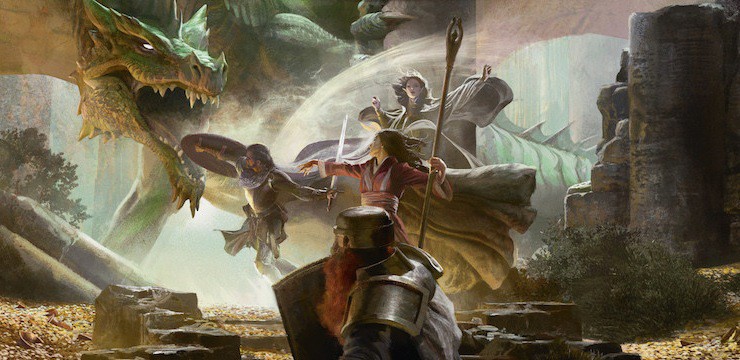
AD&D First Edition The Old FirmI was as surprised as anyone when Wizards of the Coast decided to release reprints of their old editions. It is a smart move, and one I’m glad to see them make, but personally the really interesting thing was the deluxe reprints of their Advanced Dungeons and Dragons First Edition books. Nice paper, thick covers, ribbon bookmarks, the works. I’ve heard people complain that the shading is too dark, but to me it looks crisp, and captures some of the fainter lines that might otherwise be overlooked. The fact that they donate a portion of the profits to the Gary Gygax Memorial Fund is more than icing on the cake; it is credit where credit is due (though it would be nice to have a Dave Arneson memorial, too; maybe if they reprint the non-advanced D&D?). I decided the best thing to do with these books is to look at them both in historical context…and in comparison to what follows. So I re-read them with a critical eye and was happy to find that they have a lot of great things to recommend them, and plenty of opportunities to talk about the evolution of game design.

[Read more]

Fri
May 17 2013 4:00pm

Rise of the Planet of the Plankton Scientific American

People tend to pay attention to big animals when they go to the zoo or museum. They go to see the gorillas, or the tigers, or the dinosaur bones. I get it; dinosaurs are awesome. The problem is that charismatic megafauna tell only a very narrow story about evolution and biology. Again, admittedly an awesome one—dinosaurs!—but there are plenty of other neat stories that smaller critters can tell. The lives of rodents, or the humble honey bee, of fungi who infect ants and drive them to literal lunacy. Focusing on all those oddball forms of life, big or small, can lead people to overlook the unsung heroes of the ecosystem. June’s Scientific American doesn’t fall into that trap, with its article on the “Tiny Plants That Once Ruled the Seas” being a bit of a love letter to...plankton. In particular, that the rise of modern sea life, in the wake of the Permian-Triassic Extinction Event, can be traced to phytoplankton, which literally fueled the bloom of diversity in the Mesozoic (that’s dinosaur times!) and Cenozoic (that’s now). In doing so, the authors Ronald Martin and Antoinetta Quigg also tie the rise of phytoplankton into the threat of climate change.

[Read more]

Thu
May 16 2013 5:00pm

The God-Machine World of Darkness review

Beneath the skin of the world you know, a terrible machine grinds and gnashes its gears. Its cogs range in size from the flap of a butterfly’s wings to the meteor that killed the dinosaurs. The God-Machine’s tools are timeclocks and angels, crushing banality and outrageous supernatural intervention; these contradictions are unified in the alien-clockwork of its inevitability. Azathoth is not a screaming, pulsating tumor of chaos at the center of reality; it is rust and cold and wire, soldered together. The factory assembly line for the banality of evil. Darkseid’s Anti-Life Equation, made from iron and clockwork and tesla coils. This is the premise behind The God-Machine Chronicle, the newest major World of Darkness offering (and its attendent short fiction anthology). Based on the piece of flavor text that began the core World of Darkness book, The God Machine Chronicle also introduces a number of major rules updates.

[Read more]

Fri
May 10 2013 9:00am

Dungeons & Dragons movie

What is the curse of the Dungeons and Dragons movie? Why is it that when the words “Dungeons and Dragons movie” are spoken aloud, cringing and boredom follow? Is it like the cinematic equivalent of Macbeth? Should we be saying “the elvish film” instead of “the Scottish play?” And why would Warner Bros. be taking a shot at it? Either way, it is a bit too late—did you watch that trailer for Dungeons and Dragons 3: The Book of Vile Darkness? I’m as much of a fan of Vecna’s favorite book as anybody, but that doesn’t appear to be… very good. “I’ve traveled to the floor of the pit of my own free will!” and all that jazz. Even power word kill can’t save it. Not even Thora Birch and Jeremy Irons—or cameos from Richard O’Brien and Tom Baker—could save the first Dungeons and Dragons movie. At least Dungeons and Dragons: Wrath of the Dragon God had the good graces to be a low budget made for television movie….

But what if there was a good Dungeons and Dragons movie?

[Read more]

Tue
May 7 2013 10:00am

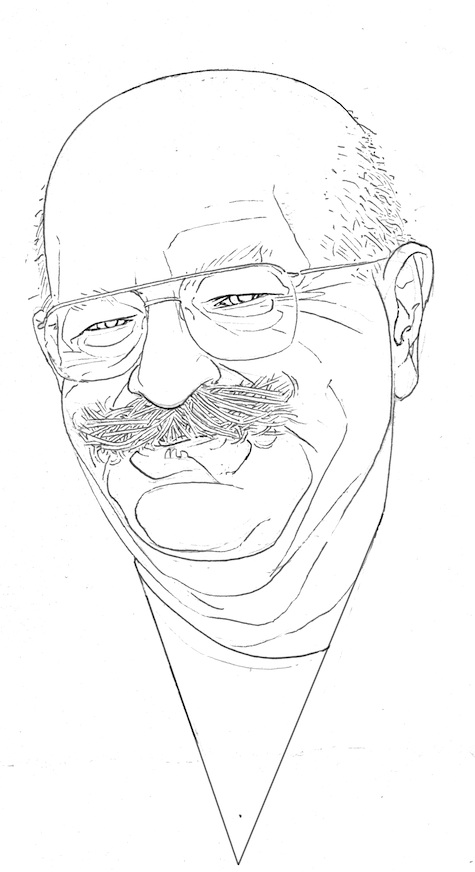
Gene Wolfe birthdayDid you know Gene Wolfe, who turns 82 years old today, invented Pringles? Well, okay, okay, that is a smidge hyperbolic, but he did develop the machine that makes them. I like to imagine that their famously mustachioed logo is an homage to Wolfe—look at that twinkle in his eye—but that is strictly head canon.

That is just the sort of person Gene Wolfe is though; he’s not content with writing a science fiction epic, or revolutionizing the fantasy epic, or creating a science fantasy epic that bridges the subgenres. Or that Neil Gaiman called him “...possibly the finest living American writer.” Or that Michael Swanwick called him the “...greatest writer in the English language alive today[,]” or that the Washington Post called The Book of the New Sun “[t]he greatest fantasy novel written by an American.” Oh no. He has to take a detour and help invent a new kind of potato chip. Even his life has secret nooks and crannies for the wary reader.

[Gene Wolfe: Unreliable narrator?]

Thu
Apr 25 2013 11:00am

Nausicaa of the Valley of the Wind Hayao Miyazaki Kaiju

One of the most striking and terrifying creations of Hayao Miyazaki are his God Warriors from Nausicaä of the Valley of the Wind. In the animated film, they are present mostly as a looming threat, an occasional piece of terrain...and most prominantly in the back history of the world. They are the holocaust that destroyed human civilization, and now Studio Ghibli has produced a short film for the Museum of Contemporary Art in Tokyo, directed by Neon Genesis Evangelion’s Shinji Higuch, about the day they attacked.

[Read more]

Mon
Apr 22 2013 3:00pm

Scientific American Human HybridsMy fondness for Neanderthals is documented, and one thing that has always been on the teeter-totter of scientific opinion was the mechanism of their extinction. Did they just get out-competed by Homo sapiens? Were they murdered, driven to extinction? Did they just die out, unrelatedly? Or were they absorbed, swallowed up through inter-breeding? For a while it seemed that there might not have been any gene-mingling—which seems odd, given humanity’s fairly active sexual appetite—which sort of stood against the notion of hybridization. Since the completion of the Neanderthal Genome Project in 2010, that tide has shifted, and Scientific American’s May issue has the most recent broadside in that volley, in an article by Michael F. Hammer called “Human Hybrids.”

[Read more]

Wed
Apr 17 2013 12:45pm

Rachel Rostad poem To JK Rowling from Cho Chang

Rachel Rostad’s 2013 College Unions Poetry Slam Invitational performance piece, “To JK Rowling, from Cho Chang,” was an indictment of J.K. Rowling’s Harry Potter series; specifically charging her with tokenism, of adding minor characters like Cho Chang and Lee Jordan without giving them the same depth other characters got, in order to create the appearance of diversity without actually including any. It is a personal, impassioned performance, rather than a strictly cerebral approach, which gives it immediacy and accessibility. This isn’t just a discussion of structural biases, some lecture or intellectual analysis; this is someone who rightfully has feelings that stem from the text.

[Watch Rachel Rostad’s “To JK Rowling, from Cho Chang”]

Thu
Apr 11 2013 1:10pm

The Man of Steel Superman no pants

Listen, I’m a fan of the “Everyone on Krypton was a perfect super-person, it was a utopia and now it is gone, alas” viewpoint so I am with you that far, Mister Snyder. I am also a fan of the Donner Era “let’s just lean on the Christ-like imagery” angle, as well. Sure! I’m just...trepidatious at Yahoo Movies saying he’s a “special child” and that his birth was a “cause for alarm.” You don’t need to push too hard on the space-savior angle. It is already built right in. I’m guessing that this actually ties into a more cerebral, Byrne- era Krypton; Krypton as a sparse emotionless world where children are conceived in test tubes birthing matrices rather than through physical contact.

[The Man of Steel can leave out some things, but shouldn’t others]

Mon
Apr 8 2013 2:00pm

Superman Unauthorized Biography Glen WeldonHow great is it that Superman is the first and best superhero? Some might invoke the name of pulp icons like Doc Savage, Nyctalope or The Phantom here, but it was really Superman who synthesized the elements of pulp action and science fiction into the bright four color world of capes and cowls. He defined it, but then, in one of the best quirks of fiction, he didn’t fall into the dustbin of history; Superman became the most famous of the lot. He started with a bang (that’d be Krypton) and kept going strong for 75 years...which Glen Weldon, who does comics for NPR, has brought together into a nice, readable biography: Superman: The Unauthorized Biography. The history of Superman, behind the curtain and the Man of Tomorrow himself, from comics and radio to television and film.

[Read more]

Mon
Apr 8 2013 10:00am

Iain M. Banks Culture Cancer Nihilism Surface DetailI’m still feeling pretty melancholy over the sad news about Iain Banks’ health. What can you say? Congratulations on your engagement, my condolences on your cancer and thanks for the dark humor. You know what? I think I’m going to go with that last impulse; I think that is a fitting attitude, a winning tactic, the right kind of tribute. In fact, alright, here goes: eff yeah The Culture. The Culture novels are modern classics and should be required reading for anybody who likes science fiction. No, scratch that, for anybody, period. I see hand-wringing articles all the time about how science fiction has become the domain of anti-science fearmongering and dystopian fiction: well! Iain M. Banks’ writes the heck out of utopian sci-fi, and he does it with a wink in the face of nihilism, and it is wonderful. Let’s just take a moment to appreciate The Culture, because The Culture, and Iain Banks, are fantastic.

[Read more]

Wed
Mar 27 2013 10:00am

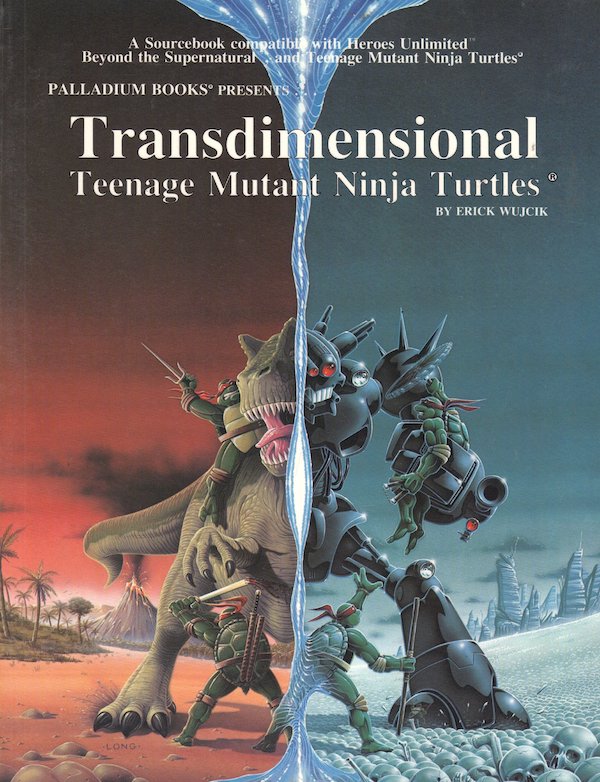
Transdimensional Teenage Mutant Ninja Turtles Dinosaurs Time Travel RPGTransdimensional Teenage Mutant Ninja Turtles may very well be the greatest role-playing game sourcebook of all time. I’m not even being slightly hyperbolic. It is a book that talks about everything from dinosaurs to time travel, from wizards to parallel dimensions. I suppose I should start a little further back: do you know that Palladium published the TMNT game, called Teenage Mutant Ninja Turtles and Other Strangeness? Well they did, and while the game is built on the rickety foundation of the Palladium system, the “Bio-E” mini-system for mutating your character from everyday animal into an anthropomorphic version is incredibly elegant. Transdimensional TMNT takes the “Strangeness” part of “...and Other Strangeness” and cranks it up to eleven. The real kicker, though, is that it has perhaps the most cogent system for time travel that I’ve ever seen, period.

[Read more]

Fri
Mar 15 2013 2:00pm

Chip Walter Last Ape Standing NeandertalRight off the bat in Last Ape Standing, Chip Walter gives off hints of what eventually grows to become his thesis: that neoteny is the mechanism that defines human evolution. He doesn’t make a big flashy “science journalism” headline out of it—which speaks well to him as a writer, and as an articulator of arguments, as he lets his statements speak for themselves—but it is always there, lurking in the background. It begins with the big toe, with the move to bipedalism, which everyone really agrees is what sets us apart, at least initially, from the other apes. Chimps, gorillas and that ilk have big toes, but they are opposable, thumb-like. It doesn’t start like that, though; no, indeed, it starts straight, and then develops that bend during gestation. What if, instead, it…didn’t? I have to hand it to Walter; it is a pithy and plausible theory.

[Read more]

Fri
Mar 8 2013 6:00pm

Grant Morrison The Invisibles ComicsYou think I’m not aware that I’m the voyeur god of this story? Standing outside the gutters and frames of the comic book panels, sure, that is where the gods and demons, the archons and aliens lurk. In the post-modern, fourth-wall-breaking context. The reader though, the reader is outside the entire framework. What does Morrison call it, in the end? The supercontext. But just how outside of it are you? Grant Morrison is outside of the comic, but he (with his artistic collaborators) created it and delivered it to you, like an infection, or a vaccine. Heck, it is even outside of time; Grant Morrison writes the message over a period of years, from 1994 to 2000, and I start reading it right at the tail end of 2012. Right at the end of the world. Ragged Robin is 33 years old in 2012, and so am I, at the end of the world, and I’m right in the middle of the supercontext.

[Read more]

Fri
Mar 8 2013 11:00am

Everything that makes The Elder Scrolls V: Skyrim such an amazing game is exactly the same stuff that I dislike in pen-and-paper role-playing games. You can learn a lot from Skyrim about how, well, not everything—there is plenty in Skyrim to rave about apart from that—but the core mechanics of the game that stand out to me as exceptional are three things that bug me about table top game design. You can learn a lot from Skyrim about how to run a game, but some lessons can only be learned by looking at what doesn’t work in a tabletop game and considering how and why it works in a computer game.

[Read more]

Fri
Jan 4 2013 11:00am

All Yesterdays: An Alternative Look at DinosaursI touched on some of the issues of illustration in biology when I read Jean-Baptiste de Panafieu and Patrick Gries’ Evolution, and while that point is largely moot when it comes to everyone’s favorite subjects—dinosaurs—there are points of the argument that are still illuminating. Dinosaurs—any extinct prehistoric animal, really—require interpretation, guesswork and assumptions. The trick is, at some point those assumptions become part of the subculture, turning into an unofficial visual canon. Popular culture plays a role in this, as well; dinosaurs are tremendously inspiring and evocative, so people have strong opinions about them. Opinions unrelated to science. We’ve seen this in the reluctance of scientific illustration to adopt the “feathered dinosaur” motif, just as we had foot dragging on the topic of whether dinosaurs were ectothermic reptiles or “warm-blooded” like birds. All Yesterdays, by Darren Naish, John Conway, C.M. Kosemen and Scott Hartman, takes a look at that cutting edge of speculative paleoart, trying to look at things “outside the box.”

[Read more]

Thu
Jan 3 2013 4:00pm

The tricks of this tale work, and produce a marvelous piece of written art. A review of Mark Z. Danielewski's The Fifty Year Sword

The Fifty Year Sword is a tale of Dungeons & Dragons high fantasy, filtered through a modern experimental novella. No wait, I’m not sure that’s it; here, let me try again: The Fifty Year Sword is a Quentin Tarantino revenge story in the vein of Kill Bill, as translated by David Lynch. Or wait! A ghost story by way of post-modernity, illustrated at needlepoint. Maybe: a tower of thread and words, full of obfuscation and dark passions?

Really the best comparison I can make is not a simile (schimile) but rather an appeal to the author’s earlier work—The Fifty Year Sword was written by Mark Z. Danielewski, who wrote House of Leaves, which I believe is the only scary novel. In The Fifty Year Sword, Danielewski continues to cleave to a sense of menace, while telling a story of vendetta through sparse, disintegrating text against a backdrop of macabre stitches.

[Read more]

Mon
Dec 31 2012 11:00am

All the middle grade post-apocalyptic space opera you could shake a stick at. A review of Tony DiTerlizzi's WondLa series.

What if the prophecy about the “The Chosen One” wasn’t about a school boy with a weird scar and foster parents who don’t love him…and was instead about a genetically engineered teenager raised in an underground bunker by a robot who does love her, who emerges into a post-apocalyptic Earth populated entirely by aliens? Embed a load of Frank L. Baum references and take the whole thing and just give it beautiful illustrations all throughout that are reminiscent of The Dark Crystal crossed with Nausicaä of the Valley of the Wind. There. That ought to give you an idea what Tony DiTerlizzi’s WondLa series is like. The second volume, A Hero for WondLa, came out this year, and it is filled with all the middle grade post-apocalyptic space opera you could shake a stick at.

[Read more]

Thu
Dec 27 2012 1:00pm

Tolkien, Alignment, Non-Violence, and Why Hobbits are Required for Middle-earth to Survive

At this point, using the Dungeons & Dragons alignment system to categorize popular culture is old hat; it has made its fair share of funny memes and passed into common parlance. There are a lot of things wrong with the alignment system…but I think it remains a useful descriptive tool. In fact, I think using it as a rubric for understanding the ethics at play in J.R.R. Tolkien’s work—from The Hobbit to The Lord of the Rings and back again—can actually tease meaningful statements out of the text. In fact, I’d go so far as to say that it explains the whole point of the most contentious of all characters: Tom Bombadil.

[Read more]

Wed
Dec 19 2012 11:00am

Pathfinder's Best BestiariesWhenever I start reading monster collections, I start…well, thinking about how roleplaying is just such an interesting salmagundi. You get mythologies of every historical stripe hodgepodged with H.P. Lovecraft and Lewis Carroll, urban legends and extinct creatures rubbing shoulders with robots and monsters created just to match up with a toy that Gary Gygax bought in a bargain bin. Just such a crazy intersection. The fact that then someone goes through and gives them statistics? Tries to judge if a “genie, djinn” is tougher than a “rhinoceros, wooly” or a “golem, alchemical”? Even better. They are lists of “might be” stories, in their way; like everything in gaming, they are an exploded narrative, pieces of shrapnel and gears. Just fragments in a “Build Your Own Adventure” novel. Pathfinder’s Bestiary 3 was so good that I had to go and give the first two a spin, and wouldn’t you know it, they are fantastic, too.

[Read more]