
Time For the Stars was first published in 1956. It was one of Heinleinās Juvenilesāa series of books he wrote in the fifties with young heroes in the near future. The book is slightly datedāless so than some of the others that have more noticeable computers in themābut not really all that much. The story is an exploration of the Twin Paradoxāa thought experiment that explains how relativity works. If you had identical twins, and one of them accelerated away from Earth and the other stayed home, so much more time would pass on Earth than in the spaceship that the Earth twin would be a hundred years old when the space twin came home, only a few years later. Heinlein took this concept and made it a real story with charactersāand he made the twin thing relevant by using twin telepathy (which works faster than light...) as a means of communicating between Earth and ship.
Heinlein was absolutely amazing at evoking world and character. Time For the Stars is one of his few first person books. It always amazes me how fast he can hook me. Iāve read this book probably more than thirty times, I know everything that happens in it, and yet when I pick it up I get sucked right in:
According to their biographies, Destinyās favoured children usually had their lives planned out from scratch. Napoleon was figuring out how to rule France when he was a barefoot boy in Corsica, Alexander the Great much the same, and Einstein was muttering equations in his cradle.
Maybe so. Me, I just muddled along.
I think this kind of thing where thereās an authoritative voice telling you things directly either grabs you or it doesnātāsee also Scalziās Old Manās Warāand Iāve always been completely sucked in by it. Iāll admit this was a comfort re-read when I wasnāt feeling well, and you know what? It comforted me and made me feel better, and I canāt see why thereās a problem with that.
No plot spoilers!
Itās revealed, in minor asides about growing up, that Earth is ridiculously over-populated, with five billion people. Thereās a heavy tax on having more than three children, and our hero, Tom (and his twin brother, Pat) are unlicensed and their parents have to pay fines every year for having excess children. This is a future that didnāt happen and isnāt going to, and itās interesting to consider why not. Lots of science fiction writers were very worried about over-populationābut Heinlein gives a figure here and itās a billion less than todayās population. I think Heinlein was assuming here that the Earthās resources would be fairly and equally divided to each of those five billion people by irritating bureaucratsāin which case we probably all would be tightening our belts and living in small apartments, instead of some of us living comfortably and others in the Third World. The overpopulation is what causes the nearly-as-fast-as-light starships to be sent out to discover Earthlike planets where the excess population can be shipped. (Iām sure Iāve seen figures suggesting that this wouldnāt work.) The attitude is very much the colonization of the US seen as spaceāany dangerous animals, diseases, and inferior aliens had better watch out for mankind, and as for mankind, the evolutionary pressure will be a good thing.
If Time For the Stars had been written now, it would have been a different book in almost every way. It wouldnāt have had that exploitative attitude to the galaxy. Earth would be dying because of global warming and pollution, not simple over-population. The book would be four or five times longer, with much more angst. The focus would be on relationships, not on adventure. The section on Earth before Tom leaves would be about the same length, but everything else would be much longer. The actual adventures on other planets would take up a lot more spaceāInferno wouldnāt be left out. There would be more sex, and it would be treated in a very different way. The telepathy thing would also be treated entirely differently. The Long Range Foundation who send the ships out would be evil, or at least duplicitous. The odd incestuous relationship between Tom and his great-great-niece Vicky would be more explicitly sexualised at long distance and contain more angst. There would be far more descriptionāthereās almost no description here except as is incidental to character. Iād read it, but I probably wouldnāt keep coming back to it.
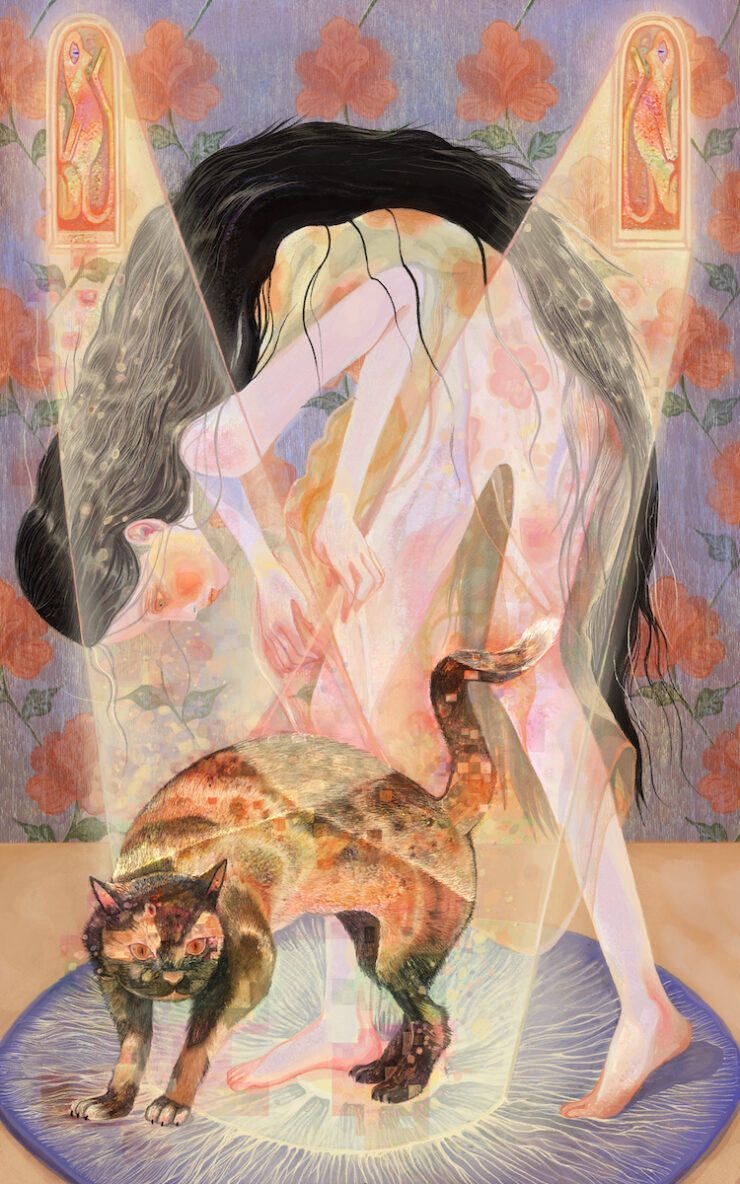
Tom and Pat are identical twins, and communicate telepathically, though they donāt at first realise that they do. Tom is sent on the mission, Pat stays at home and marries the girl they both love. They both thought they wanted to go, but maybe subconsciously neither of them wanted to go. Tom has been bullied by Pat all his lifeāand psychologically and personally the book is a coming of age story about how Tom gets free of Pat. It is therefore a bit of a copout to have telepathy work with people who are not twins, and to have it work between Tom and Patās daughter Molly, and later her daughter Kathleen and her daughter Vicky, and especially having it stop working between Tom and Pat. Thinking about what would have to be different to make this a modern book, I could actually see an improvement if the telepathy had continued between Tom and Pat as they grew further apart and more and more different. Having Tom communicate with cute nieces instead is a kind of cop-out.
I like it being the length it is and having the balance it does. Tomās a slightly surly everyboy, and thatās just fine with me. I like the casual sprinkling of details about the world. Iām delighted every time I get to the lineāin the last chapterāthat implies that all the women have been wearing hats all through the book because thatās just common politeness. I love that kind of reversalāyou find out all the women were wearing hats all the time because Tomās shocked at seeing women with their heads bare-naked like an animal, and suddenly the earlier mentions of hats form a very different pattern. Heinlein always did that kind of thing beautifully.
There are any number of reasons, some fashion, some politics, some attitudinal, some stylistic, why you wouldnāt get this book written today. But there it is in print, more than fifty years after publication, and itās still deeply readable and Iām still very fond of it.
Jo Walton is a science fiction and fantasy writer. Sheās published eight novels, most recently Half a Crown and Lifelode, and two poetry collections. She reads a lot, and blogs about it here regularly. She comes from Wales but lives in Montreal where the food and books are more varied.
VIEW ALL BY · Monday October 26, 2009 11:36am EDT
VIEW ALL BY · Monday October 26, 2009 11:59am EDT
Monday October 26, 2009 11:59am EDT
Monday October 26, 2009 01:04pm EDT
VIEW ALL BY · Monday October 26, 2009 01:32pm EDT
VIEW ALL BY · Monday October 26, 2009 02:05pm EDT
Monday October 26, 2009 02:28pm EDT
Monday October 26, 2009 02:54pm EDT
We don't have total conversion of matter to energy, which you'd think would help Heinlein Earth's more than it actually does. If I had inexpensive conversion reactors, I'd spend more time thinking about how to turn the energy they produce into chemical bonds human biochemistry can exploit than I would lobbing NAFAL ships at the near stars. Not that I wouldn't lob NAFAL ships at all but the Solving World Hunger Forever thing* would definitely provide immediate benefits, while the NAFAL ships won't produce results for years and years.
There's the same curious complete disinterest in applying similar converstion technology to mundane problems in Farmer in the Sky; there has to be a better way to apply conversion tech to the problems that Earth has than terraforming Ganymede.
* Well, except that in a Heinleinoverse, absent war famine and disease, humans have no brakes on their reproductive rates and will presumably turn the whole biosphere into a large mass of human flesh**. In the real world, humans are not limited to war, famine and disease to limit their population.
** I guess the fact that somewhere around 5000x our current energy use, we'd release enough heat energy to trigger the same sort of runaway greenhouse effect as seen on Venus just before its ocean boiled away implies another limit. Heinlein Earths never have that degree of energy use, though.
VIEW ALL BY · Monday October 26, 2009 03:08pm EDT
VIEW ALL BY · Monday October 26, 2009 03:41pm EDT
Actually, there's at least some evidence in Farmer in the Sky that this is the case -- the colonization bureau thinks Earth is doomed and Ganymede (and perhaps other colonies) will be a replacement sanctuary.
Monday October 26, 2009 03:53pm EDT
VIEW ALL BY · Monday October 26, 2009 04:01pm EDT
Monday October 26, 2009 04:47pm EDT
Monday October 26, 2009 05:40pm EDT
Monday October 26, 2009 10:06pm EDT
VIEW ALL BY · Tuesday October 27, 2009 12:11am EDT
Tuesday October 27, 2009 08:16am EDT
VIEW ALL BY · Tuesday October 27, 2009 09:20am EDT
That said, however, I also was a big fan of it, and for no good reason the line about "Colonel Plushbottom" has stuck in my mind for all these years.
The thing I always liked about Heinlein was that he made you think, and think just a little bit harder than the plot and characters seemed to demand. There was always some subtext or angle about how technology would affect people or be affected by people. I think this is why he survives re-reading so well; it seems simple, but there is a bit more to it.
I think I owned all of his stuff at one point or another over the years, he was the first author I really went out of my way to collect. In no particular order, my favorites:
Methuselah's Children
The Moon Is a Harsh Mistress
Double Star
The Door Into Summer
Stranger in a Strange Land
And lots of short stories, I don't think he gets enough credit for some of those:
The Green Hills of Earth
The Unpleasant Profession of Jonathan Hoag
By His Bootstraps
Jerry Was A Man
Tuesday October 27, 2009 11:32am EDT
Citizen of the Galaxy is my favourite too. It has been the template for at least one recent SF novel (which naturally had a lot more angst).
@18
What about the story "--All You Zombies--" ?
Tuesday October 27, 2009 11:52am EDT
VIEW ALL BY · Tuesday October 27, 2009 04:03pm EDT
Now I have to go home and look at my library to see what other favorites I forgot. Thanks for the poke!
Wednesday October 28, 2009 11:09am EDT
VIEW ALL BY · Friday November 06, 2009 02:51pm EST
A most cheering thing I heard lately was that in the latter cases, given security, medical support, and choice, most women will choose smaller families. It's harder to test with the former case; Romania, with and without Nicolae and Elena Ceau?escu perhaps?
RE: Nieces. could be way to keep boys of a certain age interested? Or early indication of slimy offputting later developments with young spunky women and crusty older and older men in his work.