



































There used to be a genre called “gothics” or “gothic romances.” It thrived through the nineteenth century and into the twentieth, and vanished sometime in the early seventies. It died at the time when women reclaimed their sexuality, because one of the things about the gothic is the virginity of the heroine, who is often abducted but never quite violated. Gothics don’t work with strong sexually active women, they need girls who scream and can’t decide who to trust. They also work best at a time period where it’s unusual for women to work. They’re about women on a class edge, often governesses. The whole context for them is gone. By the time I was old enough to read them, they were almost gone. Nevertheless, I have read half a ton of them.
The original gothic was Mrs Radcliffe’s The Mysteries of Udolpho (1794). I haven’t read it, but I know all about it because the characters in Jane Austen’s Northanger Abbey (1817) have read it. Jane Austen didn’t write gothics—far from it, one of the things she does in Northanger Abbey is make fun of them at great length. The gothic and the regency were already opposed genres that early—they’re both romance genres in the modern sense of the word romance, but they’re very different. Regencies are all about wit and romance, gothics are all about a girl and a house.
The canonical gothic is Charlotte Bronte’s Jane Eyre (1850). It has everything that can be found in the mature form of the genre. Jane goes as a governess into a house that has a mysterious secret and meets a mysterious man who has a mysterious secret. That’s the essense of a gothic, as rewritten endlessly. The girl doesn’t have to be a governess, she doesn’t even have to be a girl (The Secret Garden is a gothic with a child heroine, and I have a theory that The Magus is best read as a gothic and that’s a lot of why it’s so weird), the man can be the merest token, but the house is essential and so is the mystery. The mystery can be occult, or mundane, it can be faked, but it has to be there and it has to be connected to the house. It’s the house that’s essential. It can be anywhere, but top choices are remote parts of England, France and Greece. If it’s in the US it has to be in a part of the country readers can plausibly be expected to believe is old. The essential moment every gothic must contain is the young protagonist standing alone in a strange house. The gothic is at heart a romance between a girl and a house.
My two favourite writers of gothics are Joan Aiken and Mary Stewart.
Joan Aiken wrote millions of them, and I’ve read almost all of hers. (I was sad when I found out recently that some had different UK and US titles, so I’ve read more of them than I thought.) There’s a character in Margaret Atwood’s Lady Oracle who writes gothics as hackwork, and I wonder whether Aiken did this for a while. In any case, she wrote tons of them, and some of them are very standard kinds of gothic and some of them are very peculiar. They’re kind of hard to find, especially as very few people read gothics these days. But she has one where both protagonists are dying (The Embroidered Sunset) and one that deconstructs the genre much better than Atwood does (Foul Matter) by being about someone who was the heroine of a gothic (The Crystal Crow aka The Ribs of Death) years before. (There’s also an interesting deconstruction in Gail Godwin’s Violet Clay, whose protagonist paints covers for gothics. She imagines how the marriage of the governess and the lord works out in the long term.) Aiken comes up with all sorts of reasons for the girl to come to the house—singers, governesses, poor relations, necklace-menders. She’s quite conscious that the whole thing is absurd, and yet she has the necessary sincerity to make it work.
Mary Stewart wrote fewer of them. I fairly recently came across Nine Coaches Waiting, which is about as gothic as gothics get. The girl is a governess, she has a secret of her own, she’s concealed the fact that she speaks French. The house is in lonely Savoy, it’s a chateau. Her pupil is the count, but his uncle manages the estate, and there are several mysteries and the governess can’t decide who to trust. It’s just perfect. Her Greek ones (especially My Brother Michael) are also great, and so is The Ivy Tree. Touch Not the Cat is even fantasy, there’s family inherited telepathy.
So why do I like these? They used to be a mainstream taste, selling in vast quantities, and then they melted away as women became more free and more enlightened. Why am I still reading them, and re-reading them? There’s a character in Atwood’s Robber Bride who says she reads cosy mysteries for the interior decor. I am very much in sympathy with that. I don’t want to read rubbishy badly written gothics, but give me one with a reasonable ability to construct sentences and I know I am at the very least going to get a moment with a girl and a house, and descriptions of the house and food and clothes. I do like the scenery, and it is frequently nifty and exotic. But that’s not enough.
I’m definitely not reading them to be swept away in the romance—the romances are generally deeply implausible, though of course the heroine ends up with the guy revealed by fiat to be the hero, the same way a Shakesperean sonnet ends with a couplet. I’m not much for romance, in books or in life. To be honest, I don’t find very many romances plausible—I think there are two of Georgette Heyer’s romances I believe in, and one of Jennifer Crusie’s.
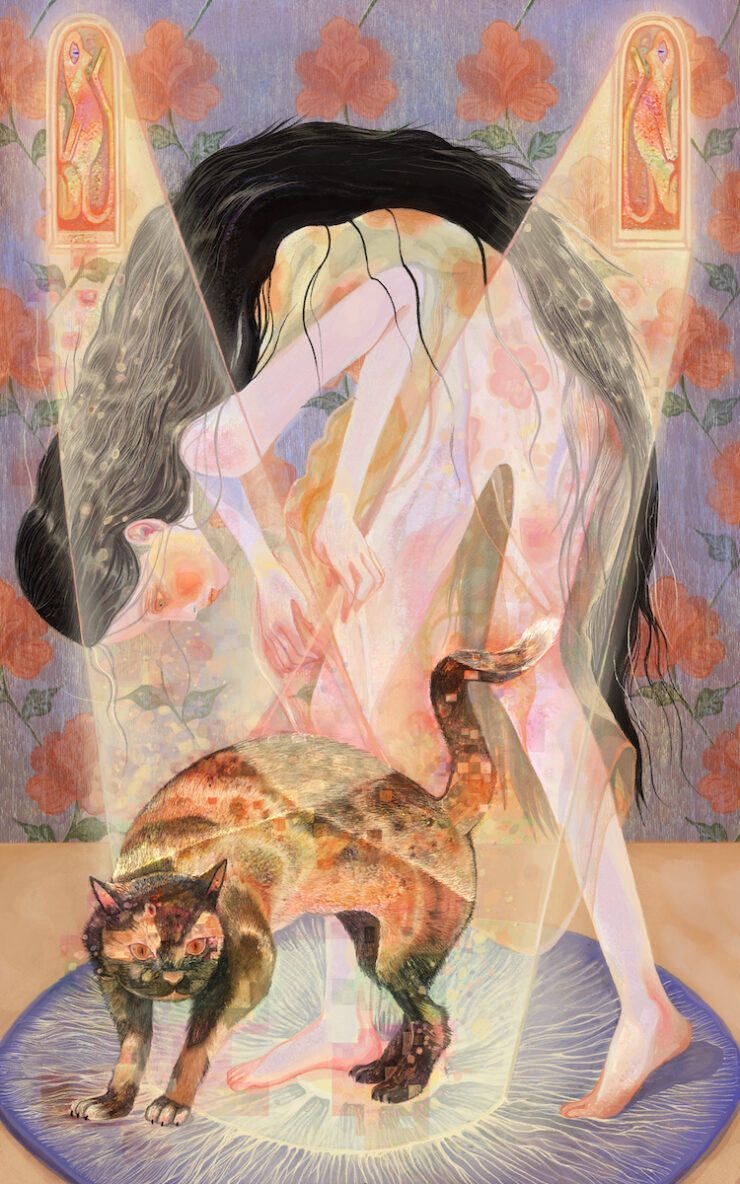
What I really get out of them is the girl and the house. The girl is innocent in a way that isn’t possible for a more enlightened heroine. She isn’t confident, because she comes from a world where women can’t be confident. She may scream, she is alone and unprotected, and she comes from a world where that isn’t supposed to happen. Things are mysterious and frightening, she is threatened, and she’s supposed to fold up under that threat, but she doesn’t. There’s a girl and a house and the girl has more agency than expected, and she doesn’t fold in the face of intimidation, or you wouldn’t have a plot. The heroine of a gothic comes from a world that expects women to be spineless, but she isn’t spineless. She solves the mystery of her house. She has adventures. She may be abducted and rescued, she may scream, but she earns her reward and wedding and her house—the hero is her reward, she is not his. She comes from this weird place where she isn’t supposed to have agency, she isn’t even really supposed to earn her own living, and she heads off into the unknown to do so and finds a house and a mystery and adventures and she acts, and she wins through. Some heroines are born to kick ass, but some have asskicking thrust upon them. The heroines of gothics discover inner resources they did not know they had and keep going to win through.
I have no idea if that’s what the readers of gothics from 1794 until the dawn of second wave feminism were getting out of them.
Jo Walton is a science fiction and fantasy writer. She’s published eight novels, most recently Half a Crown and Lifelode, and two poetry collections. She reads a lot, and blogs about it here regularly. She comes from Wales but lives in Montreal where the food and books are more varied.
VIEW ALL BY · Thursday September 24, 2009 12:26pm EDT
I have a Theory about gothic novels, romantic suspense, and urban fantasy/paranormal romance, but I haven't had time to do the reading necessary to confirm my theory--which involves female agency but also social anxiety around where women belong in society. Someday...
VIEW ALL BY · Thursday September 24, 2009 12:31pm EDT
Re: the decline of gothics, I would argue that the genre is in full force today--just not in print. Horror films, particularly Japanese and Korean horror, often perfectly encapsulate the gothic experience. J-Horror and K-Horror frequently include (just to name a handful, this is a dangerously broad brush I'm using) belief in ancestral spirits and ghosts tied to specific homes or places, and an obsession with virginity (and submissiveness) coupled with the perversion of female sexuality (and aggressiveness) as something disturbing and horrific.
Oh, and the one gothic I can think of that doesn't involve a girl and her house is The Monk, which is easily the most disturbing of the gothics I've come across. Great stuff, though.
VIEW ALL BY · Thursday September 24, 2009 12:51pm EDT
Thursday September 24, 2009 12:56pm EDT
Fiction about houses is a large category-- there's an emotional difference between inheriting a weird house and going to a weird house which belongs to someone else, but both are strong bases for fiction.
Have you read Alcott's A Long Fatal Love Chase. I don't think it's a gothic, but it's an engaging novel of a sort which I don't think could get published now.
VIEW ALL BY · Thursday September 24, 2009 12:59pm EDT
We may also be seeing fewer Gothic novels because of the death of the highly prolific Victoria Holt/Jean Plaidy/I forget the other pseudonyms in the 1990s. She was responsible for three titles a year alone.
I think Carol Goodman could be classified as a contemporary Gothic writer, or at least someone who uses some of the trappings of the genre.
Thursday September 24, 2009 01:02pm EDT
VIEW ALL BY · Thursday September 24, 2009 01:13pm EDT
VIEW ALL BY · Thursday September 24, 2009 01:25pm EDT
VIEW ALL BY · Thursday September 24, 2009 01:47pm EDT
FWIW, Romantic Times still has a romantic suspense section in the magazine--there were six titles reviewed in the November issue, but there is likely some overlap with the mystery section and I'm not familiar enough to pick out which ones are gothicky and which ones aren't based on title alone. I think there's been some evolution/re-naming in the genre, and I know there are still books coming out along those lines (for example, this month there's a book called Audrey's Door about a woman who is leaving a bad relationship and rents a haunted apartment--I can't really recommend it, though, it bounced off me in some pretty bad ways).
Thursday September 24, 2009 01:56pm EDT
Also can't say gothic without Rebecca.
VIEW ALL BY · Thursday September 24, 2009 02:34pm EDT
The books were exceedingly puzzling to me. I kept trying to locate them in time; I'd originally assumed they were contemporary, but kept moving back and back. And the people in them seemed to be remarkably isolated from anyone else in society. Eventually I learned more about the genre and the conventions thereof, and the books no longer seemed so interesting and mysterious. But I doted on the pair of them for quite a while.
Decades later, I tried to read one of Jean Plaidy's novels set (IIRC) during the Plantagenet period, and I couldn't get through it because the prose was so incredibly clunky. I haven't read the Holt novels (some author, different pseudonym) since my teens, so I don't know if I would have the same problem now. But then, they were well worth reading -- possibly at least in part because I read them with the SF eye, and they were alien cultures.
Thursday September 24, 2009 02:39pm EDT
VIEW ALL BY · Thursday September 24, 2009 02:41pm EDT
Carbonel: I was astonished when I found out that Holt was Plaidy, because I always found Holt readable and had problems getting into Plaidy. I kept getting Plaidy out of the library because her books looked as if they'd be interesting, and then I wouldn't be able to get interested in them. She must have used a completely different prose style -- I wonder how she did it?
VIEW ALL BY · Thursday September 24, 2009 02:43pm EDT
In college I was frustrated with the heroines in 18th-19th century novels and the ones in the gothics seemed a lot more active and like you said, they might scream or faint but they didn't fold, they were investigators and explorers. A big part of it for me was the girl vs. the big old house.
Rebecca is the ultimate girl vs. big old house and a battle of wills between two women. They're fighting over the *house* more than the guy if you ask me.
Thursday September 24, 2009 03:11pm EDT
Yes, *The Castle of Otranto* was the first novel (or, in the era's parlance, the first romance) that labeled itself as Gothic. *Udolpho*'s innovation largely had to do with de-mystifying the supernatural elements of the genre -- the Scooby Doo effect, as it were. In some ways this made the genre a lot less fun.
*The Monk* gets lumped in as a gothic novel for a lot of convincing reasons, but ultimately it's kind of its own, weird, disturbing thing.
But for kick-ass women, one would be hard-pressed to beat Charlotte Dacre (http://en.wikipedia.org/wiki/Charlotte_Dacre)and her totally nutty novel Zofloya. It's as problematic a novel as they come -- the MC has an affair w/ Satan who naturally takes the form of an African Muslim -- but it's a rip-roaring read, and a fascinating counterpoint to Radcliffe's goody-goody heroines...
VIEW ALL BY · Thursday September 24, 2009 03:59pm EDT
VIEW ALL BY · Thursday September 24, 2009 04:14pm EDT
Rachel Brown has some fabulous reports of extremely cracktastic Gothics over on LiveJournal.
VIEW ALL BY · Thursday September 24, 2009 06:08pm EDT
VIEW ALL BY · Thursday September 24, 2009 10:35pm EDT
On a totally unrelated note, you just can't beat the falling statue's head and helmet in Castle of Otranto. Kind of a goofy, slapstick scene where I wondered if the guy had really be squished.
Thursday September 24, 2009 10:58pm EDT
'...a world that expects women to be spineless, but she isn’t spineless. She solves the mystery of her house. She has adventures.'
True, that.
The plot devices of gothics are contrived and unbelievable, but somehow their average, non-descript heroines are more sympathetic than 'spunky' modern female characters I read about in fiction and romance novels.
Will catch up on the other gothics suggested. But I urge people to stay away from Georgette Heyer's attempt at a gothic, Cousin Kate, which is just insane and muddled-up.
VIEW ALL BY · Thursday September 24, 2009 11:58pm EDT
VIEW ALL BY · Friday September 25, 2009 09:57am EDT
VIEW ALL BY · Friday September 25, 2009 01:12pm EDT
It also made me much more thankful for the invention of quotation marks and I am not happy with some modern writers who seem to have ditched that as a newfangled luxury or something.
VIEW ALL BY · Friday September 25, 2009 08:23pm EDT
There was never a girl, but there was always a boy (perhaps a girlish boy), a house, and a mystery.
Dean Koontz, in his one book on writing, described how an aspiring author need never take a desk job, but simply crank through a few gothics in a month or two for the same amount of income. His advice seems rather dated now ...
Saturday September 26, 2009 06:25am EDT
VIEW ALL BY · Sunday September 27, 2009 06:49am EDT
I know it's not gothic, per se, but no love for Melmoth The Wanderer? It and The Monk I think are responsible for many streams of modern suspense or horror fiction.
VIEW ALL BY · Monday September 28, 2009 06:23pm EDT
VIEW ALL BY · Thursday October 15, 2009 01:29pm EDT
Wednesday November 25, 2009 01:55pm EST
But then given that Bujold describes Charlotte Bronte and Georgette Heyer as being among her inspirations for some of her books, it's probably not sheer chance.