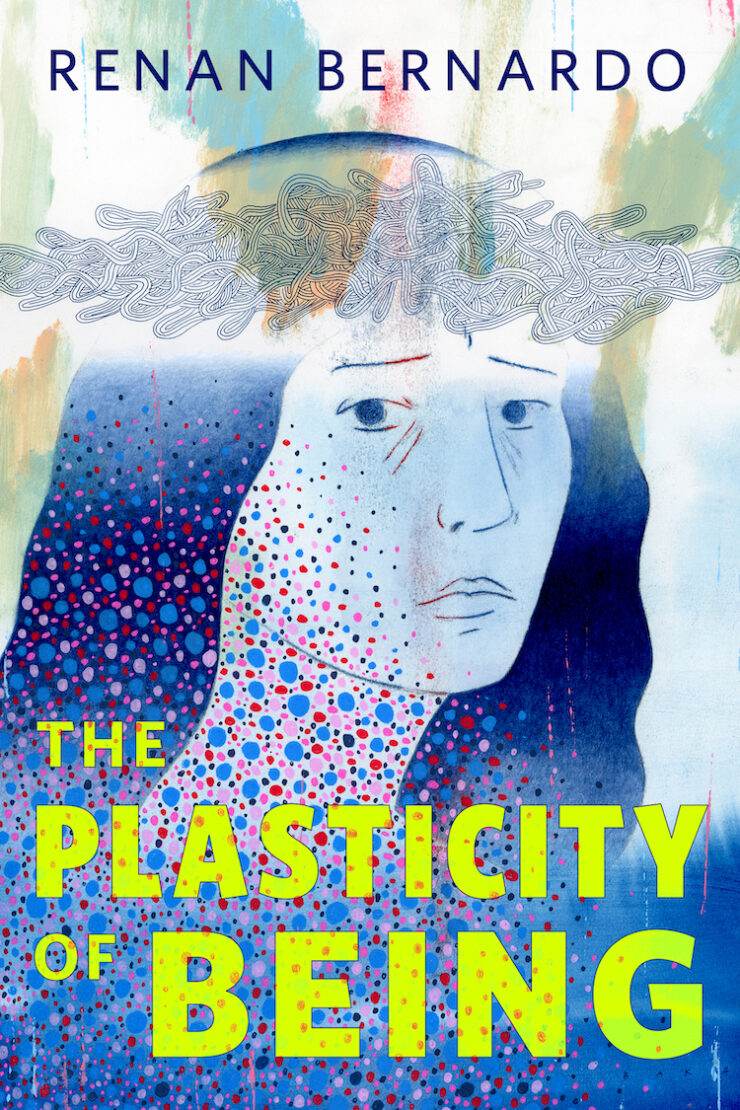



























Lavinia isnât a retelling of the Aeneid, and itâs better not to approach it as if it were one. There are all kinds of ways of retelling stories, and this isnât any of them. Lavinia isnât really like anything else at all, and itâs much the better for that. Rather, Le Guin has taken the character of Lavinia and let her know who she is. And who is she? Sheâs the daughter of Latinus, king of Latium; the cause of the war at the very end of the Aeneid; Aeneasâs wife; foremother of the kings of Alba Longa and the kings of Rome but not of Augustus, who was descended from Aeneasâs son by his first wife, Ascanius. Virgil doesnât give Lavinia much personality, and look how pinned into her own position she is by men and their positions.
Le Guin has been wrestling with the position of women in fantasy worlds since Tehanu (1990). In Lavinia sheâs found a way to do it that works for me.
Lavinia is a kingâs daughter but she lives a simple life of salt-making and spinning and weaving. Sheâs a practical girl and Le Guin gives her a first person voice that addresses us directly about her practical concerns. Sheâs such a well drawn character that she carries us through her certainties, war and peace, festivals and sickness. Her religion is a clear forerunner to Classical Rome, but more practical and everyday. She goes to the oracle at Albunea and is visited not by a god but by the spirit of the dying poet, Virgil, who knows he hasnât done her justice.
She and Virgil talk, and he tells her the story of the Aeneid, or, looked at another way, of her future husbandâs past life. Thereâs a lot more to the book than that, but thatâs the heart of it: a meditation on what it is to be at once a real and fictional character, how your life might be seen in the future as part of something you had no idea about, and Laviniaâs commonsense acceptance of all of this. The ground Virgil and Lavinia meet on is the ground of people who are both real and imagined. At one point he mentions the Underworld:
âHow do you know that?â
âI was there.â
âYou were there, in the Underworld, with Aeneas?â
âWho else would I be with?â he said. He looked about uncertainly. His voice was low and dull. He went on, hesitant. âIt was the Sybil who guided Aeneas... What man did I guide? I met him in a wood, like this. A dark wood, in the middle of the road. I came up from down there to meet him, to show him the way... But when was that? Oh, this dying is a hard business, Lavinia!â
Virgil guides Dante through Hell, of course, as we know and he doesnât. The poet and the maiden have more things in common than it seems at first, for the poetâs life, too, is reimagined after his death in an unimaginable context. They talk about Aeneasâ life, about Laviniaâs life, about Virgilâs poem that he knows he will not live to revise. On one level the book is about the life of a woman who is hardly more than a token in a great epic poem, on another itâs about how history and context shape how we are seen, and the brief moment there is to act between the inescapable past and the unknowable future.
Perhaps to write Lavinia Le Guin had to live long enough to see her own early books read in a different context from the one where they were written, and to think about what that means.
Le Guin is one of the greatest writers of our genre, fit to put up against the greatest of any genre and any time. She has written books I adore and books that I want to argue with, but sheâs never written anything that I didnât find worth reading. This is a late, elegaic work, and a comparatively minor work, which is still to say that itâs as good or better than anything anyone else is doing. I re-read Lavinia now to see whether I wanted to put it on my Hugo nominating ballot, and I decided I did. Thereâs no use saying itâs not as good as The Left Hand of Darkness, when itâs definitely one of the best five new books I read last year.
Saturday February 28, 2009 12:56am EST
I'm not sure anything will ever be as good as The Left Hand of Darkness. I don't hold other writers to that standard, so it would be most unfair to hold LeGuin to it. I am just really glad she's still writing and giving us her elegant insight.