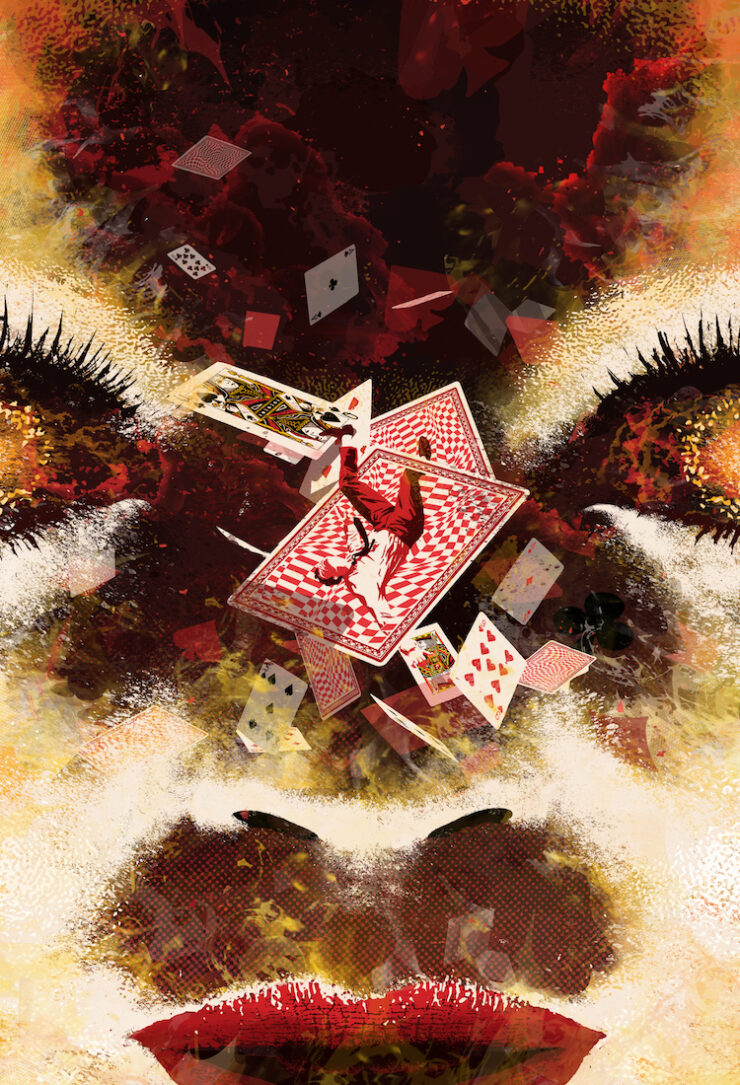





















The fascinating thing about Elizabeth Moon’s The Speed of Dark is the voice. Lou Arrendale is autistic, and never for a moment in the first person narrative that forms the vast majority of this book do we step away from the fascinating way that he sees the world. He’s like an alien, by the definition of “thinks as well as a human but not like a human,” but of course he is also human. He is utterly logical, he sees patterns, and he doesn’t perceive social signals except sometimes as an entirely learned and intellectual thing. I don’t know if this is really how autistic people think, though since Moon has an autistic son and also did a lot of research, I’m sure this is the best possible representation of how we think they think, and goodness knows it’s utterly convincing.
Most eyes have more than one color, but usually they’re related. Blue eyes may have two shades of blue, or blue and grey, or blue and green, or even a fleck or two of brown. Most people don’t notice that. When I first went to get my state ID card, the form asked for eye color. I tried to write in all the colors in my own eyes, but the blank space wasn’t big enough. They told me to put “brown.” I put “brown” but that is not the only color in my eyes. It is just the color that people see because they do not really look into other people’s eyes.
That paragraph encapsulates it neatly—both the different way of seeing and the way that the different way of seeing is an impairment when it comes to dealing with the world. There’s a great immediacy to Lou’s point of view, and it’s all entirely comprehensible, if deeply weird. Moon chose to include a few brief sections from the points of view of Lou’s friend Tom and boss Pete Aldrin, which probably do make the plot flow more smoothly but which always jerk me out of the complete immersion in Lou’s perceptions. It’s amazing how much of a life he manages to lead, despite how acutely he feels textures and how much he needs a regulating routine. Besides that, Lou sees patterns in the world, patterns that other people don’t see, patterns that are really there and help him cope. Sometimes this is just weird, like when he wants to park on a prime number spot, or counts floor tiles, and sometimes it saves his life.
The plot is simple enough. There’s an experimental new treatment that might make autistic people normal. There’s a threat that Lou might be forced to take it, and when that’s removed he has the more difficult choice of whether or not he wants it. The book is unquestionably science fiction—it’s set in the near future, with global warming killing trees and making cars unusual, not to mention the nanotech advances in curing autism. Lou’s dream is to go into space, and lots of people are working in space at the time the novel is set. Nevertheless the central question of whether Lou wants to be cured is treated in a philosophical way much closer to fantasy—are disabilities God-given, and if they are, is it right to want to be cured? Who are we anyway, and how much change is it possible to go through and remain the same person?
The title refers to a philosophical construct Lou thinks of—we know the speed of light, but when light gets there, dark is there before it, and we don’t know the speed of dark. At different times this is viewed as ignorance being illuminated, and as the darkness inside of the head being pierced by light. It’s indicative of how well Moon shows Lou’s perceptions from inside that we come to value what he is the way he is and hesitate with him over having his darkness illuminated.
I’ve read pretty much everything Moon has written, and enjoyed most of it. It’s mostly in the category of “a fast fun read”—the Paksenarrion books, the Serrano books, the Vatta books. They’re all fun, relatively undemanding fantasy or SF adventures. The Speed of Dark is something quite different, at a different level of intensity. It’s immensely readable but nobody would call it “fun” or a “romp.” It quite deservedly won a Nebula Award. If you want to try on a comprehensible but completely different set of perceptions, you can’t do better.
VIEW ALL BY · Friday February 20, 2009 09:05pm EST · amended on Friday February 20, 2009 09:06pm EST
VIEW ALL BY · Saturday February 21, 2009 02:02am EST
VIEW ALL BY · Saturday February 21, 2009 05:43am EST
VIEW ALL BY · Saturday February 21, 2009 07:42am EST
VIEW ALL BY · Saturday February 21, 2009 11:37am EST
Saturday February 21, 2009 09:47pm EST
I've also found it great as a gateway book for science fiction in book clubs with people who are leery of science fiction.
VIEW ALL BY · Saturday February 21, 2009 10:16pm EST
I was a bit disappointed by the conflict about the treatment. When reading it, it felt contrived, like it had been set up so the book could 'have a plot'. I found the conflict with Don much more compelling. I realize it could hardly have carried the book, but nonetheless found it quite a bit more interesting.
I was also very disappointed when the narrative left Lou. While I understand that this had to happen for plot, the thoughts of everybody else lacked the depth that Lou's had. I wonder if this was purposely done to emphasize Lou's complexity?
Speed of Dark is actually quite a bit outside my normal reading. Its one of those books that I throughly enjoy despite not including any of the elements I usually look for in a book. Its my introduction to Moon, and I hope the rest of her works are as well written.
Sunday February 22, 2009 05:51pm EST
And the way it's an impairment largely because "normal" people *make* it an impairment. It's not dealing with the *world* that gives Lou problems, it's dealing with the majority of the world's human inhabitants.
A "normal" person interacting with Lou in that example would probably be annoyed with him because they would think he was deliberately wasting their time or making fun of them, when in fact, their question was just insufficiently specific (they should have asked for "the single most common color in your eyes" or something like that).
Once you start thinking of people like Lou as a different kind of people, and not a defective version of the "normal" kind of people, your worldview will be altered. (Or at least, mine was.) Without the "normal" bed-of-Procrustes approach to psychology, you might even stop using phrases like "curing" and "the darkness inside of [Lou's] head".
Lou is a fictional person but there are plenty of factual people who recognize their similarity to Lou, and may take an insult to him (based on those similar characteristics) as an insult to themselves. And I'm not sure they wouldn't be right to do that, either. (For that matter, I'm not even sure I should be saying "they" and not "we".)
VIEW ALL BY · Sunday February 22, 2009 07:10pm EST
Lou's way of thinking is certainly very alien to me, but I didn't mean any insult by using those terms, and I'm sorry you felt one.
I certainly found Lou-after less appealing and less interesting than Lou-before, and that cast reflections both ways on the central parable of the angel by the pool. And there's also the interesting issue of the way Lou's autistic co-workers interact, and what sort of world they'd make if everyone but a small percentage of people was like that. Not to mention the question of where the lines are between "different" and "impaired" -- Lou's impaired because, as you say, he lives in a society of "normal" people. In a society of people like him, I'd be impaired because I can't do math and can't see the kinds of patterns he sees.
VIEW ALL BY · Monday February 23, 2009 11:11am EST
I'm dyslexic, not autistic, but Lou's internal dialog wondering if "X" situation would make sense to him if he was "normal" really hit home with me.
I thought this book was brilliant for getting that across. I've not seen that explained as well anywhere else.
Sure I'd like to be able to spell, or remember phone numbers, ore read out loud, but I'm not sure I'd risk becoming another person to get those skills.
VIEW ALL BY · Sunday March 08, 2009 12:15pm EDT
VIEW ALL BY · Sunday March 22, 2009 02:36pm EDT
VIEW ALL BY · Sunday March 22, 2009 02:43pm EDT
Friday July 24, 2009 01:16pm EDT
I agree with cbyler that most of the problems people with disabilities have in society are down to the "normals" and they're attitude, whether they're treating someone with a disability as inferior or as someone to be pitied. I can't believe that the author made Lou make this decision because she thinks anyone with autism would automatically want to be "cured"
The more I think about it the more confused I am by the ending. Am I missing something?