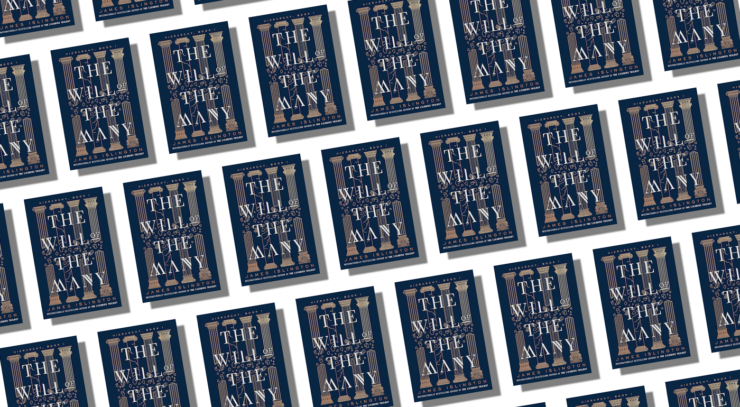








I was looking at Anthology Builder, a website that lets you choose short stories (up to 350 pages) from their selection and then prints out a physical book and sends it to you—your own anthology for $14.95. They have some terrific stories on there, but of course they only let you choose from the stories they have.
This led me to wonder what would be in my ideal anthology—in the ideal world where you could pick from all the stories there ever were, and not just from the available selection. 350 pages sounds like about eighteen stories to me. I like short stories, but I don’t generally tend to re-read them all that much. The title of my anthology would therefore be Jo’s Perfect Anthology: Eighteen Stories I Like to Re-Read.
My eighteen stories would be:
“Great Work of Time,” John Crowley
“A Habitation Enforced,” Rudyard Kipling
“The Serial Garden,” Joan Aiken
“Story of Your Life,” Ted Chiang
“Flight,” Peter Dickinson
“The Girl Who Was Plugged In,” James Tiptree, Jr.
“Scrabble With God,” John M. Ford
“In the House of the Seven Librarians,” Ellen Klages
“Owlswater,” Pamela Dean.
A Plague of Life,” Robert Reed
“Gestella,” Susan Palwick
“The Man Who Came Early,” Poul Anderson
“Bitterblooms,” George R.R. Martin
“The Liberation of Earth,” William Tenn
“Epiphany,” Connie Willis
“Time Considered as a Helix of Semi-Precious Stones,” Samuel Delany
“Air Raid,” John Varley
“Paradises Lost,” Ursula K. Le Guin
This isn’t a “world’s best” anthology—these really are all stories where I really have picked up the book they’re in just to re-read. It’s also perfectly balanced to my own slightly odd tastes. There are ten science fiction stories, one is mainstream (or maybe fantasy), and seven are definitely fantasy. They are by eleven men and seven women, and they range in date from 1905 to 2006.
“Great Work of Time” is a brilliant and convoluted alternate history, which I come back to because of its intricacy. It’s a brilliant idea, but it’s also so much more than that. Besides, it has the last flight of the venerable old R101 from the Cape to Cairo.
“A Habitation Enforced” continues the British Empire theme, but in a very different key. This would be my desert island story—I can read it and read it, and I frequently want to read it. It’s a simple enough story about a married American couple who find themselves taking over a country estate in England, or perhaps it would be better to say they are taken over by it. It’s not necessarily a genre story... I always want to read it when I am unsettled, because it is a story where every word falls perfectly in its place and every line sets off every other line, and it is a story about things fitting together.
“The Serial Garden” is also British, and whimsical, and a little old fashioned. And it’s also perfect. I have read this story aloud fairly often, and I once tried to cut some of the description to make it shorter, only to realise that there isn’t a wasted word and that supposedly extraneous description was setting up the tragedy of the end. This is a children’s story, and it’s an extremely funny tragedy.
“The Story of Your Life” is about communicating with aliens, and demonstrates how they communicate. I think it’s the cleverest and most poignant story I’ve ever read, and it always blows my head off with how brilliant it is.
“Flight” is the history of a fantasy empire. I don’t think there’s any Dickinson I don’t like, and this is one of my favourites of his. I’ve read this one aloud too, though it’s very long for that.
“The Girl Who Was Plugged In” is another tragedy, in the technical Aristotelean sense. It’s also cyberpunk before there was any such thing.
“Scrabble With God,” on the other hand, is comedy. It’s Mike Ford at his most characteristic, wry, funny, clever, deceptively simple but with so many balls in the air you can’t possibly see how he’s doing it.
“In the House of the Seven Librarians” is a modern fairy tale—not a retelling, a new modern fairytale. There’s a closed Carnegie library with seven librarians living in it, and one day they find a basket with a baby with a book that’s been returned so late the owner thought the late fine had better be a firstborn child. It just gets better from there on.
“Owlswater” is the only one that’s part of something longer. It’s connected to Dean’s Secret Country books, and I don’t often read it without reading them too, though it stands entirely alone and is about different characters. But I’d definitely want it in my anthology so I’d have it somewhere solid. It’s about a wizard who goes to watch a song happening, and what happens to him.
I only own “A Plague of Life” in the original magazine publication. Robert Reed is one of the finest writers of short fiction working today, and every year he produces enough stories for a collection—and of course he doesn’t bring out one every year. David Hartwell and I were joking that you could produce an annual The Year’s Best Robert Reed Stories. (If someone did, I’d buy it!) “A Plague of Life” is a wonderful and chilling novella about what the world would be like if people, and animals, didn’t die. You could kill them of course, but otherwise they would just stay alive indefinitely. Within that, it’s a coming of age story in a dysfunctional family.
“Gestella” is a very dark story about a werewolf, except that it isn’t the werewolf who’s the monster. It’s absolutely chilling and has a wonderfully perfect point of view.
“The Man Who Came Early” is another time travel story. It was hard to decide which Poul Anderson story to pick, as he’s someone who has a lot of short work I love. This one is a classic example of culture shock, seen from an unusual angle.
Probably everybody knows that Martin’s “For a Single Yesterday” is connected to the Kristofferson song “Me and Bobbie McGee.” However, I figured out for myself that “Bitterblooms” is Leonard Cohen’s “Suzanne,” only with the metaphors literalised as only science fiction can do. I liked the story even before that, and now I adore it.
“The Liberation of Earth” was the first science fiction story I ever fell in love with, in the excellent old Penguin Best SF collection, edited by Brian Aldiss. It’s about how successive sets of aliens liberate Earth from each other, until it’s virtually uninhabitable. It’s funny, it works as a story and it has applicability without being allegory.
“Epiphany” is just amazing. Yet when I try to talk about it, it’s like picking up jelly (er, jello) with a fork. It’s about going on trying, and it’s about traveling in bad weather. I’d read all the other stories in Miracle before, and I’d liked most of them, enough to buy the collection. But this one is the absolute standout.
“Time Considered As a Helix of Semi-Precious Stones” is an even better story than the title is a title. Delany is a poet really, his words sing, and yet his worldbuilding is as solid as anyone could want.
“Air Raid” isn’t a feel good story. In fact, almost the opposite. I didn’t figure out exactly what was so brilliant about it until I read the messed up extended version. “Air Raid” has perfect timing and perfect point of view and the timing of revelation is just staggering. You’re reading away and you think you have an idea why people are doing this, but you don’t, so when you do it jars all through you. Varley is an absolute master of short length, and this is his masterpiece.
I was going to end with my favourite short story of all time, Ursula Le Guin’s “The Day Before the Revolution.” There’s a way in which I think every collection could end with that, in the same way every sonnet could end “Silent, upon a peak, in Darien.” But as I was looking up the information on it, I realised that in recent times I have far more often read “Paradises Lost.” Le Guin is so brilliant, and so famous, that an amazing story like this can pass unnoticed—this wasn’t on any awards ballots that I saw and didn’t get any attention. It’s in the collection The Birthday of the World and I had it on the shelf for ages thinking I’d read all of it already, and I had, except for this one. It’s the story of a generation ship that develops a religion in which the ship itself is heaven, what matters is sailing endlessly forward, the world left behind and the world ahead are equally undesirable. It’s a gem.
What would you choose? And what order would you put them in?
VIEW ALL BY · Thursday January 22, 2009 10:48am EST
My first must-have is Ted Chiang's "Story of Your Life" -- my all-time favorite short story.
Another is Dirk Strasser's "Waiting for the Rain".
You've reminded me how much I loved Ellen Klages' "In the House of the Seven Librarians". Hmmm, I'd better go send an e-mail....
Thursday January 22, 2009 11:04am EST
VIEW ALL BY · Thursday January 22, 2009 11:07am EST
VIEW ALL BY · Thursday January 22, 2009 11:56am EST
VIEW ALL BY · Thursday January 22, 2009 01:24pm EST
As an aside, as people may or may not already know, 'House of Seven Librarians' was podcast on a recent Podcastle episode, which can be found here if you care to enjoy it in audio format. :)
VIEW ALL BY · Thursday January 22, 2009 05:03pm EST
VIEW ALL BY · Thursday January 22, 2009 05:16pm EST
VIEW ALL BY · Thursday January 22, 2009 06:43pm EST
Jeffrey Ford "The Empire of Ice-Cream"
I've only read the Chiang/Tiptree/Delany/Le Guin.
VIEW ALL BY · Thursday January 22, 2009 07:10pm EST
As a victorian/edwardian ghost junkie, I would be hard pressed not to include some Algernon Blackwood (the willows, or Wendigo, perhaps), or maybe Arthur Machen.
Du Maurier also wrote some great short stuff, and Michael Chabon, and Dashiell Hammet - oh Jo stop me now!
VIEW ALL BY · Thursday January 22, 2009 07:38pm EST
VIEW ALL BY · Thursday January 22, 2009 10:55pm EST
Denton, Bradley - Sergeant Chip
Dowling, Terry - Colouring the Captains
Egan, Greg - Border Guards
Ellison, Harlan - Jeffty Is Five
Frahm, Leanne - Rain Season
Howard, Robert E. - Red Nails
King, Stephen - The Gunslinger
Kress, Nancy - Saviour
Leiber, Fritz - Lean Times In Lankhmar
Lovecraft, H. P. - The Colour Out of Space
McDonald, Ian - Verthandi's Ring
Moorcock, Michael - Stealer of Souls,The
Palmer, David R. - Emergence
Reynolds, Alastair - Diamond Dogs
Smith, Cordwainer - Mother Hitton's Littul Kittons
Steele, Allen M. - The Death of Captain Future
Stross, Charles - Lobsters
Tiptree Jr, James - The Only Neat Thing To Do
Turner, George - Flowering Mandrake
Williams, Walter Jon - Green Leopard Plague,The
VIEW ALL BY · Thursday January 22, 2009 10:55pm EST
Just the first two that come to mind
Scanners Live In Vain - Cordwainer Smith
Lobsters - Charles Stross
10.
Yes, having your tables of contents in LibraryThing is very, very useful. :)
VIEW ALL BY · Thursday January 22, 2009 11:11pm EST
Howard, Robert E. - Red Nails
Pratt, Tim - Cup and Table
Lobsters - Charles Stross
The Nine Billion Names Of God - Arthur C. Clarke
Dark Integers - Greg Egan
The Scab's Progress - Paul Di Filippo and Bruce Sterling
Privateers' Moon - Terry Dowling
Scanners Live In Vain - Cordwainer Smith
Unsportsmanlike Conduct - Scott Westerfeld
The Cold Equations - Tom Godwin
The Colour Out of Space - H. P. Lovecraft
Melancholy Elephants - Spider Robinson
The Green Leopard Plague - Walter Jon Williams
When SysAdmins Ruled the Earth - Cory Doctorow
Sergeant Chip - Bradley Denton
Mother Hitton's Littul Kittons - Cordwainer Smith
The Dead - Michael Swanwick
Border Guards - Greg Egan
Who Goes There? - John W. Campbell
Exploration Team - Murray Leinster
VIEW ALL BY · Friday January 23, 2009 07:57am EST
(We can send you _Bloodchild_ if you don't have a copy and would like one.)
(Alas, that parenthetical offer was to Jo only, not the whole internet or even all of Tor.com. I wish I could send copies out to all persons of goodwill who were interested. Free books in the mail from strangers! Wouldn't that be nice?)
VIEW ALL BY · Friday January 23, 2009 08:03am EST
And your offer reminds me of the time I was with my aunt and Ken and a small Sasha in Kirlby Lonsdale and she paused outside a cake shop just as a tour group were getting out of a coach. She said "Now I'm going to buy everybody a cake!" and was immediately surrounded by very appreciative strangers.
Friday January 23, 2009 08:36am EST
The Astronaut - Valentina Zhuravlyova
Angel's Egg - Edgar Pangborn
In a way, I guess both are examinations of the end of a life, and proof positive that SF can jerk a tear like no other. I first read The Astronaut in a great collection, although I didn't realise it at the age of 10: just called "Science Fiction Stories", it also contained Allamagoosa, Obedience and Christmas Tree.
To flesh out my list, I'd go for:
The Hob - Judith Moffett
Orange Is For Anguish, Blue For Insanity - David Morell (Although Rio Grande Gothic is also great)
The Distributor - Richard Matheson
Sometimes, I can remember everything about a story except the tile. One of those would be in My Anthology: the Ray Bradbury story about 3 (or 4?) Americans on holiday in Mexico when the Bombs Start Falling. It ends with "the flies returned when the meat stopped swinging".
Friday January 23, 2009 02:08pm EST
Hmm. Its a hard thing. But if I had to pick one, this one, which isn't even genre, really:
The Old Chevalier, by Isak Dinesen
--
For the second there are several contenders:
The Goodbye Song, by Joan Aiken
Friction, by Will McIntosh
QWERTYUIOP, by Vivien Alcock
The Dragon of Pripyat, by Karl Schroeder
I'm trying to avoid two stories published in 2008 which still have the flush of newness on them, or obvious things like "The Lottery", or maybe potentially twee ones like stuff by Oscar Wilde.
Not having read every story you mention, I'm not sure how they'd fit, since I realize after all an anthology seems to be like an album--some fit together as a whole. Every one goes with a different angle.
Friday January 23, 2009 06:10pm EST
A Study in Emerald - Neil Gaiman
Bloodchild - Octavia Butler
Traitor - R. M. Meluch
Draco Campestris - Sarah Monette
The Dust Enclosed Here - Kage Baker
For a Foggy Night - Larry Niven
Follow Me Light - Elizabeth Bear
Tom Brightwind or How the Fairy Bridge was Built at Thoresby - Susanna Clarke
Easy as ABC - Rudyard Kipling
Mandalay - John M. Ford
"--We Also Walk Dogs" - Robert A. Heinlein.
Labyrinth - Lois McMaster Bujold (possibly a novella?)
Microcosmic God - Theodore Sturgeon
I don't think I've read any of your list except for "Scrabble With God" and "Bitterblooms." Lots to track down!
VIEW ALL BY · Friday January 23, 2009 06:11pm EST
VIEW ALL BY · Friday January 23, 2009 08:38pm EST
You'll definitely find the Kipling online, RE.
VIEW ALL BY · Friday January 23, 2009 08:52pm EST
Thank you. I would buy that.
As for adding two more stories, the two that spring to mind are:
- "Georgia on my mind" Charles Sheffield
- "A Dry, Quiet War" Tony Daniel
Also considered:
- "Lobsters" Charles Stross
- "24 Views of Mt. Fuji, by Hokusai" Roger Zelazny
I would totally have that Ted Chiang in my anthology, but building the rest of the anthology, that's tough, but entertaining.
VIEW ALL BY · Wednesday January 28, 2009 09:32am EST
Mountains of mourning is just heart-breaking, and it talks about infanticide of children with disabilities which is a topic that doesn't get much coverage, though it's not at all sentimental. It also works really well as SF, in that it gives you loads of world-building without detracting from the story, which is a kind of murder-mystery. It adds a lot to the whole Miles series, but it would work well as a stand-alone too.
Orphanogenesis is thinky hard SF, but it's also a very creditable attempt to describe the experience of consciousness. And it's a story where stuff happens, not just an exploration of ideas.
VIEW ALL BY · Wednesday January 28, 2009 09:49am EST
What might go in my ideal anthology is A very long way from anywhere else, which I think is technically a YA novella rather than a short story, but it's really very short. It's a beautiful love story, intensely romantic but not clichéd or soppy, talking about two young teenagers who really are deeply in love, but not going the easy route of either ignoring the problems of their young ages, or making the romance pathological or unreal.
VIEW ALL BY · Wednesday June 24, 2009 12:39am EDT
Now Let Us Sleep - Avram Davidson. I can't read this one very often, it's that powerful.
The Census Takers - Frederik Pohl
Help! I Am Dr. Morris Goldpepper (Davidson) was a close third.
But you could pick a different 20 every day, right?
VIEW ALL BY · Wednesday June 24, 2009 12:42am EDT
King of the Elves and Roog!