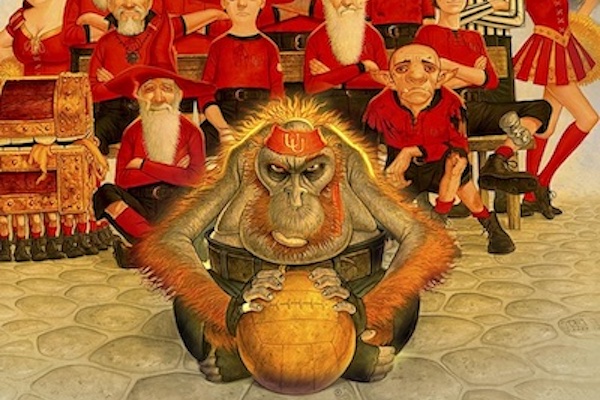






Emmet’s reading Acacia by this year’s John W. Campbell Award winner David Anthony Durham. It is labeled book one of “War with the Mein.” This led me to pondering that common pitfall of making up fantasy names: hitting on something that already means something else, and is thus inadvertently funny. “Mein” to me means “noodles” as in “chow mein” and “lo mein.” I don’t know if it’s authentic Chinese or Western restaurant Chinese. Because I’m aware it means noodles, I find it hard to take it entirely seriously as the name of an evil enemy. Next, bring on “the war with the linguini!” and “the war with the tortellini!” Fantasy names create atmosphere, and this is not the atmosphere you want unless you’re Robert Asprin.
One of the things we disagree about in our house is series reading order. Families in movies always squabble about whose turn it is to take out the garbage or wash the dishes. It must be very boring to be them. However, generally where publication order and internal chronological (IC) order are different Emmet likes reading a series in publication order and I like reading them in IC order. (We first met on rec.arts.sf.written disagreeing about reading order for Womack’s Dryco books, so this is a long standing difference of opinion.) I think I mentioned when I re-read the Miles books in publication order that I always normally read them in IC order. I used to do the same with the Vlad Taltos books until with the publication of Dragon Brust made that impossible. The reason I prefer it is that with reading in publication order you can see how a writer develops and how they develop their idea of where the series is going, but by IC order you can see how the characters develop when events happen to them in order. Pamela Dean once said that you should read Patrick O’Brian’s Aubrey and Maturin books in order if you normally read chapters of a book in order. That’s how I feel. Reading them out of IC order requires building a structure in my head to fit the characters and events into, with “how we got from here to there” arrows and bars as part of it. But since playing with structure and making you hold things in your head is one of Brust’s things, here we go, publication order.
I have to say that Jhereg is a very satisfying introduction to the series and to the world. There are seventeen Houses of the Dragaeran Empire, and the series is intended to have a book for each House plus an introduction and a conclusion, making nineteen in all. In each book, there’s a significant character belonging to the House in question, and also Vlad acts in the way characteristic for that House. So in Jhereg he’s hired to kill someone and it runs into complications. Jhereg begins with a little about Vlad’s early life and how he acquired a jhereg familiar -- a poisonous flying lizard with human intelligence and psionic capability. It then plunges directly into the story, showing Vlad running his own area, happily married, with powerful friends, he accepts a contract for more money than he’s ever had before, we learn a lot about the world.
The way the characters are introduced as friends, and the way they work as friends, is excellent. We’re going to see in earlier-set books, these relationships beginning, we’re going to see Vlad a lot less confident, and then in later-set books we’ll see him develop a conscience. Jhereg’s a good introduction and also a good story. This was the first Vlad book I read—I’d previously read The Phoenix Guards, which is a much less good introduction to the world. I can remember thinking with the overcast that perpetually covers the Empire and the way the Cycle works that now I got it.
If you haven’t read these, Jhereg is a fine place to start.
Dragaera’s a really cool world, and the publication of Iorich in January will be the seventeenth book set there. Seventeen is a pretty significant number for the Dragaerans, and for Brust, so even though I did a post on the Vlad books when Jhegaala came out, that was ages ago and it seems like a good time to do some re-reading. Brust tends to write books with seventeen chapters, or double-length books with thirty-four. The Dragaerans have seventeen Houses, and a cycle that gives each House power in turn—though all the books are set when the House of the Phoenix is due to give way to the House of the Dragon real soon now.
Dragaera looks like fantasy but there’s no doubt in my mind that it’s science fiction underneath, even though there are sorcerers doing magic, witches doing witchcraft, and the occasional person who can manipulate the forces of chaos with his bare mind. (This goes spectacularly wrong sometimes. The Great Sea of Chaos and the Lesser Sea of Chaos, the one where the capital used to be, are evidence for that.) What gives it the science fictional underpinning is the detailed complicated backstory and the underlying axioms about how things work. You can argue about it, but there are aliens and genetic experiments. It’s at least as much science fiction as Lord of Light.
One of the things that makes Dragaera so real is that Brust has given us two different kinds of stories set there, which lets you triangulate on information in a way I really like. You get this with Cherryh too, but it’s unusual. It may also be what’s stopped Brust souring on the world and the series — there have been gaps between books, but he has kept them coming, seventeen books since 1983, as well as unrelated books. The series isn’t finished, but it is continuing pretty reliably, and there’s no sign that Brust’s tired of it.
Even liking funny words, I have a problem with coffee in science fiction and fantasy. It’s clearly coffee, but nobody ever calls it coffee. There certainly are words that can throw a reader out of the world of the story, but is coffee really one of them? Coffee isn’t a word with specific Earth-only origins, like china and cordwainer and assassin and sandwich. If people wear cloaks and sit in chairs, the writer is using English to represent what they would be called in their own language. You can’t make up a funny word for everything, or you really are writing the book in a new language and forcing the reader to learn it.
The lack of coffee is particularly jarring in books purporting to be set in our future—people aren’t likely to give up coffee. I could just about believe it if everyone referred to (all ninety kinds of it) as latte, or capu, or by some other-language realworld word for coffee (cafe, caffe, kaffee) but only if the worldbuilding justified that.
I once got so wrapped up in Pohl’s story “The Gold at the Starbow’s End” that I didn’t hear the teacher asking a question and got given an order mark. I can still remember being wrenched from the line “the incident of next week” back to the classroom. Pohl wrote some other amazing short stories, many of them collected in Platinum Pohl. I’m also very fond of his novels, especially Gateway and The Space Merchants, but I think The Way the Future Was may be my favourite of Pohl’s books. It’s a memoir—but it reminds me of the comment about Churchill’s History of the Second World War “Winston’s writing an autobiography and disguising it as a history of the whole world.” The Way the Future Was is certainly Pohl’s autobiography from 1920-1979. It’s also the story of the history of science fiction and of science fiction fandom between those dates, filtered through Pohl’s unique perspective—he was fan, writer, agent and editor. He was right there when dinosaurs walked the earth and everything was fresh and starting out. If I were an editor, I’d get on to Mr Pohl and ask him to write a few more chapters about the years since 1980 and then reissue the book. Meanwhile, you could do a lot worse than read his blog.
The book begins:
When I first encountered science fiction, Herbert Hoover was the President of the United States, a plump perplexed man who never quite figured out what had gone wrong. I was ten years old. I didn’t know what had gone wrong either.
[Read more. Spoilers: the good guys won WWII, SF isn’t pulps any more, fandom was a success]
I expect everybody has seen the xkcd cartoon I’m quoting in the title. I laughed when I saw it, and yet I love the made up words in Anathem. The word “speelycaptor” makes me happy. Yet Stephenson is breaking all the rules of making up words for science fiction. There’s a rule that says “no smeerps”. A smeerp is white and woolly and grazes on mountains, you can eat the meat and make clothes from the wool... and there’s no reason not to call it a sheep because it is a sheep. (This is different from Brust’s norska, which is exactly like a rabbit except that it eats dragons.) A speelycaptor is a video camera. Stephenson does have a reason for not calling it one, apart from the fact that it’s a videocamera but awesomer, which is to underline the fact that he isn’t talking about our world but a different world that’s like our world two thousand years in the future but awesomer. I already wrote about this.
Generally though, the argument in that cartoon is right—made up words ought to be for new things and concepts, and five per book sounds about right. You need more than that if you include names, but we’re used to remembering names. We may forget which city is the capital of which planet and need to be reminded, but we can keep track of characters pretty well. It’s words for things and concepts that are the problem—if a word is explained the first time it’s used and then just used as a normal word, the reader has to remember it every time. It’s like learning a language, and it had better be worth it.
The Magus is one of those books that ought to be science fiction and is ultimately less satisfying than it could be because it isn’t. Fowles himself admits in the introduction that it is a book with problems, and that the people who really like it are adolescents. He’s right: I adored this book when I was a teenager. At the same time I was gulping down Heinlein and Piper and Le Guin and Brunner, I couldn’t get enough of this. I think of this sometimes when people talk about writing simple books to appeal to young adults—the complexity of The Magus was part of what I loved about it. At the same time that I was failing to understand why Lord of Light was a classic I was writing lists in my notebook (“Best Books In The World, Ever!!!”) that ranked The Magus second only to Tolkien, with The Dispossessed third, Triton fourth and The Moon is a Harsh Mistress fifth. I like it rather less now for a variety of reasons.
I was born in 1927, the only child of middle-class parents, both English, and themselves born in the grotesquely elongated shadow, which they never rose sufficiently above history to leave, of that monstrous dwarf Queen Victoria. I was sent to public school, I wasted two years doing my National Service, I went to Oxford; and there I began to discover I was not the person I wanted to be.
The Magus is a coming of age story. A young English man, Nicholas, gets a job teaching on a Greek island in 1953. It’s worth noting here that the book was written in 1965 and revised in 1977, which allows Fowles to have Nicholas make correct remarks about future trends. Once on the island, Nicholas encounters a Greek millionaire, Conchis, who tells him his life story and involves him in what is eventually called the “godgame”, a set of masques, masks, and mysteries, in which nothing and nobody is what they seem, psychological games are played on Nicholas, scenes acted out with and about him, and he is led to question everything he has complacently accepted about himself and the world. What’s brilliant about is is the masque, the whole thing is fascinating. Fowles’s prose really is marvellous. The stories of Conchis’s life are absorbing, and the constant hints of revelation of the purpose of the psychological wringer Nicholas is put through are intriguing. This is a story that twists and turns and tantalises but never quite makes satisfying sense, because the palette with which Fowles found himself equipped didn’t lead him to the possibility of any really interesting answers.
I have never liked Lord of Light. If I’ve ever been in a conversation with you and you’ve mentioned how great it is and I’ve nodded and smiled, I apologise. The reason I’d have done that is because my dislike of the book is amorphous and hard to pin down, which makes it hard to defend when I know it’s a much loved classic. There’s also the thing when I haven’t read it for a while and I start believing that it must be the book everybody else seems to find, rather than the one I remember.
The story of Lord of Light is that a group of high tech people with ineluctable European-origin names like Sam, Jan Olvegg, Candi and Madeleine colonized a planet on which they are now pretending to be the Hindu pantheon.
[Read more about about the book and why I don’t like it; no spoilers]
There’s a feminine kind of sentimentality which is most often seen in stories about True Love. And there’s a masculine kind of sentimentality which is most often seen in stories about Just War. There’s a moment near the beginning of Lord Kalvan of Otherwhen (1961) where a man charging into battle says “All right you guys, do you want to live forever?” And there you have it, the violins, the heart stirring, the tears in the eyes—my eyes anyway. That kind of thing has a direct and visceral appeal, and nobody does it better than Piper.
This is one of those books that I read when I was twelve (under the British title Gunpowder God) and loved uncritically. It’s hard to overstate just how much fun it is—this is a vastly enjoyable book. It’s military SF with added history of technology, and I think it might have been the first thing on those lines I read, and it set the pattern.
Caroline Stevermer is one of the writers who unaccountably doesn’t get much attention. I don’t understand why this is—maybe because she hasn’t written a series, or maybe because some of her work is YA, though YA is popular lately. She co-wrote the Sorcery and Cecelia books with Patricia Wrede, and she’s also written a number of adult books on her own. She’s one of the astonishing crop of writers from Minneapolis—I think it must have the highest density of fantasy and SF writers per capita of any city in the world.
I was born on the coldest day of the year. When the midwife handed me to my father he said “Hail the newcomer! Hardy the traveller who ventures forth on such a day.”
After four sons, my family was pleased to have a daughter at last. My father persuaded my mother than I should be named Hail, to commemorate the welcome I’d been given. My name is a greeting, dignified and sober, not a form of bad weather.
Some books take a little while to get going, but this one grabs from the first instant.
Back when paperbacks were first invented, Penguin used to sell their books with orange covers that told you nothing but the name of the book and the name of the author. A little later, when they got more sophisticated, they started to use different colours for different genres, black for classics, turquoise for non-fiction, orange for literature, purple for travel and green for crime. They never had one colour for SF and fantasy, but Gollancz did: yellow—the sight of a yellow spine still makes me happy. The original Penguins didn’t have back cover blurbs or anything, just the author’s name and the book’s title. I suppose they thought that would be enough for anyone to know whether they wanted it—if you think of old leather bound books, that’s what they were like, after all. You’d probably heard of them, and if not, and if you wanted to know what they were about, you read them.
Steven Brust’s Agyar is the only one book that I feel ought to have an edition like that, entirely unmarked except perhaps for genre in the most general terms. When my husband saw that I was reading Agyar, he pursed his lips and said “That’s going to be hard to talk about.” The problem is that while it’s a story that’s worth re-reading knowing everything, you still don’t want to spoil the joy of reading it for the first time without knowing anything about it. The thing is that it’s a completely different book when you first read it and when you re-read it knowing. It’s a good book either way, but it’s something where you want to have both experiences. And usually with some big spoiler thing, everyone delights in spoiling it and telling you about Rosebud and Bruce Willis and all of that. You wouldn’t believe how many books have spoilers in their back-cover material. But with Agyar I’ve noticed for years that people very carefully talk around it and use spoiler space because it’s not like that. The thing that Brust does here that’s most interesting is the way he takes the expectation inherent in the way people tell stories and does something with that. It’s like Attic red-figure vases—the action is in what you’d expect to be blank space, and the pattern reverses.
It has a contemporary setting. It’s kind of urban fantasy. It’s the only book on this subject I like. If you like good writing you might like it too.
Ted Chiang has never written a novel, but he’s one of the top writers in science fiction today. He writes short stories and novellas, and he isn’t very prolific with those. He just comes out with a story every year or so that does everything right.
You know how some people are ideas writers, and their ideas are so amazingly brilliant that you don’t care they can’t really write character and plot? Ted Chiang is like that, except that his characters and plots are that good as well. His stories all arise out of astonishing SFnal ideas, they couldn’t happen except in the contexts where they do happen, but they have characters with emotional trajectories that carry them along as well. He always gets the arc of story exactly right, so you know what you need to know when you need to know it and the end comes along in perfect timing and socks you in the jaw. I think Chiang is one of the great science fiction short story writers of all time, along with Varley and Sturgeon and Tiptree.

Your experience of reading Guy Gavriel Kay’s Sarantine Mosaic (Sailing to Sarantium and Lord of Emperors) is likely to be extremely different depending on how much you know about Justinian, Belisarius, and the history of sixth century Europe. There’s a way I never read these books for the first time—I was so familiar with the material Kay was using that it was like a retelling. If you’ve read more than one retelling of Homer, or of King Arthur, you know what I mean—it’s a case of interpretation, selection and shaping, rather than invention. There was never a time when I didn’t know the story to begin with, when I didn’t recognise who the characters were. And the characters are very close here—the map looks like a fuzzy Europe, and when I’m talking about the books and I haven’t just read them I’m inclined to forget Kay’s names and use their real names. Kay isn’t trying to hide the fact that Sarantium is Byzantium, Varena is Ravenna, Valerius is Justinian, Pertennius is Procopius, and Gisel is Amalasuntha. If you don’t know who those people are, your reading experience would be a discovery. If you do, then it contains a lot of recognition of how clever Kay is being. Yet Kay clearly expects a certain amount of real world context to intensify and contextualise the story he’s telling. You can enjoy the story without ever having heard of Amalasuntha or iconoclasm, but you’re expected to recognise Asher as Mohammed and appreciate the implications.
The question this demands is, if he’s going to keep it that close, why not write a historical novel? Well, the advantage of re-writing history as fantasy is that you can change the end. You don’t even have to change the end in order to get this advantage. Because it’s fantasy, because you have changed the names and reshuffled the deck, nobody knows what’s going to happen, no matter how familiar with the period they are. I realised this half way through The Lions of Al-Rassan with a shock of delight. Kay talks about respecting the historical characters by not writing about them directly, and the ability to make things clearer by purifying and condensing events and issues, and that’s also an advantage, but a historical novel is inevitably a tragedy, a historical fantasy is open.
The first word that comes to mind when I think of William Tenn is “wry.” He’s funny, he’s observant, he’s got a wonderful way of looking at things upside down, or putting two things together you’d never think of in the same universe, his stories are very different from each other, but you could find his picture in the dictionary next to the word “wry.”
Mankind consisted of 128 people.
If anyone else had written Of Men and Monsters, even as a comedy, it would be a cosy catastrophe. In Tenn’s hands it’s something else entirely. Of course, it’s very funny. The Earth has been utterly and completely conquered by aliens so long ago that the memory of the time before the aliens came is the province of religion. People live like vermin in holes in the insulation material of the walls of the homes the monsters have built, sneaking out to steal food. “Mankind” is the name of one of the front-burrow tribes.
The Sun the Moon and the Stars is not what you might expect of a fairytale retelling. Indeed, when it was originally published in Terri Windling’s excellent series of fantasy retellings of classic tales, with a long introduction about what fairytales are and a brief afterword about the Hungarian folk tradition, I imagine it must have been utterly baffling. You’d expect something straightforward like Patricia Wrede’s Snow White and Rose Red, or Charles de Lint’s Jack the Giant Killer, and instead this. It’s the story of a man painting a picture, and at the same time telling, in traditional form, a traditional Hungarian fairytale. It isn’t a fantasy novel at all—it’s a perfectly mainstream novel about a guy painting a picture and telling a story. There’s no fantasy element outside the story. And there’s no direct connection between the story he tells—which is likely to be completely new to most readers—and the other events of the book. It’s literally a fairytale retelling, someone retelling a fairytale, and it’s all told as a fairytale, with the narrator asking “bones?”, meaning “have you had enough yet?” at the end of each chapter, but it really isn’t what people would have been likely to expect.
What makes it brilliant is the way that it’s about the process of creation. Greg Kovacs, a painter, starts to paint in oils on a huge canvas, and as he goes on he discovers what he’s painting and talks about his process. Also he chats and squabbles with the other artists who share a studio with him, considers getting honest work as a draftsman, and decides to put on a show. Considered as plot, it isn’t one, but it’s utterly astonishing all the same because it talks about the way art is made in exactly the kind of way nothing else does—and woven in and out of it is the Hungarian fairytale of a Taltos who tricks and defeats monsters to steal the sun the moon and the stars and put them into the sky. He talks about painting, but it applies to any process of creation, certainly writing. If you want to know how writers actually write, either so you can do it yourself or just out of curiosity, I can’t think of anything better. It’s a book I often re-read near the beginning of starting a project, just to encourage myself.
Time For the Stars was first published in 1956. It was one of Heinlein’s Juveniles—a series of books he wrote in the fifties with young heroes in the near future. The book is slightly dated—less so than some of the others that have more noticeable computers in them—but not really all that much. The story is an exploration of the Twin Paradox—a thought experiment that explains how relativity works. If you had identical twins, and one of them accelerated away from Earth and the other stayed home, so much more time would pass on Earth than in the spaceship that the Earth twin would be a hundred years old when the space twin came home, only a few years later. Heinlein took this concept and made it a real story with characters—and he made the twin thing relevant by using twin telepathy (which works faster than light...) as a means of communicating between Earth and ship.
Heinlein was absolutely amazing at evoking world and character. Time For the Stars is one of his few first person books. It always amazes me how fast he can hook me. I’ve read this book probably more than thirty times, I know everything that happens in it, and yet when I pick it up I get sucked right in:
According to their biographies, Destiny’s favoured children usually had their lives planned out from scratch. Napoleon was figuring out how to rule France when he was a barefoot boy in Corsica, Alexander the Great much the same, and Einstein was muttering equations in his cradle.
Maybe so. Me, I just muddled along.
I think this kind of thing where there’s an authoritative voice telling you things directly either grabs you or it doesn’t—see also Scalzi’s Old Man’s War—and I’ve always been completely sucked in by it. I’ll admit this was a comfort re-read when I wasn’t feeling well, and you know what? It comforted me and made me feel better, and I can’t see why there’s a problem with that.
[Read more: why this book wouldn’t be like this if it was published today. No spoilers]

There are some kinds of books where I either don’t want to read them at all or I desperately want to immerse myself in tons of them. I hadn’t re-read Elizabeth Moon’s Serrano books (now available in omnibus editions as Heris Serrano, The Serrano Connection and The Serrano Succession) since I first read them all in one gulp. They do a lot of things right. They’re military SF with good adventures, a believable and effective military, and a much better done background than you often see in this sort of thing. I like them, they’re a lot of fun, and it wouldn’t take much for me to really love them, the way I love the Miles books or Cherryh’s Alliance Union series. They’re very good, and I thoroughly enjoyed them, but they fall short of brilliant.
Each book has an exciting adventure plot, but there isn’t really an overall plot arc to the series. The ongoing theme is the way rejuvenation affects society. The Familias Regnant is a hereditary oligarchy with a king, occupying several hundred planets. Ordinary people—well, ordinary planets for that matter, have a patron family who is Seated in Council to speak for them. There’s a largely hereditary space fleet, which they need, because they have active enemies, the Benignity of the Compassionate Hand on one side, the Bloodhorde on another, and the various split planets of Texans on another, as if they didn’t have enough internal dissent, piracy, traitors and mutiny for anyone. Fortunately they also have a border with the civilized Guerni Republic, the only place in these books I’d be willing to live.
I first read In the Wet, along with most of Shute, in the seventies when I was a kid. Nevil Shute was, according to his fascinating autobiography Slide Rule, an oddly technically and scientifically minded man for a member of the British upper-middle classes in the twenties and thirties. He spent much of his life around flying machines (airships as well as planes) and when he came to write popular fiction, flying machines featured heavily in it. Some of his work is clearly science fiction, On the Beach is probably the best known, and the rest of it tends to be interested in science and engineering in just exactly the way in which SF is and mainstream fiction isn’t. Shute flourished from the thirties to the seventies, he was a bestseller. He’s always a comfort read for me, and I am especially fond of the work he produced at night during WWII, when he has no idea who was going to win, while working designing planes all day. His best work I think is Requiem for a Wren (aka The Breaking Wave in the US, in a particularly stupid example of “what were they thinking” retitling) a novel about getting over WWII, and A Town Like Alice (aka Legacy in the US, because how stupid can you get to replace a terrific title with a bland one) a novel about how civilization works. I’m delighted to see that all these books are in print from Random House UK—though they’re also the kind of thing your library may well have, and which you can pick up secondhand easily because they were printed in vast quantities.
Shute has huge quantities of the elusive “IWantToReadItosity” that I talked about with reference to Martin’s Song of Ice and Fire series. It doesn’t matter how many times I’ve read his books, once I pick one up and read a paragraph I always want to read the whole thing again.
Having said all this, it’s only fair to say that viewed objectively, In the Wet is a very odd book, and clearly influenced by the British upheavals I talked about in the cosy catastrophe post.
[Read more: trust me, this is not the kind of book where spoilers matter]
When The Kissing Had To Stop was published in 1960, and republished in 1980, which is when I first read it. It’s a book set in the near future of 1960, clearly intended as a warning “if this goes on” type of story, about a Britain taken over by a Soviet plot aided by a few troops and some gullible British people, much as Norway was taken over by Hitler in 1941 and Tibet by China in 1959. (Russia never in fact used that kind of tactics.) It’s written in a particularly omniscient form of bestseller omni, it has a large but consistent cast of characters, and many of the chapters consist of such things as saying what they were all doing on Christmas Eve. The characters are very well done, there are Aldermaston Marches (cynically funded by Russia for their own ends) there’s a coup, and by the end all the characters except one are dead or in gulags. I think I’ve always read it through in one sitting, sometimes until very late at night, it’s not a book where it’s possible for me to sleep in the middle.
[Read more: really, this isn’t the kind of thing where you can worry about spoilers]

Cosy catastrophes are science fiction novels in which some bizarre calamity occurs that wipes out a large percentage of the population, but the protagonists survive and even thrive in the new world that follows. They are related to but distinct from the disaster novel where some relatively realistic disaster wipes out a large percentage of the population and the protagonists also have a horrible time. The name was coined by Brian Aldiss in Billion Year Spree: The History of Science Fiction, and used by John Clute in The Encyclopedia of Science Fiction by analogy to the cosy mystery, in which people die violently but there’s always tea and crumpets.
In 2001, I wrote a paper for a conference celebrating British science fiction in 2001. It was called “Who Survives the Cosy Catastrophe?” and it was later published in Foundation. In this paper I argued that the cosy catastrophe was overwhelmingly written by middle-class British people who had lived through the upheavals and new settlement during and after World War II, and who found the radical idea that the working classes were people hard to deal with, and wished they would all just go away. I also suggested that the ludicrous catastrophes that destroyed civilization (bees, in Keith Roberts The Furies; a desire to stay home in Susan Cooper’s Mandrake; a comet in John Christopher’s The Year of the Comet) were obvious stand-ins for fear the new atomic bomb that really could destroy civilization.
In the classic cosy catastrophe, the catastrophe doesn’t take long and isn’t lingered over, the people who survive are always middle class, and have rarely lost anyone significant to them. The working classes are wiped out in a way that removes guilt. The survivors wander around an empty city, usually London, regretting the lost world of restaurants and symphony orchestras. There’s an elegaic tone, so much that was so good has passed away. Nobody ever regrets football matches or carnivals. Then they begin to rebuild civilization along better, more scientific lines. Cosy catastrophes are very formulaic—unlike the vast majority of science fiction. You could quite easily write a program for generating one.