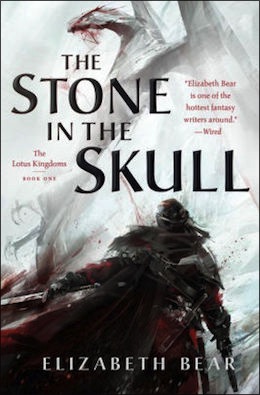
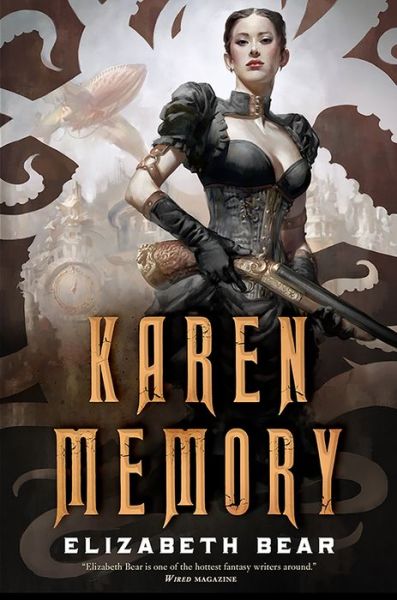
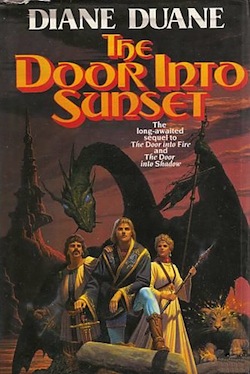
May 22, 2013 Super Bass Kai Ashante Wilson Is Gian’s love for the Summer King stronger than his hate? May 15, 2013 The Button Man and the Murder Tree Cherie Priest An all-new Wild Cards story May 14, 2013 Shall We Gather Alex Bledsoe When one world brushes another, asking the right question can be magic… May 8, 2013 Fire Above, Fire Below Garth Nix The dragon below our city has died. What is to be done?
From The Blog
May 19, 2013
It’s a Promise You Make. Doctor Who: "The Name of the Doctor"
Chris Lough
May 17, 2013
Supernatural’s Dean Winchester Dismantled His Own Machismo...
Emily Asher-Perrin
May 16, 2013
The Sookie Stackhouse Reread: Book 13, Dead Ever After Review
Whitney Ross
May 15, 2013
The Long Road to Khatovar: A Black Company Reread
Graeme Flory
May 15, 2013
Good Omens is the Perfect Gateway Fantasy
Sally Feller
Showing posts by: elizabeth bear click to see elizabeth bear's profile
Thu
Feb 21 2013 2:30pm
Excerpt

We've got an excerpt from Elizabeth Bears' Shattered Pillars, sequel to Range of Ghosts, out on March 19:

Set in a world drawn from our own great Asian Steppes, this saga of magic, politics and war sets Re-Temur, the exiled heir to the great Khagan and his friend Sarmarkar, a Wizard of Tsarepheth, against dark forces determined to conquer all the great Empires along the Celedon Road.

Elizabeth Bear is an astonishing writer, whose prose draws you into strange and wonderful worlds, and makes you care deeply about the people and the stories she tells. The world of The Eternal Sky is broadly and deeply created—her award-nominated novella, “Bone and Jewel Creatures” is also set there.

[Read more]

Wed
Aug 8 2012 10:00am
Original Story

It’s hundreds of miles from the nearest ocean, and a hundred times too big to be a ship. It looks like nothing anyone ever saw. And it’s crashed just outside Tombstone with something alive inside.

This story was acquired and edited for Tor.com by Tor Books editor Patrick Nielsen Hayden.

[Read “Faster Gun” by Elizabeth Bear]

Mon
Jul 2 2012 5:00pm

This week we’re looking at the novels nominated for this year’s upcoming Hugo Awards. Today we look at this year’s Nebula Award winner for Best Novel, Jo Walton’s Among Others.

Among Others by Jo WaltonThere are a lot of coming-of-age stories in fantasy. They’re a staple of the genre; some might go so far as to say a cliché. But Among Others (excerpt available here) is far from your father’s fantasy Bildungsroman, and not just because it transfers the story of a girl growing up to more-or-less modern-day Wales.

In fact, it’s not really a Bildungsroman at all. Nor, despite featuring a sixteen-year-old heroine, is it a coming-of-age story. Because as the story starts, our heroine has already come of age. This is a book that concerns itself far more with surviving trauma and finding a place in the world than with finding one’s self.  Morwenna Phelps has already faced her worst monster, emerging scarred for life, with an indeterminate victory that cost the life of her twin sister.

[Spoilers are off at boarding school for the term]

Wed
Feb 8 2012 4:00pm
Excerpt

We know you’ve been waiting for a glimpse — here’s an excerpt from Elizabeth Bear’s Range of Ghosts, out on March 27:

Temur, grandson of the Great Khan, is walking away from a battlefield where he was left for dead. All around lie the fallen armies of his cousin and his brother, who made war to rule the Khaganate. Temur is now the legitimate heir by blood to his grandfather’s throne, but he is not the strongest. Going into exile is the only way to survive his ruthless cousin.

Once-Princess Samarkar is climbing the thousand steps of the Citadel of the Wizards of Tsarepheth. She was heir to the Rasan Empire until her father got a son on a new wife. Then she was sent to be the wife of a Prince in Song, but that marriage ended in battle and blood. Now she has renounced her worldly power to seek the magical power of the wizards. These two will come together to stand against the hidden cult that has so carefully brought all the empires of the Celadon Highway to strife and civil war through guile and deceit and sorcerous power.

[Read more]

Thu
Mar 3 2011 1:00pm

Blindsight by Peter WattsIt’s my opinion that Peter Watts’s Blindsight is the best hard science fiction novel of the first decade of this millennium—and I say that as someone who remains unconvinced of all the ramifications of its central argument. Watts is one of the crown princes of science fiction’s most difficult subgenre: his work is rigorous, unsentimental, and full of the sort of brilliant little moments of synthesis that make a nerd’s brain light up like a pinball machine. But he’s also a poet—a damned fine writer on a sentence level, who can make you feel the blank Lovecraftian indifference of the sea floor or of interplanetary space with the same ease facility with which he can pen an absolutely breathtaking passage of description. His characters have personalities and depth, and if most of them aren’t very nice people, well, that’s appropriate to the dystopian hellholes they inhabit.

[Read more]

Tue
Jan 25 2011 4:30pm
Excerpt

Please enjoy this excerpt from Elizabeth Bear's upcoming book, The Sea Thy Mistress, out this February 1st from Tor Books. This quiet sequel to 2008's All the Windwracked Stars, focuses on those the angel Muire left behind, and the growth they must undergo even as the goddess Heythe plots against them.

Along with this excerpt, you can also enjoy Elizabeth Bear's extensive review posts here on Tor.com.

*

34 A.R. (After Rekindling)
1st of Spring

An old man with radiation scars surrounding the chromed half of his face limped down a salt-grass covered dune. Metal armatures creaked under his clothing as he thumped heavily across dry sand to wet, scuffing through the black and white line of the high-tide boundary, where the sharp glitter of cast-up teeth tangled in film-shiny ribbons of kelp. About his feet, small combers glittered in the light of a gibbous moon. Above, the sky was deepest indigo: the stars were breathtakingly bright.

[Read more]

Thu
Jan 20 2011 9:34am

Among Others by Jo WaltonThere are a lot of coming-of-age stories in fantasy. They're a staple of the genre; some might go so far as to say a cliché. But Among Others (excerpt available here) is far from your father's fantasy Bildungsroman, and not just because it transfers the story of a girl growing up to more-or-less modern-day Wales.

In fact, it's not really a Bildungsroman at all. Nor, despite featuring a sixteen-year-old heroine, is it a coming-of-age story. Because as the story starts, our heroine has already come of age. This is a book that concerns itself far more with surviving trauma and finding a place in the world than with finding one's self.  Morwenna Phelps has already faced her worst monster, emerging scarred for life, with an indeterminate victory that cost the life of her twin sister.

[Spoilers are off at boarding school for the term]

Mon
Jan 3 2011 9:57am

Hull Zero Three by Greg BearIt’s an interesting experience being asked to review Hull Zero Three—a bit like stepping into an alternate universe, in some ways. Because this book bears a superficial resemblance to my own Jacob’s Ladder trilogy—Dust, Chill, and Grail—in that both are about derelict generation ships gone to mysterious and awful biomechanical fecundity, whose histories conceal awful secrets and whose surviving crews must struggle with a series of knotty ethical dilemmas.

What can I say? You railroad when it’s railroading time.

But the thing that makes it interesting is not how similar the books are, but—given their parallel premises—how very different. Because while a quick plot summary makes them sound very like, Hull Zero Three is very much its own thing.

[No real spoilers here]

Wed
Dec 29 2010 2:43pm

This is the third in a series of reviews of spec fic by stealth. The rest are here.

Unstoppable film

At first glance, Tony Scott’s Unstoppable might appear to be just Speed on a train. But I submit to you that not only is it a much better movie than SpeedUnstoppable is one of the best thrillers I’ve seen in a long time—but that it’s uniquely suited to a science fiction audience. Throughout the film, I found myself comparing it not to Speed, but to Tom Godwin’s legendary science fiction short “The Cold Equations.” Not because Unstoppable revolves around a moral quandary supported by a contrived narrative, but because it sets up its premise and parameters and then follows them ruthlessly to the end.

To wit: a half-mile long freight train weighing in excess of a million pounds and carrying hazardous material is headed for a 15-mph curve in a Harrisberg/Scrantonesque cryptomunicipality in Pennsylvania at 71 miles per hour. Due to human error, the behemoth is unmanned, and the air brakes are not operational.

What do you do?

[The train, it won’t stop going. No way to slow down]

Wed
Dec 22 2010 5:43pm

A Marked Man by Barbara HamiltonIf you hadn’t guessed from the tags, “Barbara Hamilton” is a somewhat transparent pseudonym for SFF’s own Barbara Hambly. I reviewed the first of her Abigail Adams mysteries here last year around this time.

A Negro slave is missing. The King’s Special Commissioner—a man of limited popularity in pre-Revolution Boston—has been murdered. And Abigail Adams is on the job.

More than anything else about Hamilton/Hambly’s work, I think I love the way she writes marriages. They make me think that I might like to be married, which is a pretty good trick given my track record. The central relationship in these books—that of Abigail and John Adams, one of the most famous (and famously well-documented, given the status of both of its members as compulsive letter-writers) romances in American history—is delightful. It’s writen in delightful nuance, neither saccharine nor flat nor overly “romancy,” but just the daily life of two strong and nonconformist people who have well-worn in to each others tics and quirks through the years.

Abigail is also a cunning protagonist: she’s smart and bold and completely believable as an 18th-century woman of very good sense and a strong belief in justice. Likewise, I can’t fault Hamilton’s worldbuilding. Her wintry Boston of the late colonial era rings as true as if you’d dropped a silver coin on its stones.

[Which is not to say I am bereft of quibbles]

Fri
Dec 17 2010 10:02am

This is the second in a series of reviews of spec fic by stealth. The whole list is here.

The CoolerWayne Kramer’s 2003 drama The Cooler is one of urban fantasy’s best-kept secrets. It’s also one of the very few cinematic representations of Las Vegas that ring true to me, as a long-term former resident of the city where you’re not supposed to remember that not everybody’s a tourist.

The Cooler, like the short-lived FX comedy Lucky, focuses on the lives of the people who eke out a living in the margins of Sin City—cocktail waitresses, washed-up lounge acts, old-school Vegas mobsters failing to adapt in the shadow of the new corporate moneymakers that now run the town. And one Bernie Lootz, played brilliantly by William H. Macy—a guy so unlucky he’s contagious. Really, really contagious. Magically so.

[You blindsided me, Bernie Lootz. I didn’t see it coming. You shouldn’t do that to a girl]

Fri
Dec 10 2010 3:31pm

The Fortunate Fall by Raphael CarterThere’s a long literary tradition of legendary “only” novels—books with no siblings, authors who only published one novel—and Raphael Carter’s The Fortunate Fall is one of them. It’s been reviewed extensively—here at Tor.com, among other places, by our own Jo Walton—and remains widely admired.

And it is, in fact, admirable. And rich enough to reward repeated reading and discussion.

Among its other strengths, The Fortunate Fall is a beautifully constructed first-person narrative, told from the point of view of Maya Andreyeva, a “camera.” Which is to say, a person whose entire career is devoted to being a first-person point of view for faceless, amorphous millions. She broadcasts a full-sensation telepresence to the net.

[Here there be no spoilers of significance]

Tue
Dec 7 2010 6:02pm

Juliet by Anne FortierThis is the first in a series of posts discussing various works that may be considered “stealth” speculative fiction—by which I mean, science fiction that is not marketed as such, but which undeniably embraces speculative elements. This may include movies, books, plays, poetry, and anything else that catches my eye.

Good. Whew. Now that’s out of the way, let’s talk about Anne Fortier’s Juliet.

Juliet is the story of Julie Jacobs, a woman orphaned at a young age in Italy and raised by her Aunt Rose in America, who returns to Italy after the death of her aunt seeking some clue as to her family history. She’s been both urged to and cautioned against this trip, but she’s left with little option, as her aunt’s entire estate has been willed to Julie’s despised sister Janice, and Julie (feckless, unemployed, and deep in debt) is left with only a ticket to Italy, the name of a bank manager, and a passport in her birth name—which turns out not to be Julie Jacobs at all.

[A plague on both your houses!]

Wed
Sep 1 2010 9:57am

So—shock of shockers here, I know—I really like Ted Chiang, and not just because he’s got really awesome hair and is proof that it’s still possible to amass a very good reputation as an SF writer while sticking to a focus on short work. My favorite story of his to date is “Stories of Your Life,” which may have made me have to find a Kleenex quickly.

In short, I jumped at the opportunity to review his new novella from Subterranean, The Lifecycle of Software Objects.

This? Ladies and gentlemen, this is a very peculiar little book, and I mean that in the absolute best way possible. Chiang gives us a rapid overview of the evolution and abandonment of a species of digital pet that may—or may not—be evolving artificial intelligence, and a very cogent overview of how people might respond... the ones that even notice.

[Spoilers want to marry out of their species]

Mon
Aug 30 2010 3:29pm

For those who are familiar with the ouvre of Diane Duane, Omnitopia Dawn will seem a departure. Duane is best known for her fantasy: the Young Wizards series of children’s books and their spinoff novels about wizard cats, and the seemingly eternally incomplete Tales of the Five series, which seem to be linked to these others by way of universe.

Omnitopia Dawn is something very different—a near-future science fiction novel structured like a thriller, rather than an epic fantasy revolving around the moral judgments of human or feline wizards. I think it’s more fair to consider it as a thriller than as science fiction, actually, because while it does ask some questions about how future technologies may affect human interactions, those are not its central concerns.

[Spoilers aren’t really spoilers at all]

Fri
Aug 6 2010 9:48am

When I was a kid, children’s books that had magic in them almost always seemed to end with the kids giving up the magic because they had earned their character growth and could be adults now. At the time, I thought this was bogus and lame, and it’s a good part of the reason I liked Oz and John Bellairs so very fiercely.

John Bellairs never made anybody give their magic up to hold down a day job.

I find that even as an adult, I am feeling a similar fierce loyalty to Greg van Eekhout’s middle-grade novel Kid Vs. Squid, despite the fact that the second-billed squid doesn’t make an appearance until very late in the novel, which seems to me a bit of false advertising.

On the other hand, I couldn’t pass up a title like Kid Vs. Squid either. So who am I to judge?

[So other than the squid, what’s this book like then?]

Thu
Jul 1 2010 6:18pm

First, I must confess my bias: ever since we shared a particularly challenging convention guest appearance a few years back, I have considered Paolo Bacigalupi a fast friend, and I am absolutely delighted by the critical and reader attention his recent books have been getting.

That said—man oh man, this boy can write. And worldbuild, and make you feel for his characters.

Ship Breaker (Little, Brown, 2010) is a YA science fiction novel—more sociological/adventure than hard SF, but one that takes an unflinching look at what life may be like for the majority of people in the Western world given a few more decades of ecological degradation, economic collapse, global climate change, governmental failure, and corporate pillage. I say “the Western world” because in all honesty, the future this book portrays is a world that most human beings on Earth already live in—surviving as scavengers, repurposing scraps, living on the margins and the waste of wealthier cultures, existing to be exploited and discarded.

[Spoilers want to steal your gold]

Wed
Jun 30 2010 3:58pm

Jonathan Lethem’s debut novel (Topeka Bindery, 1994) has one of the best titles I’ve ever heard. It is everything a title should be—iconic, inventive, intriguing, thematic. I admit, I read the book for the title, not really expecting that it would live up.

It does. The book, too, is iconic, inventive, intriguing, thematic. On the face of it, Gun, with Occasional Music is a classic hard-boiled detective novel with a series of well-worn science fictional genre twists (anthropomorphic animals; totalitarian dystopia), but this particular novel manages to engage with its genre trappings while not being constrained by them.

[Read more...]

Fri
Jun 25 2010 12:31pm

I’m going to out myself right now and say I did not understand the last paragraph of this novel. I have several theories about what just happened, mind, but I’m not convinced of any of them, and so it goes with John Crowley’s Little, Big on the short shelf of books I really pretty much liked but feel like I have assigned my own ending to, in a sort of Rorschachian fashion, based on some interesting ink blots that the author provided.

In the case of Tea from an Empty Cup (Tor, 1998) that may just be thematically appropriate.

[Read more...]

Wed
Jun 23 2010 10:21am

Galen Beckett’s debut novel, a fantasy of manners entitled The Magicians and Mrs. Quent (Spectra, 2008), came as an absolutely delightful surprise. I had heard absolutely nothing about the book or author until a perspicacious friend thrust a copy upon me.

Reader, I was engaged.

Mr. Beckett is a skilled writer, demonstrating unusual control of his voice and prosody for someone at the start of his career. Indeed, the attention to language—and to the structure of his narrative—and to the individuality of the female characters—were such that I initially suspected “Galen Beckett” might be a pseudonym for an established author (it proves to be so) and a woman (and here I was wrong).

[Read more]