




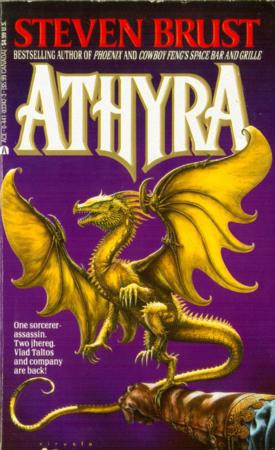
Athyra is a complete departure from the rest of the Vlad Taltos series, in that it isn’t in Vlad’s voice. All the other Vlad books up to this point, whatever order they’ve been written in, have had Vlad’s first person wiseass voice to carry them along. Yendi starts: “Kragar says that life is like an onion, but he doesn’t mean the same thing by it that I do.” It goes on to do wonderful things with that simile, the Dragaeran Houses, life, and it connects through the whole book. You can’t trust Vlad to know about things, or even necessarily to tell the truth—he’s not so much unreliable as shifty, and he has his own agenda. But you can rely on his storytelling to carry you through anything. So when I picked up Athyra it was a shock to find myself in third person, and the point of view of a young Teckla boy. Athyra was the second book of this series, after Teckla, that I hated the first time I read it. It grew on me—indeed, it grew on me much more than Teckla, which is always difficult to read. Athyra is now one I really admire, and I like it for the change in perspective as much as anything.
Viewed away from the context and expectations of the rest of the series, Athyra is an exceptional fantasy novel, and I almost wish I had read it first. Savn is a peasant boy of about ninety, of an expected lifespan of a couple of thousand years. The book gives us a good view of his life in his village. He’s embedded in his life, his village, his friends, his apprenticeship to the doctor, the harvest, his parents and sister. The village makes sense. The way the magic fits into his worldview is different from anything we’ve seen in Dragaera and yet it’s smooth and easy. Savn’s a great character. He’s curious and intelligent. Without the other books, the story of Athyra is “mysterious stranger comes to town and turns everything upside down.” The other point of view is Rocza, and she’s also done brilliantly—Loiosh with his wisecracking is a great foil for Vlad but even with “Two dead teckla on your pillow” and “Can I eat him now?” he’s too human, he’s been brought up with Vlad from an egg. Rocza is plausibly an intelligent animal.
Writing the lines from the Cycle as headings for these posts, I’m surprised to find I know some of them, and this was one. I have never consciously set out to learn them, but some of them are very memorable. Also, some Houses are very significant in the series. We’ve seen a lot of Athyra before Athyra. I had a lot of expectations about meeting some wizards. Well, we do, but not in the way I expected. The Athyra in Athyra is Loraan, who we thought had been killed in Taltos. Vlad acts like an Athyra very directly—he philosophises a great deal, and as he tells Savn, Athyra use people, and Vlad uses Savn. Vlad’s been using people all along, but not quite like this.
“There are two types of Athyra, some are mystics who attempt to explore the nature of the world by looking within themselves, and some are explorers, who look upon the world as a problem to be solved, and thus reduce other people to either distractions or pieces of a puzzle and treat them accordingly.”
Vlad does both of these things in this book. The first time I read it, I wondered if it wasn’t out of character, and then I started wondering if Vlad showing typical characteristics of each of the Houses in each book wasn’t all acting out of character, and what it means about character that he does. I think that’s one of the benefits of seeing him from outside here, because one of the things about first person voice is that it’s very convincing, whatever it says. Vlad philosophising here sounds like Vlad talking about the simile of the onion, he isn’t out of character at all, he just has a multi-faceted character. Maybe the Houses were a Jenoine experiment in dividing character, or maybe people think they ought to have the characteristics of their House and concentrate on that—which is why Kragar left but is still a Dragon.
I love the bits that wouldn’t work as well if this were a standalone book, the bits where the reader is privileged to know what’s going on with Vlad and the jhereg, and Vlad and the Jhereg, where Savn isn’t. That’s done beautifully. This is also the first time we see Vlad’s missing finger and hear the first of his lies—or rather misdirections—concerning how it happened. At the end of Phoenix we see him heading off to a new life, and this is our first view of him in it—from outside, and considerably battered.
The thing I still hate about Athyra is the end. After spending a whole book with Savn and coming to really like him, it’s unbearable to see his mind broken that way. If it wasn’t for that, this would be one I’d look forward to reading.
Onward to Five Hundred Years After, that’ll cheer me up!
Jo Walton is a science fiction and fantasy writer. She’s published eight novels, most recently Half a Crown and Lifelode, and two poetry collections. She reads a lot, and blogs about it here regularly. She comes from Wales but lives in Montreal where the food and books are more varied.
