

Wed
Jan 21 2009 3:15pm
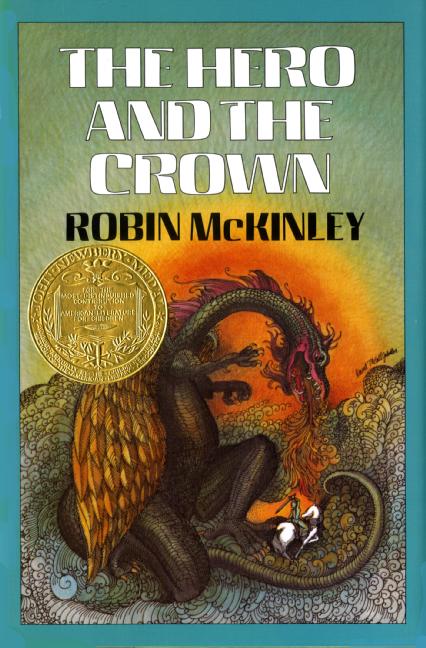
Fighting dragons and depression: Robin McKinley’s The Hero and the Crown

The Hero and the Crown isn’t a title that leads you to expect anything unusual, but the novel attached to it is very different from a standard fantasy in some interesting ways. It was published in 1985, three years after The Blue Sword. I’d never really noticed that three year gap, as I read it approximately ten minutes after—well, actually I had to wait for the library to open in the morning. I always re-read them together. The thing I did notice is that it’s set several hundred years before The Blue Sword. There are, thank goodness, no Homelanders yet, though the protagonist, Aerin, is “conspicuous as the only pale-skinned redhead in a country of cinnamon-skinned brunettes” (p.124 Orbit edition).

Aerin is an unsatisfactory princess—she isn’t beautiful, she isn’t accomplished, she has a dubious dead mother who was probably a witch, and she managed to give herself a bad case of vertigo by eating a magic plant. By long and positively scientific methodology, she makes a flameproof ointment that lets her be a dragonkiller—which doesn’t help make her popular, because dragons are vermin, and killing them is necessary rather than glamorous. Then everything goes to hell in a series of handbaskets and Aerin saves the day.

McKinley, as always, writes brilliantly. She has immense readability; her prose carries me along. Here, as in The Blue Sword, the details of day to day life are so solid and interesting that they’d make the book worthwhile on their own. Retraining the old battlehorse, making the magic ointment—it’s all wonderful. The characters are great, too. The plot...the plot of this book somehow melts away like mist. I’ve read it exactly as many times as I have The Blue Sword, and if you stopped me on any random day I could summarize the plot of The Blue Sword for you easily. This one, no. I can remember the details, and what happens to the characters emotionally, but not the story. Re-reading it this time and coming towards the end I couldn’t remember how Aerin was going to get out of it.

I’m much more interested in the things that make this different from a standard wish-fulfillment fantasy, but it’s hard to talk about them without spoilers.

The first thing: Aerin spends a remarkable amount of the book ill. First there’s the surka poisoning, which leaves her with blurry vision and a tendency to fall over. Then after she fights the Great Dragon Maur, she has a broken ankle, an arm burned to uselessness, several other minor burns and a severe depression. She spends a good two-thirds of the book barely able to shuffle about. I think this is terrific and a great role model for disabled and/or depressed people, because she is also despite and during all this, just awesome.

I’m particularly impressed with the depression. Depression is a hard thing to write about without being depressing. (It’s like pain and boredom in that respect. Paining, boring or depressing readers is better avoided!) I can hardly think of any effective fictional treatments of it that actually work. There’s Margaret Drabble’s The Realms of Gold, and there’s the computer that runs on draining joy from the world in Barbara Hambly’s Silent Tower/Silicon Mage. Aerin’s depression is caused by the dragon, and is likewise cured by magic, but the magic only gets a chance because she plods on despite dread and despair and the dead dragon’s head telling her it’s all hopeless.

The next unusual thing: Aerin falls in love with two men, spends a little while with the immortal one, sleeping with him as they travel, then marries the mortal one on the understanding that she will (having become immortal herself) go back to the immortal one afterwards. And this in a YA and Newberry Medal winner! It isn’t unique—Tamora Pierce’s Alanna loves two men and has relationships with both of them. But it’s pretty unusual. Beyond that, it isn’t a huge source of angst. It’s quite clear to Aerin how to resolve the problem, by dividing her time. There’s never a question of having to choose.

Then there’s the unusual thing about the plot, beyond the fact that it falls out of my head. Aerin kills Maur, and everybody is pleased, even if they don’t entirely understand that bringing a dragon’s head home is going to cause problems. But then Aerin goes away and is magically healed and has to fight the evil bad guy... and nobody at home really knows or cares about it. They have their own problems. They’re glad to see her back with the Crown, in the nick of time, but her real confrontation and victory isn’t of any significance, or even generally announced.

On the Blue Sword thread, CEDunkley said:

I enjoyed the book but was surprised by how I’ve become so used to the tight 3rd person POV narrative that dominates today’s fantasy.

It took me a little bit to get used to McKinley’s casual POV switches in the middle of the page but I soon settled down and enjoyed the book.

I wonder if this book were submitted today would the author be told by either Agent or Editor to tighten up the POV or would it be accepted as is?

So I was thinking about this as I re-read The Hero and the Crown. It seems to me that the early eighties aren’t as long ago as that, and that tight third was normal then, too. I think McKinley likes playing with point of view and often does odd things with it. As her more recent books also have weird POVs, some of them far odder than anything here, I think the answer to the last question is that nobody would ask her to change it. (If it was a first novel, who knows? But her first novel is Beauty, and Beauty is in first person, so it wasn’t a first novel then either.) She also does a lot of playing around with time. The first third of the book covers Aerin’s early life, but it doesn’t do it in order. It begins with the same events it ends with, and goes back and fills in, and does that in a hopping about manner rather than as straightforward flashbacks. She does almost the same in The Blue Sword. Yet I’d never really noticed it. The POV here is more solidly Aerin’s, but with pieces of Tor and Luthe’s, the two love interests, and also Talat’s, the horse.  You’re close to Aerin but always outside, so it isn’t jarring to go into someone else’s head for a moment. The book, both books, are actually a form of omniscient (omni). There’s a narrator in both books, not an intrusive one, but a narrator none the less, and it’s always half-way to being a fairytale omni. What McKinley’s really been doing throughout her whole career is telling fairytales as if they happened to specific real people in real places and with emotional consequences,

The other interesting thing I noticed is how the book begins with Aerin being told the story of her parents—which is exactly how the much darker (and much later) Deerskin begins. Of course it’s a very different story about parents, but I’d forgotten that this was how this began too, and it disconcerted me.

12 comments
blocksmash
1. blocksmash
I don't remember exactly when I read the books first, but I definitely read Hero andthe Crown before The Blue Sword. I think I just found it at the library first. However, everytime that I've reread them over the years, I do it in that order. I don't know if there has been any impact on the way that I perceive the naratives of each book, but I do think that some elements(like the homelanders) are somewhat changed.
(while I was thinking about this I realized that I did this a couple of times a couple of times in my youth: Mossflower before Redwall being the most prominent)
Alida Saxon
2. alida
A pleasant surprise to see this book reviewed. I'd read it maybe 15 years ago and I can't remember how I got it, or where it went to, but it has claimed it's own little space in my mind and I think of it every once in a while.
Kate Nepveu
3. katenepveu
The portrayal of depression is indeed amazing, for all that it makes it a hard book for me to re-read.
blocksmash
4. nutmeag
Great review. I'm the same with the plot--even after just reading the review, I still couldn't give you a full synopsis of the book.

And I like how you talk about the POV thing. A few years ago I picked up The Blue Sword after a long absence, and the loose POV really annoyed me. I've come to since then accept it, but I do enjoy The Hero and the Crown's slightly tighter narrative.
blocksmash
5. Alex Freed
I'm going to ramble on a bit with my thoughts on both the books (as well as a brief comparison to Sunshine), so spoilers ahoy.

I first read The Hero and the Crown a year or two back, but my sister read it to me--or, more accurately, read a portion of it to me--when I was a small child. I don't know why she only read a chapter or two out of the middle, but I'm fairly sure that's how it happened.

In any case, the sequence she read was the one in which Aerin fights Maur, is utterly destroyed, and spends the next days crawling through the ashes. It left a tremendous impression on me; I still think it's an incredibly powerful scene, showing a hero who's won at a devastating personal cost. I remembered that sequence for decades before I actually read the book, and I wonder how much it shaped my love of hero-is-wounded-and-recovers stories.

(The other example that immediately springs to mind--another childhood favorite--Elizabeth Moon's Paksenarrion novels, where Paks is nursed back to health after being physically and psychologically injured in captivity by the dark elves.)

When I finally got around to reading the book (along with The Blue Sword), I found that sequence to be as powerful as ever. Aerin's defeat and depression, along with McKinley's always-lovely prose, are enough to make the book worth reading.

On the other hand, I found a number of items which prevented me from really falling in love with the books. The aforementioned racial and cultural oddities were one factor. Another was the romances. I understood on a technical level why Aerin and Harry's lovers were appealing, but I never found any of them interesting or compelling characters. They felt more like idealized teenage romances than people with equal depth to the protagonists.

Another qualm I had (mainly in The Blue Sword, so, uh, apologies for posting in the wrong thread) was a sense of deus ex machina toward the end. Harry won the day with her powerful magic because... well, just because, it seemed. The plot ticked off the proper boxes, but I never got a sense that she had learned and sacrificed in order to grow in power and as a person. (I had a similar complaint regarding Sunshine, which I adored save for a few specific, extremely frustrating points.) Reading The Hero and the Crown improved the ending for me, but I doubt in a way that was intended; I can credit Aerin with winning the day for Harry, and Aerin earned it even if Harry didn't.

I wish I could remember more details, since I feel like I'm nitpicking vague feelings--but I'm very curious whether anyone else had similar problems, or if I'm alone.

All that said, they're powerful books. I wouldn't be complaining so much if they weren't. And I don't expect to forget Aerin's recovery for a few more decades yet.
blocksmash
6. Solanole
Thank you for posting this review! The Hero and The Crown was one of my favorite books as a child (I didn't read The Blue Sword until much later), and I still recommend it to people in college. As a red-headed, socially awkward tomboy, it was pretty much custom-made for me. Also, it's one of the rare examples, in my opinion, of a really quality fantasy story involving dragons.

While I agree with Alex's point about the lovers being underdeveloped characters, the story more than compensates with its striking action scenes and the remarkable character of Aerin herself. When I was young she was one of the few female characters I could respect - most female protagonists I compared her to reeked of a very generic form of "empowerment" that seemed to focus more on women finding comfort in their bodies than endurance in their souls.
blocksmash
7. Ardith
Robin McKinley is one of my favorite authors. Thanks for bringing attention to this book. It's one of my favorites, up there with McKinley's Beauty.
blocksmash
8. Erin C.
I haven't yet read "The Hero and the Crown" or "The Blue Sword", but these are great insights into McKinley's writing. This, right here...

--
What McKinley’s really been doing throughout her whole career is telling fairytales as if they happened to specific real people in real places and with emotional consequences
--

...puts its finger precisely on why I like her fairytale retellings so well -- she makes them Real while somehow still preserving the essential fairytaleness of them that made me wear out two 800-page compilations of Grimm's Fairy Tales as a child.

Also, I'm so glad I'm not the only one who thought that about Hambly's first two Windrose books. I was chilled, when I read them, how well she captures the experience of depression in what the Dark Mage's machine does to people.
blocksmash
9. Mary Frances
Sigh. Now I have to go reread The Hero and the Crown, too . . .
blocksmash
10. Mary Frances
Okay. Hero and the Crown finally reread. Good grief. I'd actually forgotten how good this book was--in some ways stronger that The Blue Sword, I now think, and I could have sworn just the opposite.

First, the racial implications, holdovers from the Blue Sword discussion . . . are less relevant, here. Yes, Aerin is the only fair redhead in Damar, but she's also pretty clearly not-quite-human (even before she becomes immortal). That undercuts some of the colonial implications, a bit. The focus on Damar, and Damar alone, helps too--though the distinction between the South and the North makes some bits of The Blue Sword even more problematic, in some ways. This is a much larger kingdom than the mountain kingdom appears to be, in Blue Sword--which makes me wonder just what happened, in the interim, when the larger world broke into this, well, world. Or even if that world--the one in which the Homeland Empire is presumably busy fighting off the Iberian Armada, or whatever--is really out there, yet . . . that's how tight the focus is on Damar, in Hero; if I hadn't read Blue Sword, I'd see no parallels to our world at all.

What's fascinating to me, at this point, is the way Damar is its own world, here, one that McKinley is exploring and creating as a far more "alien" fantasy realm than it seemed to be in Blue Sword. I stress "seemed," but it does makes me wonder if that was McKinley's intention in the first place, or if it grew out of trying to write Aerin's story. There is at least one hint (in one of Aerin's visions) that there is a later story, after Harry's story--maybe after Harry's story. More importantly, maybe, is this implication: if Aerin is immortal, then she's still out there somewhere (Luthe is, after all, still tied to his lakeside home) . . . and I wonder what her opinion of the Homeland Empire is? And that might change--well, a very great deal, about the perception of colonial power in Damar. Maybe. In any case, I do hope that McKinley writes that book someday (and not only because I'll pretty much read anything McKinley chooses to write).

Oh--one more point--Jo, you mentioned that Hero begins, like Deerskin, with Aerin being told her parent's story . . . except she isn't, really. She doesn't remember who told her the story, it isn't the whole story (let alone the completely true story)--and the way the rest of the story unfolds for both Aerin and the reader is just really, really understated and brilliant, in my opinion. Thank you for calling my attention to that; it's one of the small pleasures of this book that I might have missed, this time through, otherwise.
Jo Walton
11. bluejo
Mary Frances: There's a mention of Aerin (though not of Damar) in Deerskin which means that's also in that world, though where and when goodness only knows.
blocksmash
12. Kylara
The Blue Sword is one of my all time favorite books, but I like the Hero and the Crown too. However, I have the same meory problem too. I can never remember the whole plot. All I remember is this feeling of being confused. Like what's up with all this time stuff and how did she become immortal and why does she marry her cousin.

I think a re-read now that I'm an adult is a good idea.

Subscribe to this thread

Receive notification by email when a new comment is added. You must be a registered user to subscribe to threads.
Post a comment